I · THE OBJECT · BRITISH MUSEUM
Cervara Polyptych
▶ Listen · narrated
Its oil-painted oak panels join Renaissance religious art to a present-day catalogue puzzle: one work, two museum collections, two inventory numbers, and several recorded locations.
At a glance
- Artist
- Gerard David
- Date
- 1500
- Type
- Polyptych and altarpiece
- Size
- 255 × 218 centimetres (7 ft 2 in)
- Medium
- Oil paint on oak panel
Look closer
A work made in parts
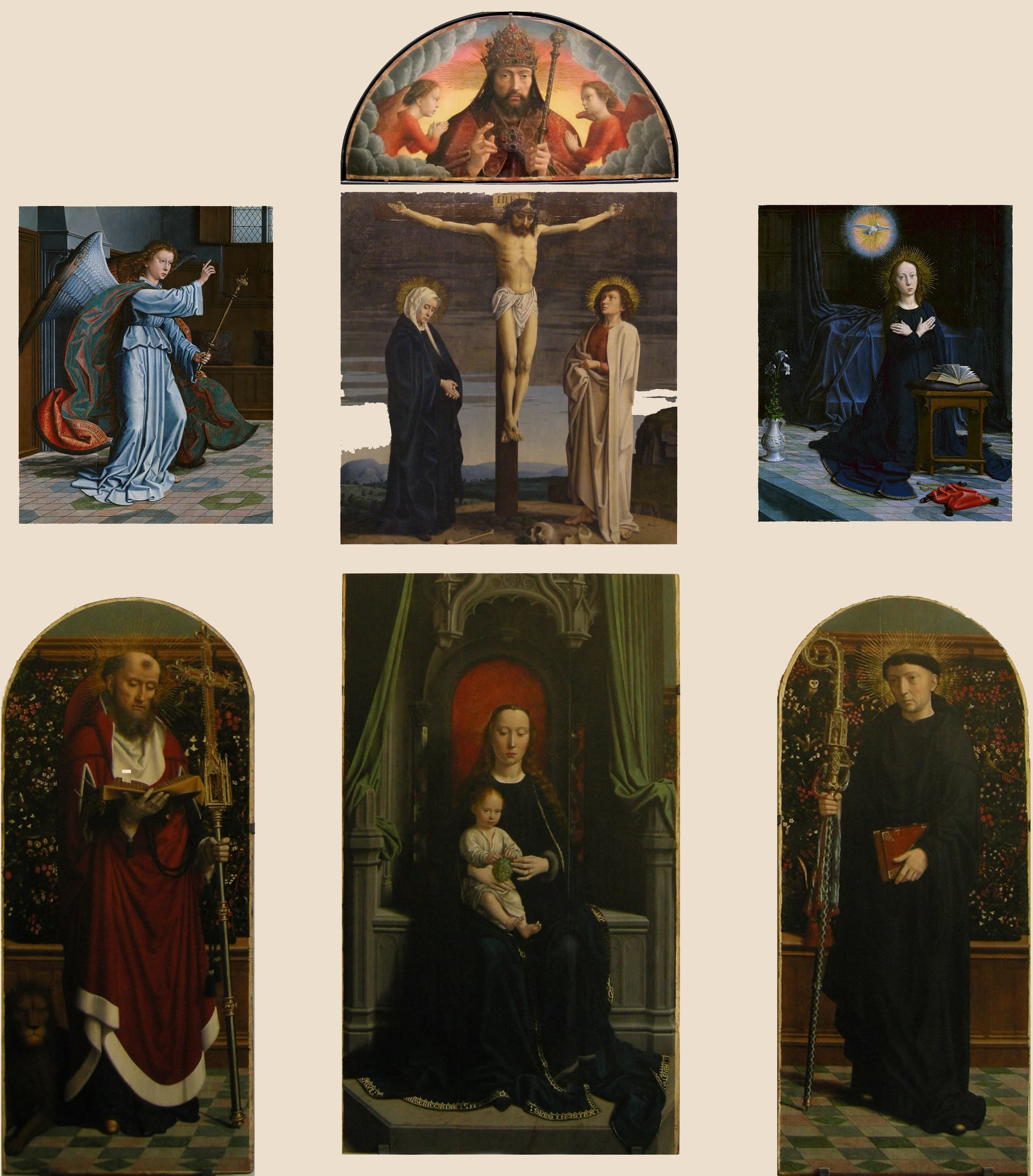
The designation polyptych tells us that this is a work formed from more than one panel. That structure matters before any individual image is considered: the object was conceived as an arrangement, with separate painted surfaces contributing to a single religious work.
Oak beneath the paint
Oil paint is recorded over oak panel. The support is not an incidental detail. It establishes the work as a painted wooden object as well as an image, and places its material construction alongside the visible religious subject.
A commanding scale
At 255 centimetres (8 ft 4 in) high and 218 centimetres (7 ft 2 in) wide, the polyptych has a substantial physical presence. Even without relying on a close view of its painted details, those dimensions make clear that it was not a small, portable panel.
The story
The Cervara Polyptych is a religious altarpiece and polyptych, made in oil paint on oak panel. Its creator is Gerard David, and its inception is recorded as 1500. In museum language, those brief facts set out a great deal: a named painter, a date, a material, and a form assembled from multiple panels.
It belongs to Early Netherlandish painting. That classification sits beside another useful description, religious art. Neither label replaces the object itself. Together, however, they indicate that the work can be approached both as a Renaissance painting and as an altarpiece: an object whose format is central to its meaning.
Its scale is equally direct. The work measures 255 centimetres (8 ft 4 in) in height and 218 centimetres (7 ft 2 in) in width. A polyptych of this size asks to be understood as a physical arrangement in space, not merely as a reproduced image. Oak provides the support; oil paint supplies the painted surface; the divisions of the polyptych organise the whole.
The surviving catalogue information also gives the work an unusual institutional profile. It is associated with the Department of Paintings of the Louvre and with the Metropolitan Museum of Art. Its recorded locations include the Metropolitan Museum of Art, Room 817, and Cervara Abbey. Two inventory numbers are supplied: RF 2228 and 49.7.21. These entries identify the work across collections and locations, but they do not, by themselves, explain the sequence behind those associations.
That limit is worth keeping in view. The supplied facts identify the polyptych, its maker, its date, materials, dimensions, type and institutional records. They do not provide an account of its discovery or of the route by which it reached its present museum setting. The object remains significant not because every part of that history is supplied, but because its basic record still lets us see a large, deliberately structured religious painting moving between the categories of abbey, collection and museum room.
Why it mattered then
In 1500, the work’s identity as an altarpiece and religious polyptych would have been inseparable from its format. Multiple panels made an organised whole, while its recorded dimensions gave that whole considerable presence. Oil paint on oak panel was the material basis for a work classified as religious art, rather than a painting understood only as an independent image.
Why it matters now
The Cervara Polyptych still matters because it requires more than one way of looking. It is an Early Netherlandish painting by Gerard David, but it is also a large wooden altarpiece whose polyptych form shapes how its painted surfaces belong together. Its records at the Louvre and the Metropolitan Museum of Art also show how one object can acquire several institutional identifiers without those identifiers telling a complete story.
The surprising detail
The most arresting fact may be administrative rather than pictorial. One polyptych is recorded with two inventory numbers, RF 2228 and 49.7.21, and is associated with both the Department of Paintings of the Louvre and the Metropolitan Museum of Art. It is also listed at Cervara Abbey and in Room 817 at the Metropolitan Museum of Art. The entries preserve several points in the work’s record, but not the narrative that joins them.
What is disputed
The supplied facts do not say how or where the polyptych was found. They also do not explain the precise relationship between its recorded locations, collections and inventory numbers.
How it got here
The available record associates the work with Cervara Abbey, the Department of Paintings of the Louvre and the Metropolitan Museum of Art, including Room 817. It does not provide a transfer history, acquisition account or information about ownership claims.
Remember this
Gerard David’s 1500 oil-on-oak polyptych is a large religious altarpiece whose museum record spans the Louvre, the Metropolitan Museum of Art and Cervara Abbey.
Test yourself
Why does calling this work a polyptych change the way we should approach it, rather than merely adding a catalogue label?
Because a polyptych is an arrangement of multiple panels. The term directs attention to the relation between separate painted parts and the larger religious whole they form. Here, material, scale and structure all matter: this is oil paint on oak panel, measuring 255 by 218 centimetres (7 ft 2 in), and classified as both a polyptych and an altarpiece.
Go deeper
Image: Gerard David, Public domain. Licence: Public domain. Source.