I · THE OBJECT · BRITISH MUSEUM
Portrait of Francesco d'Este
▶ Listen · narrated
For decades the sitter’s name was uncertain. A crest on the reverse and a 1939 identification restored it, and with it a cooler, worldly strain of Early Netherlandish portraiture.
At a glance
- Date
- c. 1460
- Artist
- Rogier van der Weyden
- Material
- Oil paint on panel
- Dimensions
- 29.8 × 20.3 cm (8 in)
- Collection
- Metropolitan Museum of Art
- Inventory
- 32.100.43
Look closer
A shallow white ground
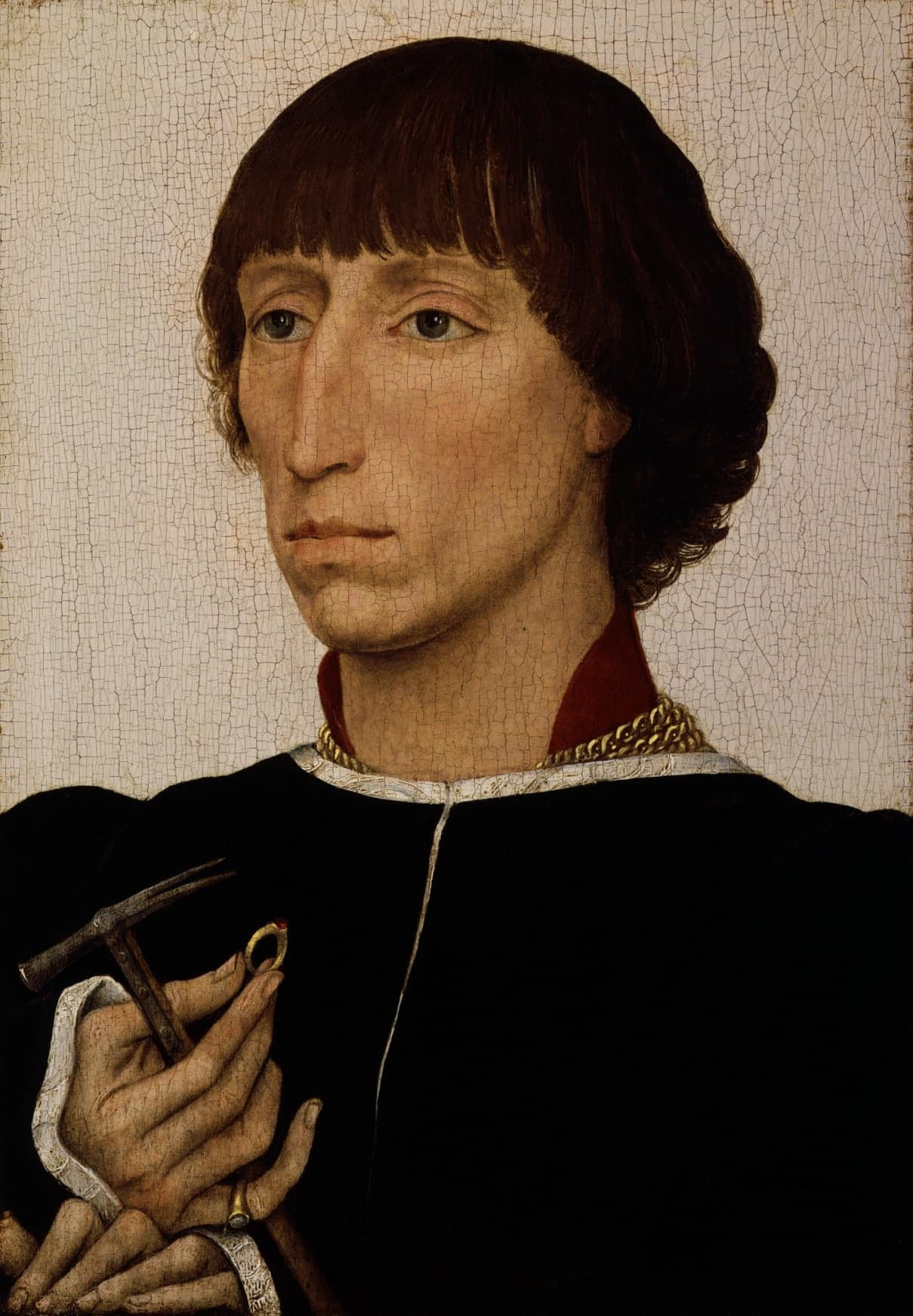
The sitter is set half-length, in three-quarters view, against a plain background built up in white rather than the deep grey or black more usual in Northern portraiture after van Eyck. The space feels shallow and close. There is little atmospheric recession; the face and hands press forward against a pale field that refuses to recede into shadow.
Hammer and ring
In his hand the sitter holds a small hammer and a ring. The ring only became visible after a cleaning in 1934. Both objects are generally read as status emblems, yet their exact meaning has not been positively identified. They sit in the lower part of the composition where the long, bony fingers almost seem to rest on the edge of the panel itself.
The working of the hands
As often in van der Weyden’s late male portraits, the fingers are highly detailed and prominent: elongated, jointed, and carefully modelled. They carry as much descriptive weight as the face. The effect is less soft flattery than a kind of attentive, slightly austere presence, consistent with the cooler manner of his later work.
The story
Portrait of Francesco d’Este is a small oil painting on a wood panel, made around 1460 by the Early Netherlandish painter Rogier van der Weyden. It measures only 29.8 by 20.3 centimetres (8 in). The work is in good condition and has belonged to the Metropolitan Museum of Art in New York since 1931, where it is inventoried as 32.100.43.
The sitter appears half-length against that shallow white ground, turned in the familiar three-quarters view of van der Weyden’s late male portraits. He is shown broad-chested, with a long neck, an aquiline nose and a keen, cultivated expression. The painting does not lean on devotional props or signs of personal humility. It presents a worldly figure and seeks to flatter his standing.
When the panel was attributed to van der Weyden in the early twentieth century, the identity of the man remained a matter of speculation. A crest on the reverse pointed to the d’Este family of Ferrara. For a time he was taken to be Leonello d’Este, an Italian prince with strong Burgundian ties and a known patron of Rogier. In 1939 the historian Ernst Kantorowicz argued that the sitter was instead Leonello’s illegitimate son Francesco (born about 1430, last recorded after 1475). That identification is now generally accepted. The panel would show Francesco at about thirty.
Two objects complicate the reading. The hammer and the ring held in his hand look like deliberate badges of rank or office, yet no secure explanation of either has been established. The ring’s late reappearance after cleaning only underlines how much of the picture’s meaning still depends on evidence that can shift. What remains clear is the painter’s method: a restrained format, a pale close ground, and hands treated with the same exactness as the face. The result is compact, secular and controlled — a portrait that works by attention rather than by narrative clutter.
Why it mattered then
In the mid-fifteenth century a portrait of this kind served a courtly purpose. Francesco d’Este moved between the Ferrarese world of his family and the Burgundian milieu in which van der Weyden worked. A likeness that stressed breadth of chest, cultivated features and hand-held emblems of status could travel as a claim of rank without needing a religious frame. Van der Weyden’s late formula — half-length, three-quarters turn, plain ground — was already a recognisable type. Choosing a light, shallow background rather than a deep shadowed one kept the sitter near the surface of the panel, almost continuous with the viewer’s space. The unusually secular tone mattered in a period when many portraits still folded identity into devotion. Here the emphasis falls on worldly position: the face, the grip, the unexplained hammer and ring. Whether or not every emblem can now be decoded, the painting’s job in its own moment was to present a specific man as someone worth knowing and remembering at court.
Why it matters now
The panel still matters because it shows how much a small portrait can withhold and still hold attention. The sitter’s name was recovered only through a crest and later scholarship; the hammer and ring remain without a settled reading. That combination of firm attribution and open detail is useful. It keeps the object from hardening into a simple illustration of a biography. It also offers a clear example of Early Netherlandish portrait practice at a late, austere point in van der Weyden’s career: limited space, exact hands, a pale ground that refuses atmospheric depth. For anyone looking at Northern Renaissance faces in museums today, this is a reminder that likeness was negotiated — flattered, staged, and sometimes misidentified for decades — and that cleaning and archival work can still change what we think we see. The painting’s scale helps. At under thirty centimetres high it asks for close looking, which is where its decisions about ground, grip and expression become legible.
The surprising detail
The ring in Francesco’s hand was not always part of the public image of this picture. It only came to light after a cleaning in 1934. For years before that, viewers and scholars were reading a composition missing one of its two held emblems. The hammer had to carry the symbolic weight alone until the second object reappeared. Their exact significance is still not positively identified, so the painting has gained a detail without yet gaining a full explanation.
What is disputed
The sitter was long thought to be Leonello d’Este; Francesco’s identity, proposed in 1939, is now generally accepted but rests on scholarly argument rather than an original inscription on the face of the panel. The hammer and ring are likely status symbols, yet their exact significance has not been positively identified.
How it got here
The painting has been in the Metropolitan Museum of Art since 1931 (inventory number 32.100.43). The supplied sources do not detail its earlier ownership chain or any contested-ownership claim.
Remember this
A small secular panel, a pale shallow ground, and two emblems whose meaning is still not settled — identity recovered, symbols not yet.
Test yourself
Why did linking the reverse crest to the d’Este family not, by itself, settle who the sitter was?
Because the crest narrowed the field to a family, not to one man. For years the panel was associated with Leonello d’Este, a plausible patron connected to van der Weyden’s Burgundian world. Only in 1939 did Kantorowicz argue for Leonello’s illegitimate son Francesco, an identification now generally accepted. A heraldic clue can place a portrait inside a lineage while still leaving the individual open; settling the face required matching biography, age and circumstance to the image, not only reading the arms.
Go deeper
Image: Rogier van der Weyden, Public domain. Licence: Public domain. Source.