III · THE WORK · ART HISTORY
Madonna of Chancellor Rolin
▶ Listen · narrated
Jan van Eyck places a powerful layman face to face with the Mother of God, at the same scale, in the same light, with nothing ecclesiastical between them.
At a glance
- Artist
- Jan van Eyck
- Medium
- Oil paint on panel
- Dimensions
- 66 × 62 cm (2 ft)
- Collection
- Louvre, Room 818
- Type
- Ex-voto; religious art
- Movement
- Early Netherlandish painting
Look closer
Equal ground, equal light
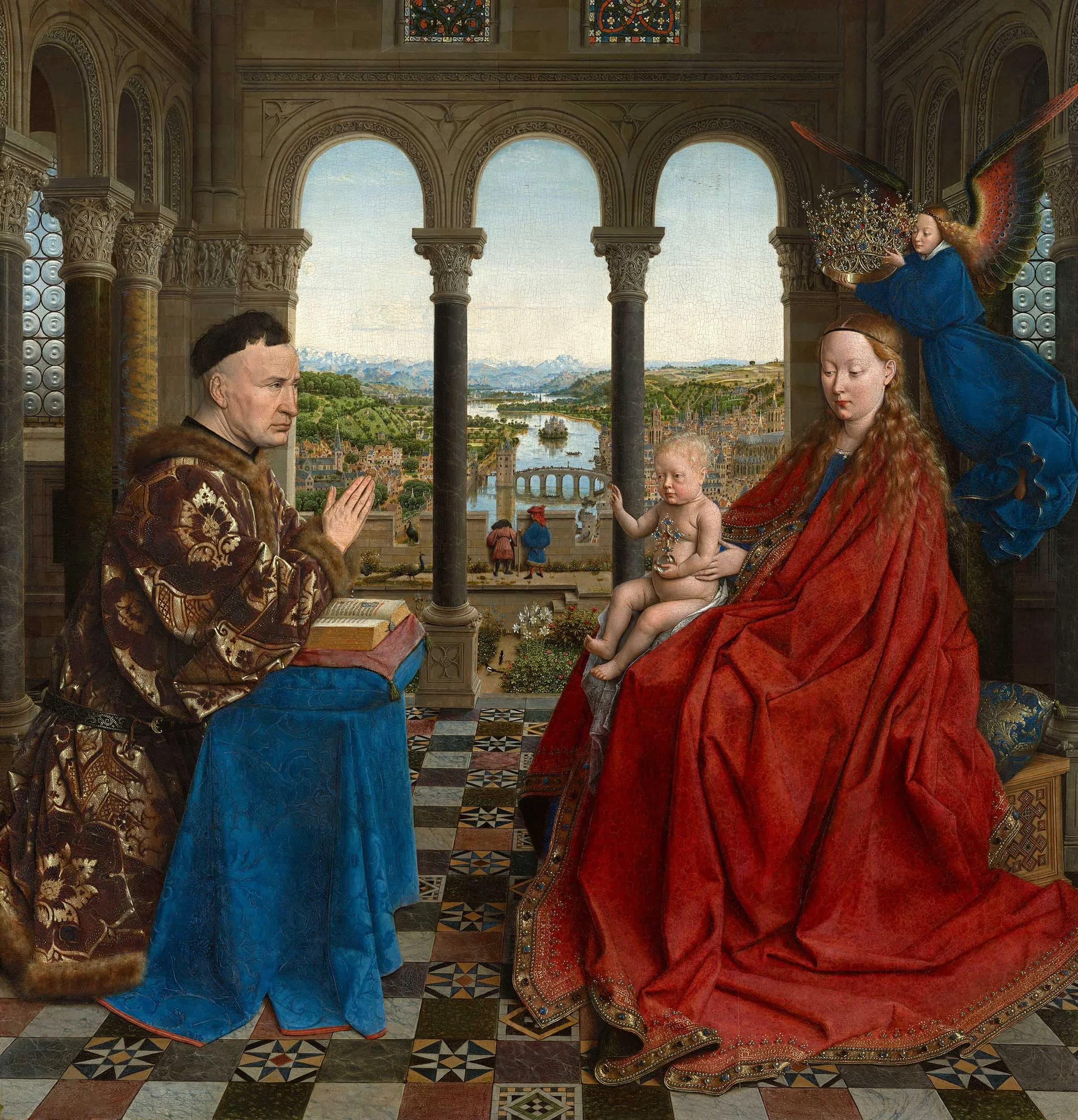
The man and the Virgin occupy the same shallow loggia. He kneels at the left; she sits at the right with the Child. Neither is set higher, smaller, or deeper in space. The light that models his furred robe is the light that models her mantle. Van Eyck has refused the usual hierarchy in which a donor shrinks toward the margin while the holy figures hold the centre. Here the meeting is staged as a confrontation across a shared floor.
The world beyond the pillars
Behind them an arcade opens onto a high terrace and, beyond that, a river landscape dense with buildings, boats, fields and distant hills. The view is continuous and sharply focused, as if the sacred encounter were taking place not in a sealed chapel but on a balcony above an actual city. The landscape does not read as a vague heavenly backdrop; it is particular, measured, and almost distractingly full.
The tiled stage
The floor is a geometric pavement of alternating tiles that runs straight from the foreground to the arcade. It locks the two figures into one measurable room and lets the eye test distances. Small objects and the fall of hems register against it. The tiles are not decoration alone; they are the painting’s quiet argument that this meeting happens in a constructed, earthly space rather than in pure gold-ground heaven.
The story
The Madonna of Chancellor Rolin is a small oil painting on panel by Jan van Eyck, now in the Department of Paintings of the Louvre, in Room 818. It measures sixty-six centimetres high by sixty-two wide — almost square — and is catalogued as both religious art and an ex-voto: a votive image offered in devotion or thanksgiving. Its inventory numbers are INV 1271 and MR 705.
What the panel shows is a single continuous interior. At the left a man in heavy secular dress kneels at a prie-dieu, hands joined. Opposite him the Virgin sits with the Christ Child, who raises a hand toward the kneeling figure. An angel holds a crown above the Virgin’s head. The three principal heads form a shallow triangle across the middle of the picture. Nothing separates the donor’s half of the room from hers except the open air between them and the low wall of the loggia behind.
Van Eyck’s oil method is everywhere in the surface. Fur, brocade, skin, stone and distant roof tiles are differentiated not by outline alone but by the way light settles into each substance. The Child’s body is small and solid; the Virgin’s drapery falls in long, weighty folds; the man’s robe absorbs light where the pile is thick and returns it where the nap catches. The same daylight seems to enter from the open arcade and from a source in front of the picture plane, so that faces and hands are modelled without harsh shadow.
The composition is built on a calm bilateral balance that is slightly unsettled by content. The left half belongs to a living official; the right half to the Mother of God. Their bodies are comparable in mass. Their eyes nearly meet across the gap. The Child’s gesture bridges that gap, turning the donor’s private prayer into a scene of address and response. Because the panel is an ex-voto, that address is not theatrical only: the image itself is the offering, and the painted encounter is what the offering records.
Behind the figures the architecture opens rather than closes. Columns and a carved capital frame a terrace where tiny people stand and look out. Beyond the parapet the landscape drops through gardens and a river toward a dense town and far hills. Birds are visible in the air. The clarity does not fade politely with distance; it stays legible, which keeps the outdoor world competing for attention with the holy group. Sacred presence and civic topography occupy one continuous optical field.
The near-square format matters. There is little spare sky and no long vertical thrust. The room feels low and close, the meeting intimate rather than processional. Floor tiles lead the eye inward; the arcade stops it and then releases it into depth. Everything is arranged so that looking becomes a slow inventory — robe, crown, capital, river, roof — without a single dominant empty area in which the mind can rest.
As Early Netherlandish painting, the work trusts oil’s capacity for minute difference: a reflection in a polished surface, a shift in stone colour, the separate identity of each distant facade. Those differences are not scattered effects. They serve the central claim of the picture, which is that a chancellor and the Virgin can share one lit room, and that the world outside the pillars is still there while they do.
Why it mattered then
As an ex-voto, the panel was not only a work of art but an act. It fixed a relationship between a named earthly power — the chancellor of the title — and the Virgin and Child in a durable, public form. In the religious culture of Early Netherlandish painting, such images could serve as permanent prayer: the donor remains kneeling for as long as the panel is seen. Placing the layman at full scale beside the Madonna mattered in that setting. Hierarchy was usually marked by size, placement, or an intervening altar. Van Eyck’s arrangement compresses those signals. The holy figures retain their attributes — crown, blessing Child, angel — yet they occupy the same architecture and the same light as the kneeling man. The painting could thus honour both devotion and rank without reducing either to a symbol in the margin. Oil on panel made that double honour persuasive. Substance by substance, the surface argues that the encounter is solid enough to be believed. For a votive work, credibility of presence was part of the gift.
Why it matters now
The panel still rewards the kind of looking it was built for: slow, comparative, and willing to move between a face and a far roofline without treating either as filler. In a museum room it continues to stage a problem that has not gone away — how an image holds political personhood and sacred personhood in one frame without simply collapsing one into the other. It also remains a clear demonstration of what early oil painting could do on a modest wooden support. At sixty-six by sixty-two centimetres the world it contains is disproportionate to its size. That disproportion is not a trick for its own sake; it is how the picture keeps earthly detail and devotional focus in tension. Viewers who come for the landscape stay for the meeting; viewers who come for the Madonna leave having measured a floor.
The surprising detail
The painting is only four centimetres taller than it is wide. That near-square proportion is easy to miss in reproduction, yet it shapes every decision inside the frame: the low loggia, the short run of tiles, the way the two groups face each other across a gap rather than up a vertical hierarchy. A slightly taller panel would have encouraged a more conventional sacred ascent. The format van Eyck used keeps the encounter lateral, close, and socially sharp. The Louvre hangs it in Room 818; its numbers, INV 1271 and MR 705, mark the long administrative life of a small object made as a personal offering.
What is disputed
The supplied catalogue inception reads simply ‘16th century,’ which sits awkwardly beside van Eyck’s authorship and the work’s place in Early Netherlandish painting. A precise year is therefore not stated here. Commission history, original church setting and later movements of the panel are widely discussed in the literature but are not treated as certain in this lesson.
Remember this
Van Eyck stages chancellor and Virgin in one shared loggia, at one scale, so that votive devotion becomes a face-to-face meeting rather than a distant petition.
Test yourself
The donor and the Virgin sit across from each other at comparable scale in the same room. What does that compositional choice do to the meaning of an ex-voto?
It turns the votive image from a hierarchical petition into a staged encounter. In many donor pictures the living figure is smaller, lower, or set apart, which keeps holiness and rank on different visual levels. Here the shared floor, shared light and matched bodily mass imply that the offering is not only ‘I give this painting’ but ‘I appear before her.’ The sacred figures still carry their signs of authority — crown, Child, angel — yet the chancellor is not reduced to a margin note. The ex-voto thus records proximity as well as piety.
Go deeper
Image: Jan van Eyck, Public domain. Licence: Public domain. Source.