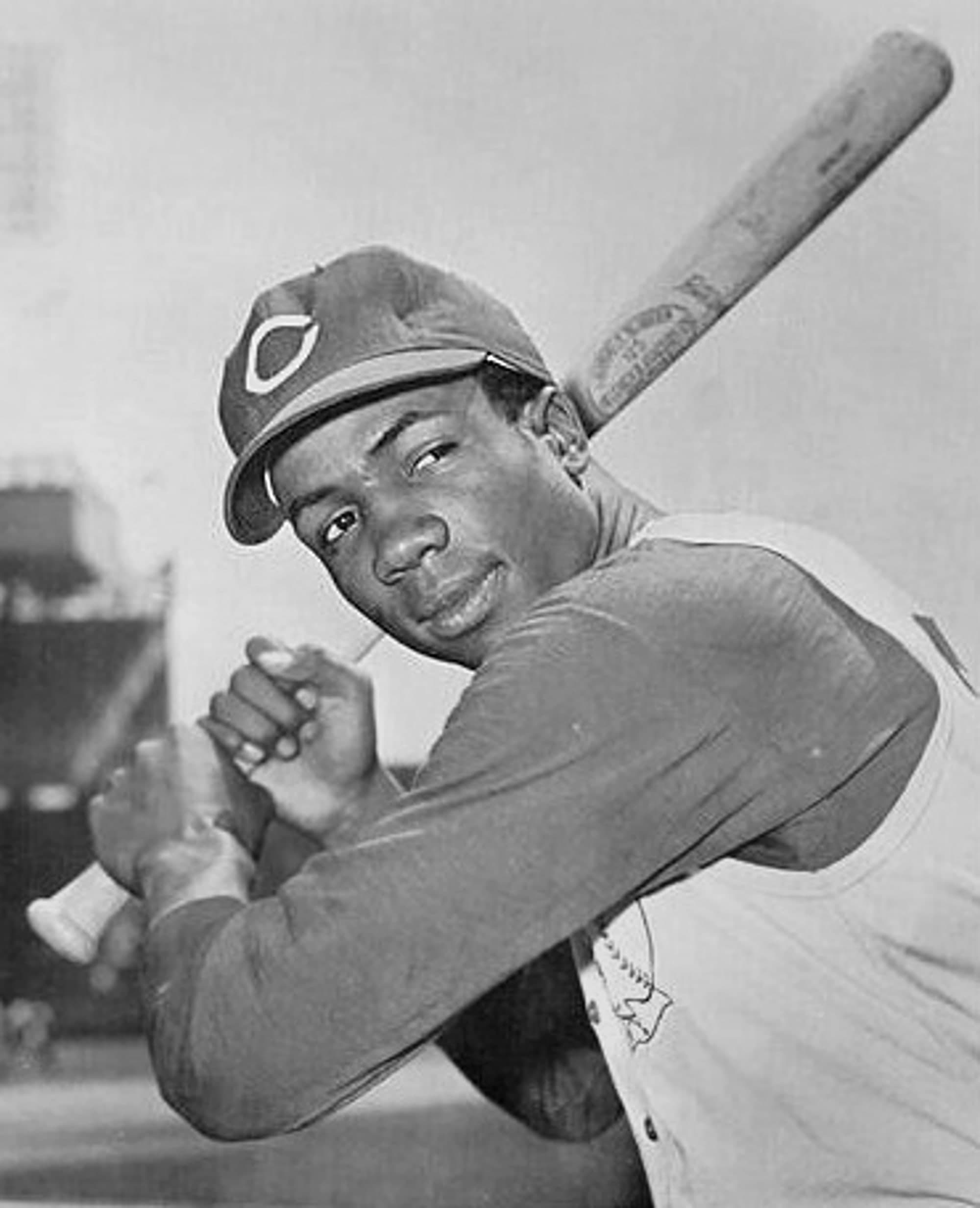
IV · THE GAME · MAJOR LEAGUE BASEBALL
Frank Robinson
Robinson's debut came in a game where both sides made twelve hits and neither made an error, yet one club scored twice as many runs as the other.
At a glance
- Career
- 2,808 games · 2,943 hits · 586 home runs · 1,812 runs batted in · .294 average
- Debut
- 17 April 1956, aged 20, at Crosley Field, Cincinnati
- Last game
- 18 September 1976, for the Cleveland Indians
- Height and weight
- 6' 1" · 195 lb · batted right · threw right
Look closer
The debut was a loss decided by timing, not hits
On 17 April 1956 St. Louis and Cincinnati each made twelve hits and neither made an error. St. Louis won 4–2. The difference lies in when the hits arrived. St. Louis scored one in the first, one in the fourth, and two in the ninth — scattered across the game. Cincinnati scored one in the second and one in the fourth, then nothing for five innings. Equal hits do not mean equal runs when the hits cluster differently. The game took two hours and thirty-one minutes in front of 32,095 people.
The highest home run total came with 34 doubles that same season
In 1966, playing for Baltimore, Robinson hit 49 home runs — his career high. That same season he made 34 doubles. Four years earlier, in 1962, when he was still with Cincinnati, he hit 39 home runs and made 51 doubles, the most doubles of any season. The two totals track each other: power to the fence and power over it are related skills, not separate ones. His career total of 528 doubles is nearly as large as his 586 home runs, and both were accumulated steadily rather than in a few enormous seasons.
The career lasted twenty-one seasons and crossed five clubs
Robinson played from 1956 to 1976 — twenty-one distinct seasons. He spent time with Cincinnati, Baltimore, Los Angeles, California and Cleveland. The final three seasons, all with Cleveland, show the shape of a career ending: 49 games in 1975, 36 in 1976, with batting averages of .237 and .224 and on-base percentages of .385 and .329. The totals decline, but the plate discipline — measured by walks — held longer than the contact did.
The story
On 17 April 1956, the Cincinnati Redlegs and the St. Louis Cardinals each made twelve hits at Crosley Field. Neither side committed an error. St. Louis won 4–2. The difference was not in the quantity of hits but in their timing. St. Louis scored one run in the first inning, one in the fourth, and two in the ninth. Cincinnati scored one in the second and one in the fourth, then went scoreless for the final five innings. Equal hits distributed unevenly produce unequal runs. The game took two hours and thirty-one minutes. 32,095 people attended.
Robinson's first season, 1956, shows the career in miniature. He played 152 games, made 166 hits, hit 38 home runs, and drove in 83 runs. His batting average was .290, his on-base percentage .379, his slugging percentage .558. Those are not apprentice numbers. The power was there from the start, and it stayed.
The season table shows a career built out of length rather than a few extraordinary years. His highest home run total was 49, in 1966 with Baltimore. That same season he made 34 doubles. Four years earlier, with Cincinnati in 1962, he hit 39 home runs and made 51 doubles — his career high in doubles. Power to the fence and power over it are related, not separate. His career total of 528 doubles is nearly as large as his 586 home runs.
The career lasted twenty-one seasons and crossed five clubs. He spent time with Cincinnati, Baltimore, Los Angeles, California and Cleveland. The final three seasons, all with Cleveland, show the shape of a career ending. In 1975 he played 49 games, batted .237, and walked 29 times in 118 at-bats — an on-base percentage of .385. In 1976 he played 36 games, batted .224, and walked 11 times in 67 at-bats — an on-base percentage of .329. The totals decline, but the discipline at the plate — the ability to draw a walk — held longer than the ability to make contact.
The career was not built out of a few peaks. It was built out of twenty-one seasons in which he played between 103 and 162 games per year, made between 86 and 208 hits per year, and hit between 15 and 49 home runs per year. The total of 586 home runs is the sum of those twenty-one lines, not the result of a handful of enormous seasons. The same applies to the 2,943 hits, the 1,812 runs batted in, and the 1,420 walks. The arithmetic is steady, and the steadiness is the point.
Why it mattered then
Robinson's debut in 1956 came at a moment when the major leagues were still adjusting to changes that had begun nearly a decade earlier. The career he built — time with Cincinnati, Baltimore, Los Angeles, California and Cleveland — was shaped by the structures of the time: trades, not free agency, moved players between clubs. The numbers he accumulated were recorded season by season, but the categories themselves were not always tracked consistently across the two decades his career spanned. Some statistics were compiled retrospectively from contemporary scoring, and the totals published today are the ones the league has settled on rather than figures recorded in real time. The career was long enough to cross changes in how the game was played and how it was counted.
Why it matters now
The career totals — 586 home runs, 2,943 hits, 1,812 runs batted in — are figures that appear in discussions of the game's history, and the season table shows how they were accumulated. The steadiness of the numbers, the way power and contact track each other, and the length of time over which the totals were built are all visible in the data. The table shows what a career looks like when it is built out of twenty-one seasons rather than a few extraordinary ones. The final seasons, with Cleveland, show what happens when the skills decline but the discipline remains. The figures are specific enough to support close reading.
The surprising detail
The two totals that sit oddest together are 49 home runs and 51 doubles — but they came in different seasons. The 49 home runs came in 1966, with 34 doubles. The 51 doubles came in 1962, with 39 home runs. Both seasons show power, but the balance between the two kinds of power shifted. The 1962 season is the single year in which he made more than 50 doubles, and it is also a season in which his batting average exceeded .340 — it was .342. The combination suggests that the power that year was less about lifting the ball than about hitting it hard.
What is disputed
Every figure here comes from the MLB Stats API. Statistical categories were not all recorded consistently across the twenty-one seasons covered, and some records were compiled retrospectively from contemporary scoring. The totals are the ones the league publishes today rather than anything independently recomputed here.
Remember this
586 home runs and 528 doubles: the power was to the fence as much as over it, and the career was twenty-one seasons long.
Test yourself
St. Louis and Cincinnati each made twelve hits in Robinson's debut game, and neither made an error, yet St. Louis won 4–2. Using only the linescore, what explains the result?
Timing. St. Louis scored in three different innings — one run in the first, one in the fourth, and two in the ninth. Cincinnati scored in two innings — one in the second and one in the fourth — then went scoreless for the final five. Equal hits do not produce equal runs when they arrive at different moments. Clustered hits score runners; scattered hits strand them. The linescore shows that Cincinnati's offence stopped after the fourth inning, while St. Louis added two runs late. No errors means the difference was not defensive mistakes but offensive timing.
Go deeper
- Frank Robinson — MLB Stats API player record · MLB Advanced Media
- Frank Robinson — career hitting totals (MLB Stats API) · MLB Advanced Media
- Debut game linescore — MLB Stats API game 137685 · MLB Advanced Media
- Frank Robinson — Wikidata · Wikidata
Image: Unknown author, Public domain. Licence: Public domain. Source.