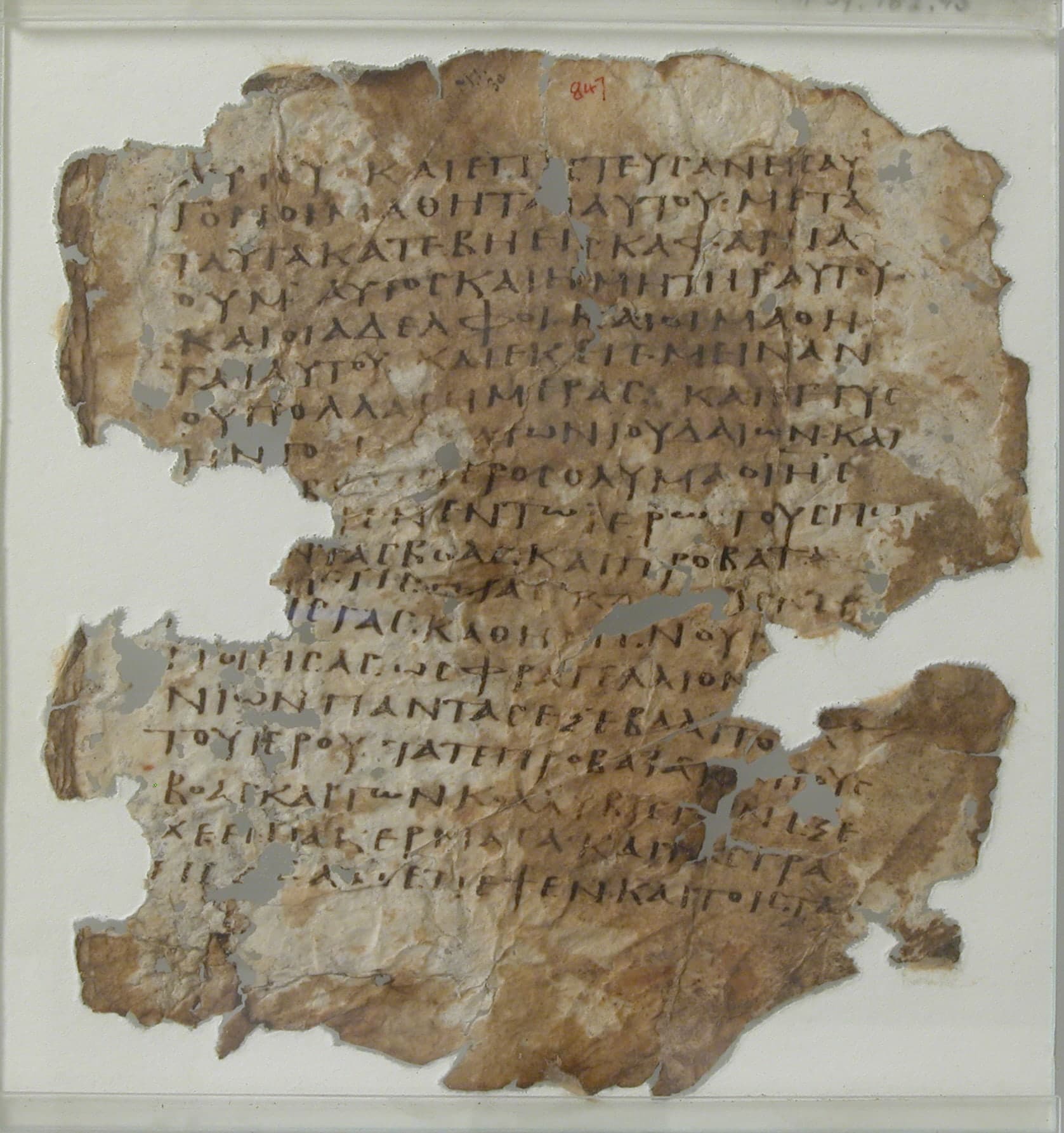
I · THE OBJECT · BRITISH MUSEUM
Uncial 0162
▶ Listen · narrated
A fragment of John's Gospel, copied when the codex was still a new technology and Christianity an illegal religion. What survives is one leaf.
At a glance
- Material
- Vellum (prepared animal skin)
- Date
- 3rd or 4th century CE (paleographic estimate)
- Content
- Gospel of John, in Greek
- Format
- One leaf from a codex
Look closer
Uncial script: letters that do not join
The text is written in uncial — a script made of separate, rounded capital letters that do not connect to one another. Each letter stands alone. The name comes from the Latin word for inch, possibly because the letters were described as an inch high, though that explanation is disputed. Uncial was the formal bookhand of early Christian manuscripts, used when a text was meant to be permanent and legible. It is distinct from the cursive scripts used for everyday documents, where speed mattered more than clarity and letters ran together.
A codex leaf, not a scroll
This is a leaf from a codex — a book made of folded and bound sheets, the ancestor of the form you are reading now. The codex was a newer technology in the third and fourth centuries. Jewish and pagan texts were still usually copied onto scrolls, which were read by unrolling one end while rolling up the other. Christians adopted the codex early, perhaps because it made reference easier: you could flip to a passage rather than unroll to it. A codex also let you gather multiple texts — the four Gospels, say — into a single volume. This leaf would have been one sheet in a gathering, sewn through the fold.
Paleographic dating: reading the hand, not testing the material
The date assigned to this leaf — third or fourth century — comes from paleography, the study of historical handwriting. Specialists compare the shape of the letters, the spacing, the abbreviations and the layout to other manuscripts whose dates are more securely known, and estimate where this hand fits in the sequence. Paleographic dates are always ranges, not fixed points, because scribal styles changed gradually and unevenly across regions. A century of uncertainty is typical. Scientific tests of the vellum itself might narrow the range, but the results given here rest on reading the script.
The story
Uncial 0162 is a single leaf of vellum carrying part of the Gospel of John in Greek. The text is written in uncial script — rounded, separated capital letters that were the formal bookhand of early Christian manuscripts. The leaf has been dated by its handwriting to the third or fourth century, a range that reflects the limits of paleography, the study of historical scripts.
The leaf is catalogued under multiple systems. In the Gregory-Aland numbering, a standard reference system for manuscripts of the Gospels, it is Uncial 0162. In an earlier system it was called ε 023. It is also known as Papyrus Oxyrhynchus 847, a designation that records its origin: it was found at Oxyrhynchus, a Greco-Roman town in Egypt that has yielded tens of thousands of papyrus and parchment fragments, many of them literary and documentary texts discarded in ancient rubbish heaps. The dry climate preserved them.
The leaf is vellum — animal skin that has been scraped, stretched and prepared as a writing surface. Vellum is more durable than papyrus, the plant-based material used for most everyday documents in the ancient Mediterranean, and it was the preferred material for books meant to last. The choice of vellum suggests this was a valued text, not a draft or a schoolroom copy.
The codex — a book made of folded, stacked and sewn sheets — was a relatively new format when this leaf was made. Scrolls were still the dominant form for Jewish and pagan literature in the third and fourth centuries, but Christians adopted the codex early and used it widely. The reasons are debated. A codex is easier to search: you can turn to a passage without unrolling the entire scroll. It also allows you to bind multiple texts together, which may have mattered to communities that read several Gospels as a set. This leaf would have been one sheet in a gathering, with other leaves stacked and sewn through the centre fold.
What the leaf contained, and how much is lost, is not recorded in the available sources. The Gospel of John is the fourth and latest of the canonical Gospels, probably written in the last decade of the first century. It differs in structure and tone from the other three: it opens with a theological prologue rather than a birth narrative, and it includes long discourses rather than short parables. By the third century, when this leaf may have been copied, the four Gospels were already circulating as a recognised set.
The dating of the leaf — third or fourth century — is a paleographic estimate, meaning it is based on comparing the handwriting to other manuscripts. Scribal hands changed over time, and specialists can often place a manuscript within a range of decades or a century by looking at letter shapes, spacing, and the use of abbreviations. But paleographic dating is not precise. Regional variation, individual scribal habits, and the fact that older styles sometimes persisted alongside newer ones all introduce uncertainty. A range of a hundred years is common and honest.
Why it mattered then
In the third and fourth centuries, Christianity was still a minority religion, and for much of that period it was illegal. Copying a Gospel was an act of community maintenance, not state-sponsored scholarship. Christian congregations needed texts for teaching, for liturgy, and for reading aloud during worship, and they produced them locally, often in small scriptoria attached to churches or in the homes of wealthier members. A codex of John would have been read in a group, not studied in silence by an individual reader. Literacy rates were low, and even those who could read often heard texts performed rather than reading them privately. The choice of vellum rather than papyrus suggests the community that commissioned this codex valued permanence. Vellum was more expensive, but it lasted longer and could be corrected more easily. The use of uncial script, which is slower to write than cursive but easier to read, points to the same concern: this was a book meant to be read aloud clearly and to survive repeated use. The century between the third and fourth saw transformations in how Christian texts were produced and in the legal status of the religion itself. This leaf sits somewhere in that transition, though exactly where is uncertain.
Why it matters now
Uncial 0162 is one piece of evidence in the textual history of the Gospels. Scholars who work on that history are trying to reconstruct the original wording of texts that have been copied and recopied for two millennia, and every early manuscript is a data point. The Gospel of John exists in hundreds of manuscripts, and they do not all agree. Most differences are trivial — a word order variation, a spelling — but some are substantial, and deciding which reading is older requires comparing manuscripts and weighing their relationships to one another. This leaf is not a complete witness. It preserves only part of the Gospel, and without knowing which verses it contains or how its text compares to other manuscripts, its contribution to that larger project is limited. But it is still a material record of how early Christians read and transmitted their foundational texts. The fact that it was copied onto vellum, bound into a codex, and written in a careful uncial hand tells us something about the resources and priorities of the community that made it. The leaf is also part of a larger archive. The finds from Oxyrhynchus have transformed the study of the ancient world, not because any single fragment is uniquely important, but because the sheer volume of material — literary, documentary, religious, mundane — gives a detailed picture of daily life, literacy, and book culture in a provincial town. Christian texts make up a significant portion of the Oxyrhynchus finds, and together they document the spread of Christianity through Egypt in the centuries before it became the dominant religion. For a museum visitor, the leaf is a reminder that the texts we now read as fixed and authoritative were once manuscripts, copied by hand, one letter at a time, by people whose names we do not know. The ink and the vellum are still here. The rest of the codex is not.
The surprising detail
The designation 'Papyrus Oxyrhynchus 847' is slightly misleading: the leaf is not papyrus but vellum. The name comes from the excavation site, not the material. Oxyrhynchus was a major source of papyrus finds, and the cataloguing system used for the site was established before all the fragments had been examined. By the time this leaf was identified as vellum, the numbering was already in place, and it was not changed. The result is a category label — 'Papyrus Oxyrhynchus' — that sometimes refers to parchment instead.
What is disputed
The date assigned to this leaf — third or fourth century — is a paleographic estimate, meaning it rests on comparing the handwriting to other manuscripts. Such dates are always ranges, and a span of a century reflects the limits of the method rather than scholarly disagreement. The leaf is identified in some sources as papyrus and in others as vellum or parchment; the current cataloguing treats it as vellum, though 'Papyrus Oxyrhynchus 847' remains the standard reference name.
Remember this
One vellum leaf, copied in uncial script, part of a lost codex. The dating is uncertain by a century, and the rest of the book is gone.
Test yourself
Why does a paleographic date — one based on analysing the handwriting — typically give a range of decades or even a century, rather than a specific year?
Because scribal handwriting changed gradually, not all at once, and the changes were neither uniform across regions nor consistent among individual scribes. Paleographers compare letter shapes, spacing, and abbreviations to other manuscripts with more securely known dates, but even well-dated comparisons only establish a range. An older style might persist in one region while a newer style was already standard elsewhere, and a conservative scribe might write in a style learned decades earlier. Add to that the fact that most ancient manuscripts are not dated by their scribes, and the result is that handwriting analysis can place a manuscript within a period but rarely to a single decade. A range of a century is not a failure of method; it is an honest statement of what the evidence supports.