III · THE WORK · ART HISTORY
The Gleaners
▶ Listen · narrated
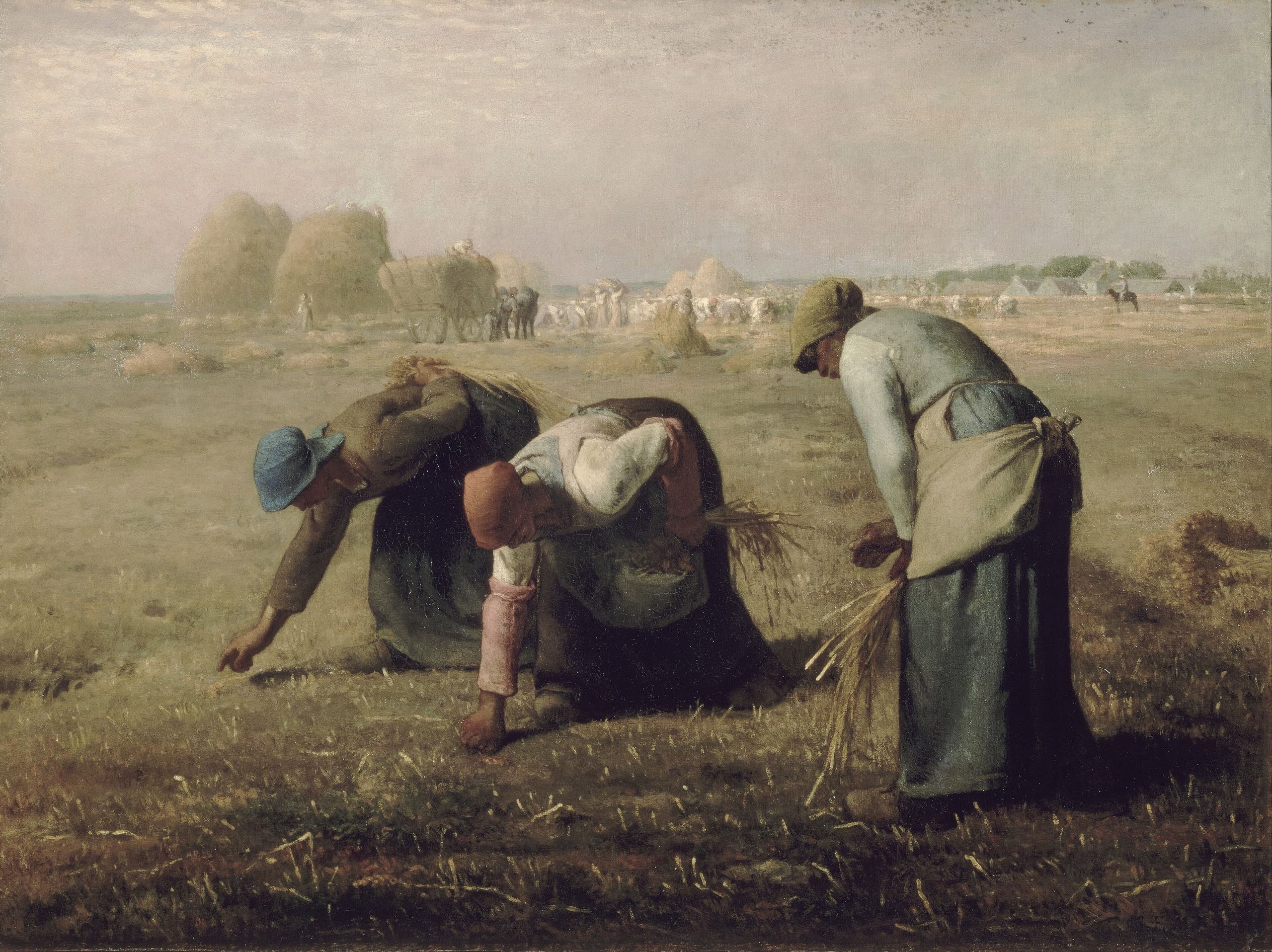
After the reapers have gone, three women stoop for stray stalks of wheat. Millet gave the lowest rural labour the steady attention of a finished oil painting.
At a glance
- Artist
- Jean-François Millet
- Date
- 1857
- Medium
- Oil on canvas
- Dimensions
- 830 × 1100 mm (43.31 in)
- Collection
- Musée d'Orsay
- Movement
- French Realism
Look closer
Three figures, one task
The painting holds to a single action repeated across three bodies: peasant women gleaning, bent to the ground for the stray stalks of wheat left after the harvest. Nothing pulls the eye toward a hero or a narrative climax. The subject is the work itself, shared and ordinary, given the full width of the canvas.
After the harvest
The field is not standing ripe. Gleaning happens when the main crop has already been taken. What remains are leftovers — stalks missed or dropped — and the women are there for those. The picture is set in the aftermath of abundance, not inside it, which quietly fixes the social rank of the labour on view.
Scale without spectacle
At 830 by 1100 millimetres (43.31 in) the canvas is substantial enough for three figures to dominate without crowding into anecdote. Millet uses that size for genre art — a scene of ordinary rural life — rather than for myth or public history. The seriousness is in the proportions: low labour, treated as if it warranted room.
The story
Jean-François Millet completed The Gleaners in 1857. The work is an oil painting on canvas, French in origin, and now hangs in the Musée d'Orsay in Paris under the inventory number RF 592. Its French title, Des glaneuses, names the women by what they are doing.
The picture shows three peasant women in a field after the harvest, gathering the stray stalks of wheat that remain. Gleaning was not the reaping itself. It was the slower work that followed, when the main crop had been taken and only leftovers were left to find. Millet places that labour at the centre of the composition and stays with it.
The women belong to what were then the lowest ranks of rural society. The painting presents them sympathetically. That choice is not a side note; it is the point on which the picture’s early reputation turned. The French upper classes received the work poorly. A finished oil that gave careful attention to the poorest field labour did not land as a harmless rustic scene.
Millet was working within French Realism and within genre art — painting drawn from ordinary life rather than from history, religion or allegory. Nothing in the verified account of the picture turns the three women into symbols. They are gleaners, bent to a real task, on a canvas large enough (830 millimetres (32.68 in) high, 1100 wide) for their action to hold the surface without needing a secondary drama.
What the painting refuses is distance dressed up as charm. The viewer is not offered a picturesque pause in the countryside so much as a sustained look at people collecting what others have left. The sympathy is built into the decision to paint them this way at all: three figures, one repeated gesture, a field already stripped of its main wealth. The rest of the meaning follows from that arrangement.
The canvas has remained in France and is kept at the Musée d'Orsay. Its facts are plain — maker, date, material, size, subject — and they are enough. The Gleaners does not depend on a hidden story. It depends on who was allowed to occupy the middle of a serious painting in 1857, and on how little comfort that gave some of the people who first looked at it.
Why it mattered then
In 1857 a painting of three gleaners was not a neutral record of country life. Gleaning marked the bottom edge of rural labour: the gathering of leftover wheat after the harvest had been carried off. By treating women of that rank with sympathy, and by giving them the space of a substantial oil on canvas, Millet put the lowest rural work where French viewers were more used to finding elevated subjects. Genre art and French Realism had already turned toward ordinary life, but the reception of this picture shows how far that turn could still unsettle. The French upper classes received it poorly. The discomfort was social as much as aesthetic. A canvas that lingered on poverty without comedy or distance asked to be read as more than decoration, and some of its first audience preferred not to.
Why it matters now
The Gleaners still matters as a test of what painting chooses to take seriously. Its subject is narrow and concrete — three women, leftover wheat, a field after harvest — yet the questions around it have not expired. Who is given scale? Who is shown at work rather than at rest? How much sympathy can a picture extend toward the poorest labour before it stops feeling safe to those who do not share that labour? Millet’s canvas does not answer with a programme. It answers with attention: repeated bending, a stripped field, no escape into grandeur. Looking at it now is still a way of noticing how often images of work either flatter the viewer or look away. This one does neither.
The surprising detail
The painting’s early trouble came less from how it was made than from whom it took seriously. Millet’s sympathetic treatment of women from the lowest ranks of rural society was enough for the French upper classes to receive the work poorly. The subject was gleaning — leftover stalks after the harvest — and the offence was that such labour had been given the full regard of a finished oil painting.
What is disputed
The supplied sources establish a poor reception among the French upper classes and a sympathetic treatment of the lowest rural ranks, but they do not detail individual reviews, exact exhibition circumstances, or a single agreed reading of Millet’s politics. Those finer points should not be filled in beyond what is stated.
Remember this
Millet gave three gleaners — among the poorest rural workers — the scale and sympathy of a serious 1857 oil, and the French upper classes did not thank him for it.
Test yourself
The painting shows gleaning rather than reaping. Why does that choice of moment sharpen what the picture is about?
Reaping takes the main harvest; gleaning comes afterward, when only stray stalks remain. By setting the three women in that later moment, Millet fixes them inside the economy of leftovers rather than of abundance. The sympathy the painting extends is therefore aimed at the lowest rural rank, not at farm labour in general — which is also why the work could unsettle upper-class viewers who preferred not to dwell on that rank at all.
Go deeper
Image: Jean-François Millet, Public domain. Licence: Public domain. Source.