III · THE WORK · ART HISTORY
Bacchus
▶ Listen · narrated
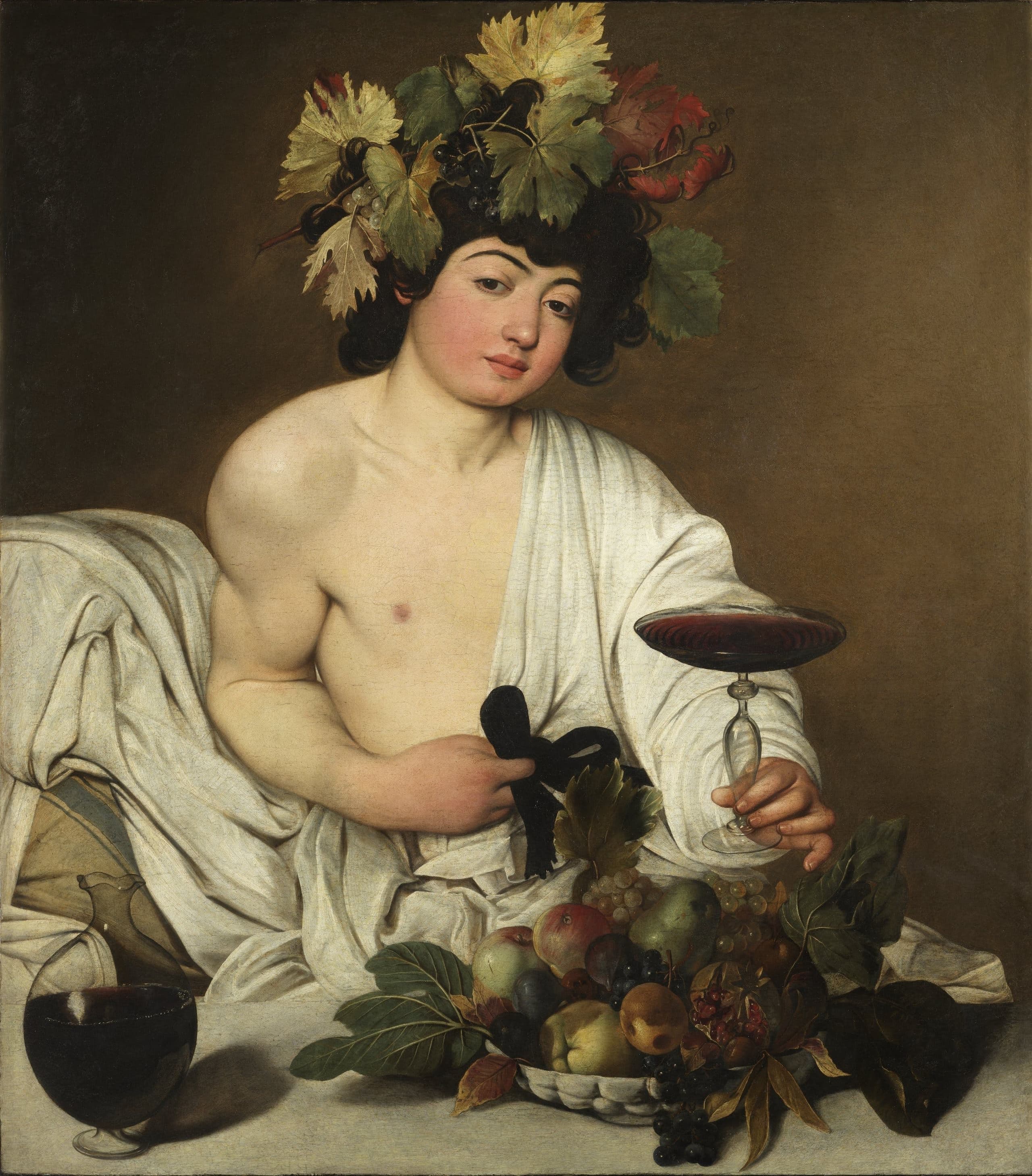
Caravaggio gives Bacchus a living body, a loose robe and a cup offered straight to the viewer. The myth arrives without ceremony, as an invitation across a table.
At a glance
- Artist
- Caravaggio
- Date
- c. 1593–1598
- Medium
- Oil on canvas
- Size
- 95 × 85 cm (2 ft 9 in)
- Collection
- Uffizi Gallery, hall 90
- Inventory
- 5312
Look closer
The offered cup
Bacchus holds a shallow goblet of red wine out toward the viewer, the stem caught between fingers that look slightly dirty under the nails. The gesture is not grand. It is the ordinary motion of someone passing a drink across a table, and it collapses the distance between a classical god and the person standing in front of the canvas.
Fruit already past its best
On the stone surface sits a bowl of fruit — apples, grapes, a bruised peach, leaves beginning to curl. Nothing is arranged as a perfect still life. The produce has weight, soft spots and the look of food that will not last the afternoon. Beside it, a large carafe of the same red wine catches light through the glass and shows a small reflection on its surface.
Vines in black hair
Grapes and vine leaves are tucked into the figure’s dark hair, the classical attribute of Bacchus rendered as something he might have put on himself. The leaves sit unevenly; a few grapes hang loose. Above the bare shoulder and the loosely draped robe, the head-dress is the one clear signal that this is not simply a young man at a table.
The story
The painting shows a youthful Bacchus reclining behind a stone table, turned three-quarters toward us. Grapes and vine leaves sit in his dark hair. A white robe has slipped from one shoulder; he fingers its drawstring with one hand and, with the other, holds out a shallow goblet of red wine. In front of him stand a bowl of fruit and a full carafe of the same wine. The format is modest — ninety-five centimetres high by eighty-five wide — so the figure fills the frame and the invitation feels close.
Caravaggio worked in oil on canvas, building the body and the still life with the strong contrasts of light and dark that later came to be called chiaroscuro. Light falls from the left, modelling the chest, the hand on the goblet and the curved glass of the carafe, while the background drops away into a warm, almost empty dusk. There is no architectural setting and almost no depth beyond the table edge. What matters is the plane between the fruit, the offered cup and the viewer.
The subject is mythological, yet almost nothing in the picture behaves like a classical frieze. Bacchus does not preside over a feast or lead a throng of followers. He is alone, slightly flushed, and the fruit before him is already past perfect freshness. The robe reads as cloth rather than ideal drapery. Even the pose — reclining, one elbow down, the cup extended — feels borrowed from the way a real sitter might settle on a couch for a long session. The god is identified by attributes, then painted as if those attributes had been fetched from a market and a garden that morning.
The work belongs to the early years of what is now grouped as Italian Baroque painting, though its date is not fixed to a single year. Wikidata records inception dates of 1593 and 1598; the painting is usually placed somewhere in the mid-1590s. It was made in Rome and later entered the collection of the Uffizi Gallery in Florence, where it hangs in the Caravaggio room, hall 90, under inventory number 5312.
What the picture does, quietly, is reverse the usual traffic of a mythological scene. Instead of asking us to look up at a distant deity, it places Bacchus on our side of the table and has him pass the wine across. The still life is not decoration around the figure; it is the furniture of the encounter. Grapes in the hair answer grapes in the bowl. Wine in the carafe answers wine in the goblet. The whole composition is built so that the myth arrives as an offer, not a spectacle.
Why it mattered then
In the Rome of the 1590s, paintings of classical gods were familiar furniture in learned households, yet they often kept their distance — marble calm, ideal bodies, settings that signalled antiquity. A Bacchus who looks like a young man with dirty fingernails and fruit going soft on the table sits differently in that company. The picture treats myth as something that can be staged with ordinary props and a living model, lit hard from one side so that flesh and glass and bruised skin take equal weight. That approach mattered for how sacred and secular subjects alike would be painted in the decades that followed. Strong directional light, shallow space and the refusal to idealise the body became tools other painters could recognise and reuse. Whether or not every early owner read the work as a deliberate break with earlier modes, the canvas shows a mythological genre being pulled toward the texture of daily things: a carafe, a peach, a cup held out at arm’s length. In a culture that still used Bacchus as a figure of revelry, hospitality and controlled excess, an intimate, half-dressed god offering wine was not a neutral image. It brought the classical world into the scale of a private room.
Why it matters now
The painting still works because it never quite settles what kind of encounter we are in. We know the figure is Bacchus from the vines and the wine; we also see a specific body, a specific table and a gesture that could be read as hospitality, seduction or simple testing of the viewer’s nerve. That double register — attribute and flesh, god and boy — remains legible without footnotes. It also rewards slow looking of a kind museums now encourage. The carafe’s reflection, the condition of the fruit, the slack of the robe and the angle of the goblet are all concrete. Nothing depends on recognising a rare emblem. For anyone interested in how European painting learned to make myth feel present rather than remote, this small canvas is a clear early case: chiaroscuro used not for drama alone, but to pin a classical subject to the same light that falls on a bowl of fruit.
The surprising detail
The dating of the picture is genuinely unsettled in the record. The same work is given inception years of 1593 and 1598, a five-year spread that places it somewhere in Caravaggio’s early Roman period without pinning it to a single commission document in the facts at hand. For a painting this finished and this specific in its still-life detail, that looseness is a reminder of how much early catalogue information remains approximate. The canvas is otherwise firmly placed: oil on canvas, ninety-five by eighty-five centimetres, Uffizi inventory 5312, hanging in hall 90.
What is disputed
The inception date is not fixed to one year. The supplied record gives both 1593 and 1598; the painting should be treated as belonging to the mid-1590s rather than to a single documented season. Claims about precise month, exact sitting or unanimous workshop practice are not supported here.
Remember this
Bacchus is built as an invitation across a table: myth reduced to a cup of wine, a bowl of fruit and a body lit from the side.
Test yourself
The painting identifies its sitter as Bacchus with only a few classical signs, then paints everything else as ordinary. Why does that combination change how the offer of wine reads?
Because the vines and the wine tell us this is a god, while the slack robe, the ageing fruit and the close, lit flesh tell us he is also a particular young man at a table. The goblet held out toward us therefore works on two levels at once: it is the attribute of Bacchus and a real drink being passed across a real surface. Without the attributes, the scene would be only genre; without the ordinary detail, it would be only allegory. The tension between the two is what makes the invitation feel pointed rather than decorative.
Go deeper
Image: Caravaggio, Public domain. Licence: Public domain. Source.