I · THE OBJECT · BRITISH MUSEUM
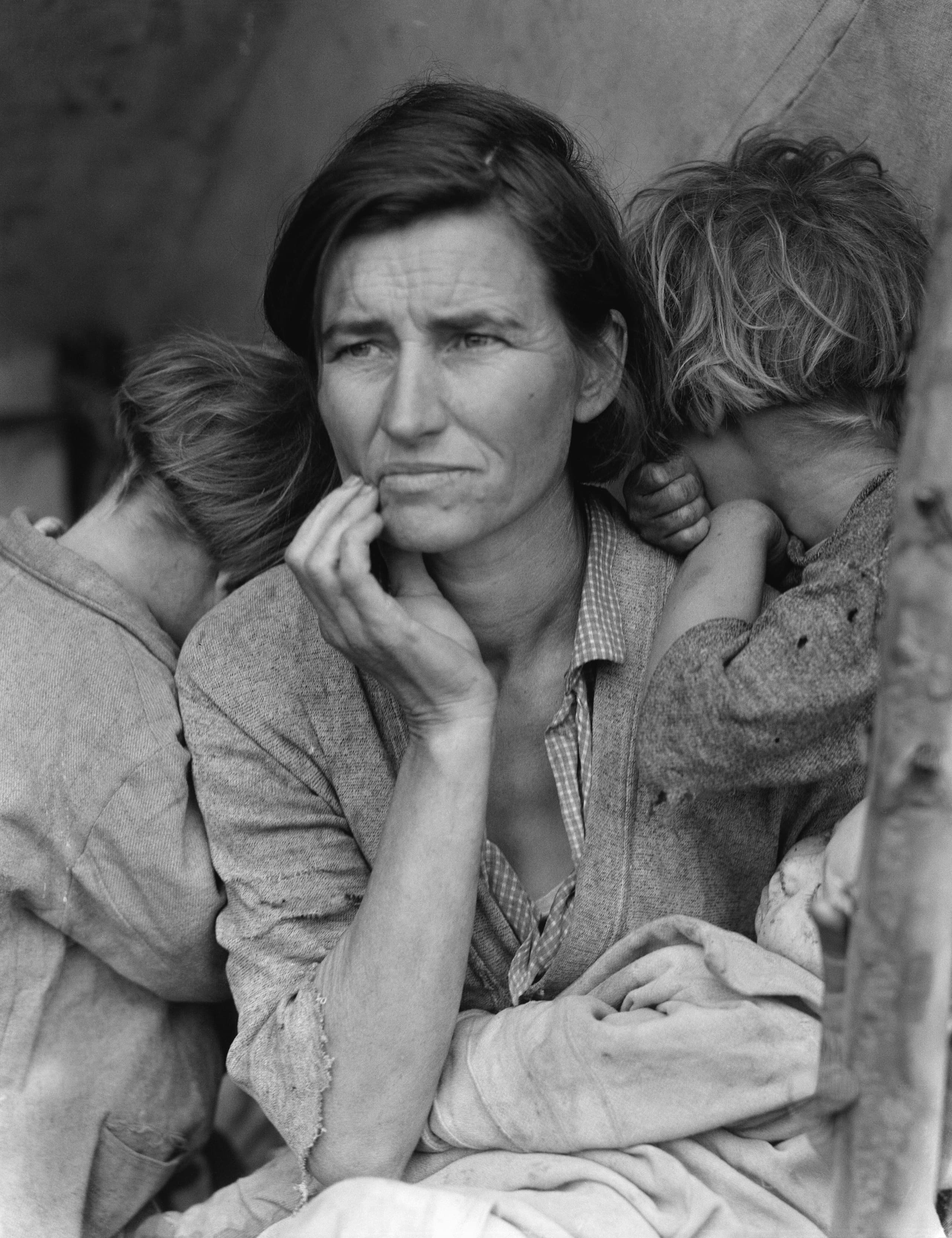
Migrant Mother, Nipomo, California
▶ Listen · narrated
Made for a federal agency documenting rural poverty, this portrait of one mother and her children came to stand for the Depression itself.
At a glance
- Date
- 6 March 1936
- Creator
- Dorothea Lange
- Dimensions
- 5 × 4 cm (2 in)
- Genre
- Portrait photography
- Origin
- United States
- Collections
- MoMA; SFMOMA; Met; FDR Library
Look closer
A gaze that will not meet yours
The mother’s face is turned slightly aside and her eyes look past the camera, into middle distance. One hand is raised to her cheek and mouth. The expression is watchful rather than posed; the photograph holds a pause rather than a performance. That averted attention is what gives the portrait its charge: she is present for the lens and already elsewhere.
Children who hide their faces
Two older children lean in from either side, their heads turned inward against the mother’s shoulders so that only hair and the backs of necks are visible. An infant rests in her lap. The arrangement is tight and asymmetrical. By withholding the children’s faces, the frame concentrates the viewer on the adult’s expression and on the fact of their dependence.
A portrait, not a scene
Although the subject is a migrant family in a temporary camp, the photograph is classed as portrait photography. Background detail is sparse and largely out of contention; clothing, shelter and landscape are secondary. The decision to isolate the group at close range is what allowed a single frame from a relief assignment to travel as an image of a person rather than only as evidence of a place.
The story
In early March 1936 the American photographer Dorothea Lange was working in California for the Resettlement Administration, a federal body later known as the Farm Security Administration. Its brief was to record rural poverty and the movement of people looking for seasonal work during the Great Depression. On 6 March, at a migrant camp in Nipomo, she made a series of exposures of a mother with an infant and two older children. One of those frames became the photograph now known as Migrant Mother, Nipomo, California.
The print is small — five centimetres by four in the dimensions recorded for this entry — and the genre is portrait photography. The mother sits at the centre, a baby in her lap, the two older children pressed close with their faces turned away from the camera. She looks out past the lens, one hand lifted to her face. Nothing in the frame names the place or the economic crisis; the force of the image comes from how tightly it holds four people and how little it explains.
At the time the woman was not identified. Lange’s assignment was to document conditions, not to publish biographies, and the photograph circulated as a type: a migrant mother, a family on the move, proof of need. Prints entered major collections, including the Museum of Modern Art, the San Francisco Museum of Modern Art, the Metropolitan Museum of Art, and the Franklin D. Roosevelt Presidential Library and Museum. Inventory numbers attached to different holdings — among them 331.1995, 71.71.10, 2000.351.1 and NLR-PHOCO-A-65593(65) — mark how widely the image was acquired and kept.
Only in 1978 was the sitter named in public as Florence Owens Thompson, after reporting by a journalist at the California newspaper The Modesto Bee. That late identification changed the ethical weather around the picture without undoing its earlier life. For more than forty years it had stood for a class of experience rather than for one biography. Once a name was attached, viewers could no longer treat the face as purely symbolic, even though the photograph had already done much of its cultural work under anonymity.
The image is now in the public domain and has been endlessly reprinted in educational material, advertisements and other media. It is routinely described as part of the classic canon of American art and of international photography. Those later uses are not a footnote to the original assignment; they are the reason a single frame from a government survey still needs careful looking. The photograph was made to show a problem to people who were not there. It remains useful, and contested, because it did that job too well.
Why it mattered then
In 1936 the Resettlement Administration needed pictures that could make distant hardship legible to officials and to a wider public. Lange’s Nipomo exposures belonged to that documentary programme. A portrait of one mother and her children could travel farther than a table of figures about migrant labour in California. The photograph’s clarity — few props, little background, a face held in tension — suited the practical demand for images that would persuade as well as record. It mattered in its moment because it condensed a large, mobile population of farm workers into a single readable human claim on attention.
Why it matters now
The photograph still matters because it is both evidence and icon, and the two roles chafe. It continues to stand for the Great Depression in classrooms, exhibitions and popular memory, yet the delayed naming of Florence Owens Thompson reminds viewers that symbolic power and personal life are not the same thing. As a public-domain work held across several major museums, it is also a case study in how a government document becomes art history: reproduced, collected, captioned and argued over long after the camp at Nipomo was gone. Looking at it carefully now means holding the federal brief, the private face and the later fame in the same frame.
The surprising detail
For more than forty years the woman in the photograph had no public name. Only in 1978, after work by a journalist for The Modesto Bee, was she identified as Florence Owens Thompson. The image had already become a national symbol while its subject remained, for most viewers, anonymous. That lag is part of the object’s history: fame first, biography later.
What is disputed
Wikidata records the work at 5 × 4 cm (2 in); other widely cited prints are larger gelatin silver enlargements. Different museum holdings are separate prints from the same negative, so dimensions and inventory numbers vary by collection. The familiar story of exactly how Lange entered the Nipomo camp and chose this family is thinner in the surviving record than later retellings suggest.
How it got here
Prints from Lange’s negative are held by the Museum of Modern Art, the San Francisco Museum of Modern Art, the Metropolitan Museum of Art, and the Franklin D. Roosevelt Presidential Library and Museum, among other collections. The photograph was made in the course of federal work for the Resettlement Administration and is in the public domain; it has been widely reproduced beyond museum walls.
Remember this
A federal documentary portrait of one unnamed family became, and remains, a principal image of the American Depression — name attached only decades after the shutter closed.
Test yourself
Why does the late identification of the sitter as Florence Owens Thompson complicate, rather than simply complete, the meaning of Migrant Mother?
Because the photograph did most of its public work as a type, not as a portrait of a known person. For decades it stood for migrant hardship in general; adding a name restores a private life the original brief had no room to carry, and forces a choice about whether we are looking at evidence, symbol, or both. The lesson is that documentary fame can outrun consent and biography, and that recognition after the fact does not erase the years of anonymity — it sits beside them.
Go deeper
Image: Dorothea Lange, Public domain. Licence: Public domain. Source.