I · THE OBJECT · BRITISH MUSEUM
September Morn
▶ Listen · narrated
Paul Émile Chabas painted a young woman standing in morning water. The canvas itself nearly disappeared; the image, uncopyrighted, became a national argument about art and decency.
At a glance
- Date
- 1912
- Artist
- Paul Émile Chabas
- Material
- Oil paint on canvas
- Dimensions
- 163.8 × 216.5 cm (7 ft 1 in)
- Inventory
- 57.89
- Genre
- Genre art
Look closer
One figure, open water
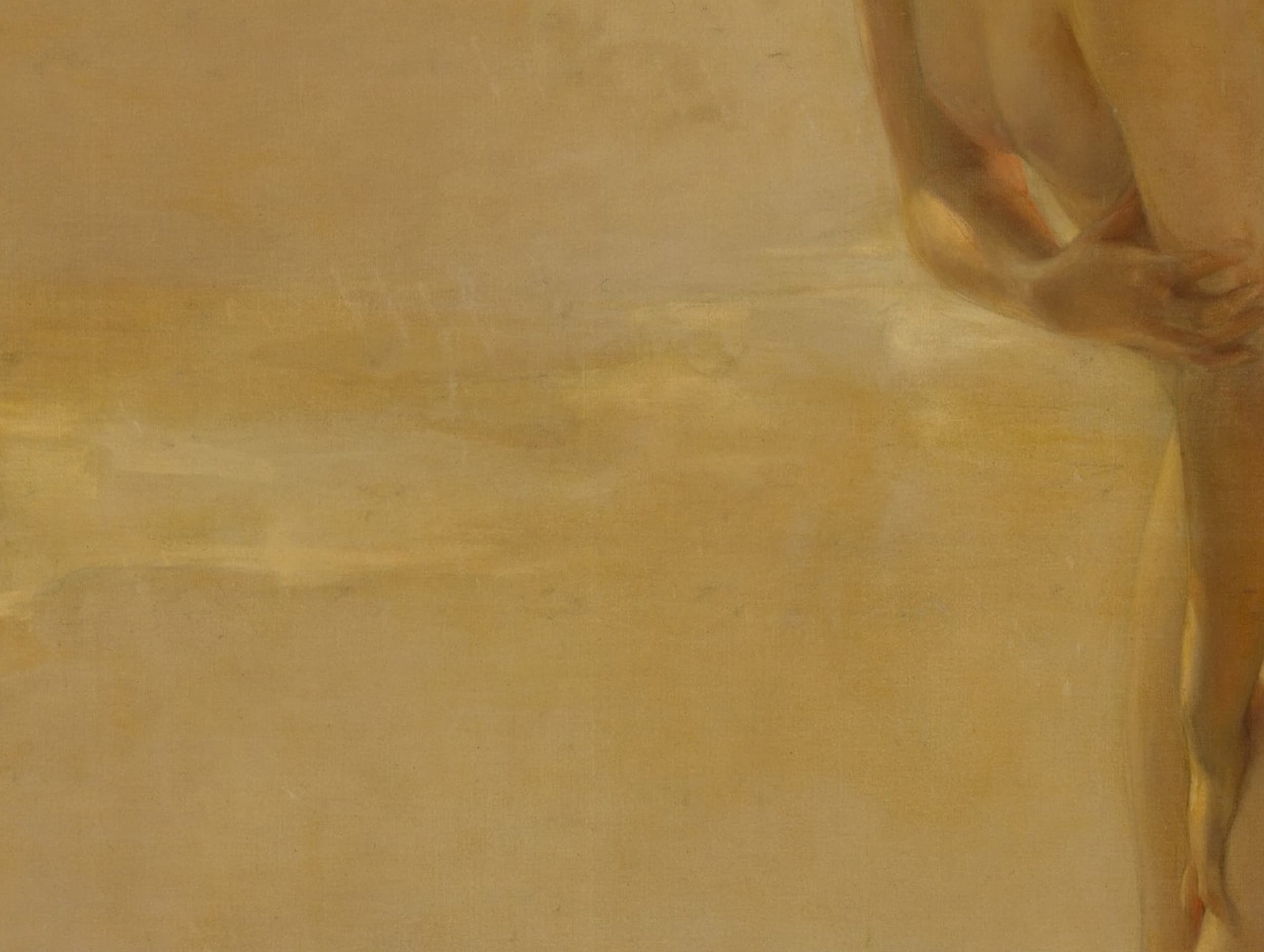
The canvas is wider than it is tall, and almost the whole surface is given to a single nude standing in the shallows of a lake. Morning light falls across her body; the far shore and water take up the rest. There is no narrative clutter — no boat, no companion, no bathhouse — only the figure and the cold brightness of the scene.
The forward lean
She bends slightly at the waist, arms drawn in. The pose has been read as modesty, as a shiver against cold water, and as a private act of washing. None of those readings is settled by the paint alone. The ambiguity is part of what the picture offers, and part of what later made reproductions so easy to attack or to sell.
Scale without spectacle
At roughly 164 by 217 centimetres (7 ft 1 in) the painting is large enough for a Salon wall, yet the handling stays quiet: soft modelling, a limited outdoor palette, no heroic gesture. It presents itself as genre art — a moment from ordinary life — rather than as allegory or myth, which is exactly how it entered public debate once copies left the gallery.
The story
September Morn — Matinée de Septembre — is an oil painting on canvas by the French artist Paul Émile Chabas. The verified date is 1912, the year it was shown at the Paris Salon. It belongs to the Metropolitan Museum of Art in New York, where it is held under inventory number 57.89. The support measures 163.8 centimetres (5 ft 4 in) high by 216.5 centimetres (7 ft 1 in) wide.
The subject is simple to describe and harder to fix in meaning. A nude girl or young woman stands in the shallow water of a lake, lit by morning sun. She leans a little forward. Viewers have taken that lean as a gesture of modesty, as a reaction to cold, or as the posture of someone bathing. Others have read it less charitably, as a pose that invites the viewer while pretending not to. Chabas never settled the point in public, and he never named the model. Several women later claimed the role; none was confirmed by him.
He is said to have worked on the picture across several summers before it reached the Salon. Once exhibited, its early private history is only partly clear. The identity of the first owner is not established. What is certain is that the oil magnate Leon Mantashev had acquired it by the end of 1913. The painting went to Russia. After the October Revolution of 1917 it was feared lost. It reappeared in 1935 in the collection of Calouste Gulbenkian. Following Gulbenkian’s death in 1955 it was sold to a Philadelphia broker, who in 1957 gave it anonymously to the Metropolitan Museum of Art.
While the original moved east, the image moved west in another form. From 1913, reproductions of September Morn caused repeated trouble in the United States. A Chicago dealer was charged with indecency for displaying it. In New York another dealer drew the attention of the anti-vice campaigner Anthony Comstock. Newspapers turned the episode into a running argument about art, censorship, and public morals. The picture was copied onto pins, calendars, and other cheap goods. It prompted songs, stage shows, and films. Some seven million reproductions were sold. Chabas had not copyrighted the work, and he received no royalties from that flood of copies.
He spoke of the painting as “all I know of painting,” and he welcomed the idea that it was his finest picture. Later writers have been cooler, calling it kitsch and valuing it chiefly as a historical object — evidence of what a mass public would buy, defend, or try to suppress. As of 2014 the canvas itself was not on display at the Met. The fame that still attaches to the title belongs less to the quiet surface of the oil than to the long afterlife of its uncopyrighted image.
Why it mattered then
In 1912 the painting entered the ordinary machinery of the Paris Salon: a finished canvas, a French painter, a genre subject. Within a year it had become something else in the United States — a test case for what could be shown in a shop window. The Chicago indecency charge and Comstock’s campaign in New York turned a single lakeside nude into copy for the papers. Editors and readers argued over whether the image was art or offence, and over who had the right to decide. That argument mattered because reproduction technology had already separated the picture from the painting. Pins and calendars carried September Morn far beyond any gallery public. The same qualities that made the composition easy to read — one figure, clear light, no learned allegory — made it easy to print and easy to police. Chabas’s failure to copyright the work shaped the outcome. The market in copies ran without him. The original could travel to Russia and drop from Western sight; the image could not be recalled. For a few years the title stood at the junction of Salon painting, mass print culture, and American vice reform — a junction that neither the artist nor the first owners had designed.
Why it matters now
September Morn still matters less as a triumph of technique than as a document of how images move. It shows how quickly a canvas can lose control of its own likeness once reproduction and commerce take over, and how unevenly reward follows fame when copyright is absent. It also keeps the early twentieth-century American fight over decency in view. The Chicago charge and the Comstock episode are specific; the underlying dispute — who polices the nude, and on what grounds — has not disappeared. Looking at the painting’s reception is a way to watch moral panic, free-speech rhetoric, and the art market share the same object without agreeing on what it is. Later dismissals of the work as kitsch are part of the story rather than the last word on it. Even if the oil is valued mainly as artefact, the artefact records a moment when a French genre picture became American popular culture. That passage, from Salon wall to calendar and courtroom, remains a useful measure of how public taste and public regulation invent each other.
The surprising detail
Roughly seven million reproductions of September Morn were sold, yet Chabas earned nothing from them. He had never copyrighted the painting. The original could be feared lost in revolutionary Russia and still the image kept circulating on pins and calendars in the United States — a split between canvas and copy that the artist had not planned and could not reverse.
What is disputed
The identity of the painting’s first owner is unclear; Leon Mantashev’s acquisition by the end of 1913 is the first ownership that can be stated with confidence. Chabas never named the model, though several women later claimed to have posed. Readings of her forward lean — modesty, cold, bathing, or something more calculated — remain interpretive, not settled by the artist. Contemporary accounts of the American seizures and complaints also differ in emphasis, as vice campaigns and newspaper retellings often do.
How it got here
By the end of 1913 the painting belonged to Leon Mantashev and was taken to Russia; after the October Revolution of 1917 it was feared lost. It resurfaced in 1935 in the collection of Calouste Gulbenkian. After Gulbenkian’s death in 1955 it was sold to a Philadelphia broker, who donated it anonymously to the Metropolitan Museum of Art in 1957, where it is inventoried as 57.89. As of 2014 it was not on display.
Remember this
A quiet Salon nude became an American mass image; without copyright, its painter watched millions of copies enrich everyone but him.
Test yourself
The original canvas vanished from Western view for years after 1917, yet September Morn remained famous in the United States. What does that split tell us about where the painting’s public power actually sat?
It sat with the uncopyrighted image, not with the unique oil. Once cheap reproductions were already in shops, newspapers, and private homes, the whereabouts of the Salon canvas no longer controlled the argument. Indecency charges, calendar sales, songs, and films could all proceed from the copy. The lesson is structural: when a work’s likeness is free to multiply, fame and controversy attach to the circulating picture, and the original becomes only one object among millions of impressions — easy to lose track of, and no longer required for the culture around it to keep going.
Go deeper
Image: Paul Émile Chabas, Public domain. Licence: Public domain. Source.