II · THE DISCOVERY · HISTORY OF SCIENCE
Sulfur
Sulfur was never hidden. The question Lavoisier answered was whether this yellow, reeking substance was itself elemental, or a compound of simpler things.
At a glance
- Chemical symbol
- S
- Atomic number
- 16
- Recognised as element
- 1777
- Credited to
- Antoine Lavoisier
- Type
- Chemical element; chalcophile element
Look closer
Discovery means classification here
The 1777 date is not when someone found sulfur — people had been mining and burning it for millennia. What Lavoisier established was that sulfur is an element, meaning it cannot be decomposed into simpler substances by chemical means. Before that classification, sulfur was a known material but its place in the structure of matter was unsettled.
Bright yellow at room temperature
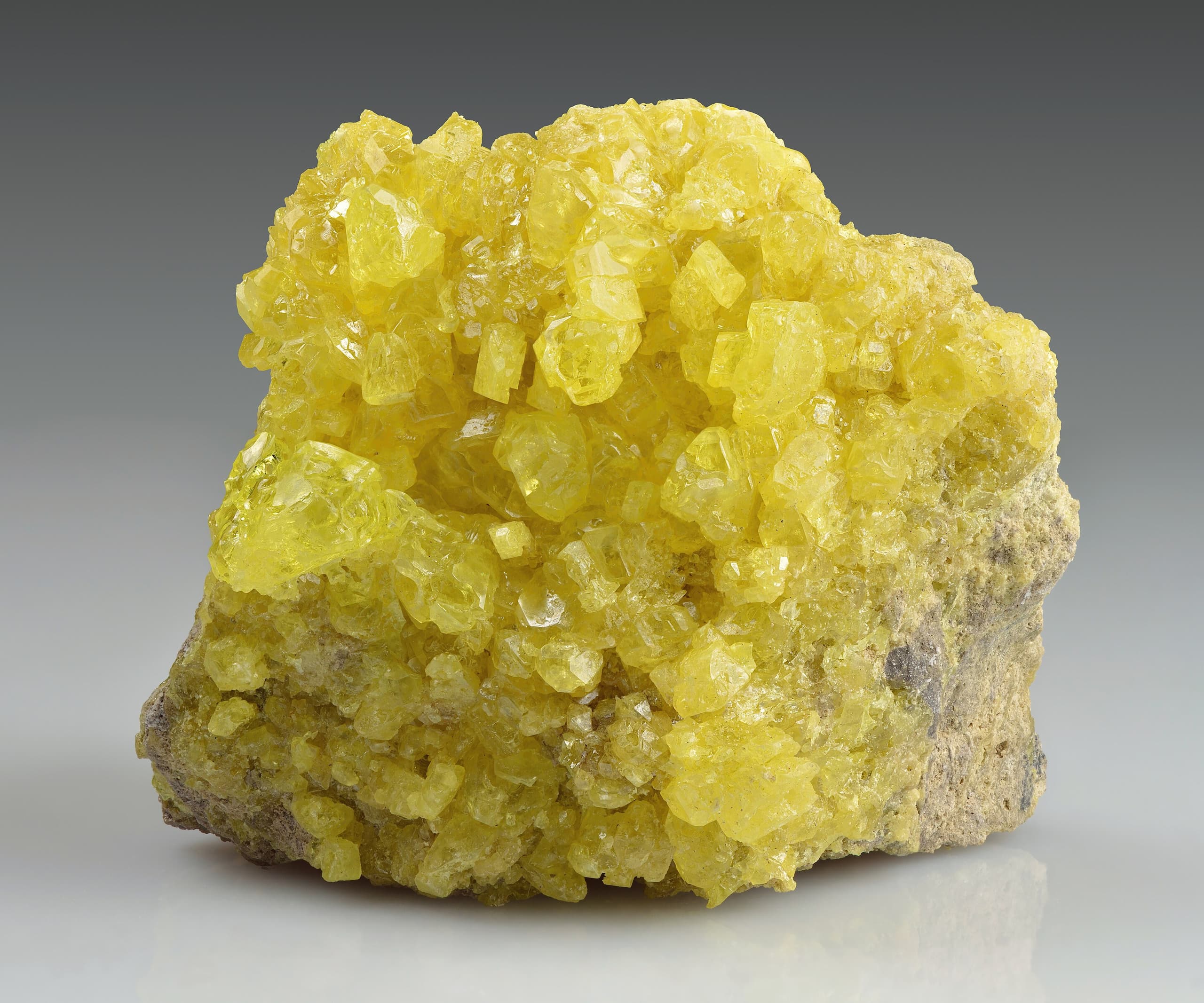
Elemental sulfur is a bright yellow crystalline solid under normal conditions. That colour made it conspicuous in nature and easy to recognise, which is why it appears in ancient texts from India, Greece, China and Egypt. The yellow crystals form when sulfur atoms link into rings of eight, written chemically as S₈.
Chalcophile means ore-forming
Sulfur is classed as a chalcophile element, meaning it bonds readily with metals to form sulfide minerals. That behaviour explains why sulfur on Earth usually occurs not as pure yellow crystals but combined with copper, iron, lead and zinc in ores. The term comes from the Greek for copper, because sulfur and copper are often found together.
The story
Sulfur was never a rare or hidden substance. It occurred as bright yellow crystals near volcanic vents, burned with a blue flame and a choking smell, and turned up in metal ores across the ancient world. Texts from India, Greece, China and Egypt all mention it, often under names that translate as burning stone or brimstone. What was unclear was not whether sulfur existed, but what it was made of.
In 1777, Antoine Lavoisier classified sulfur as an element. That designation meant something specific in the emerging language of chemistry: sulfur could not be broken down into simpler substances by any known chemical process. It was a building block, not a compound. Lavoisier's insight was part of a broader programme to sort materials into elements and compounds, replacing older theories that treated fire, earth, air and water as fundamental.
Sulfur atoms, when isolated, link together into rings of eight, written as S₈. Those octatomic rings pack into bright yellow crystals at room temperature. The material is nonmetallic and multivalent, meaning sulfur atoms can form different numbers of bonds with other elements depending on conditions. That flexibility explains why sulfur appears in so many compounds, from the sulfides in metal ores to the sulfates in fertilisers.
On Earth, sulfur is common. Though sometimes found in pure form, it more often occurs combined with metals as sulfide minerals or with oxygen as sulfates. In the universe as a whole, sulfur is formed in the cores of massive stars and scattered by supernovae.
Today, almost all elemental sulfur is produced not by mining but as a byproduct of cleaning natural gas and petroleum. Fossil fuels contain sulfur compounds that must be removed before burning, and that removal process yields pure sulfur. Much of the sulfur produced goes into making sulfuric acid, which in turn is used to produce fertilisers and in other industrial processes. Sulfur also goes into matches, insecticides and fungicides.
Many sulfur compounds are odoriferous. The smell of odorised natural gas, skunk spray, bad breath, grapefruit and garlic all come from organosulfur compounds — molecules where sulfur is bonded to carbon. Hydrogen sulfide, which smells of rotting eggs, is produced by biological decay.
Sulfur is essential for all life. Two of the amino acids that build proteins — cysteine and methionine — contain sulfur, as do many other biological molecules including the vitamins biotin and thiamine. Sulfur also appears in cofactors such as glutathione and in iron–sulfur proteins. The disulfide bonds between sulfur atoms give mechanical strength to keratin, the protein in hair, feathers and outer skin. Living organisms require sulfur as an elemental macronutrient, meaning they need it in relatively large amounts for biochemical functioning.
Why it mattered then
Before Lavoisier's classification, sulfur was a known material but its status was ambiguous. Alchemists and early chemists debated whether it was a fundamental substance or a mixture of simpler things. Lavoisier's work in the late eighteenth century established a new framework: elements were substances that could not be decomposed further, and sulfur met that test. That clarity mattered because it allowed chemists to map out how sulfur combined with other elements. Once sulfur was recognised as elemental, its compounds — sulfides, sulfates, sulfites — could be understood as combinations of sulfur with metals or with oxygen, rather than as mysterious transformations of an unclear starting material. The classification made the behaviour of sulfur predictable and its chemistry teachable. The immediate practical consequence was modest, because people had been using sulfur for centuries without needing to know its elemental status. What changed was the conceptual structure within which that use was understood. Sulfur became a reference point in the new chemistry, a substance whose reactions could be studied systematically and whose place in the table of elements was fixed.
Why it matters now
Sulfur underpins modern agriculture. Sulfuric acid, made from sulfur, is used to produce phosphate and sulfate fertilisers that supply the nutrients crops need. Without sulfur chemistry, the scale of contemporary food production would not be possible. Almost all the elemental sulfur used for this purpose is recovered from natural gas and petroleum, meaning sulfur supply is tied to fossil fuel extraction. Sulfur is also essential to all living organisms. The two sulfur-containing amino acids, cysteine and methionine, cannot be replaced by anything else in the proteins they help build. The disulfide bonds that sulfur atoms form give structural strength to hair, feathers, skin and other tissues. Sulfur appears in vitamins, in cofactors that drive metabolic reactions, and in iron–sulfur clusters that transfer electrons in cells. The element's role in biology means that sulfur must be present in any environment that supports life, and it must be available in a form organisms can incorporate. On Earth, sulfur cycles through rocks, water, air and living tissue, moving between sulfides, sulfates and organic forms. Understanding that cycle matters for agriculture, for managing pollution, and for thinking about where else in the universe life might exist.
The surprising detail
Sulfur is called brimstone in older texts, a name that means burning stone. The term appears in religious and literary writing to describe divine punishment or hellfire, drawing on sulfur's association with volcanic vents and its choking smell when burned. That symbolic use lasted long after chemists had classified sulfur as an element and mapped its compounds. The yellow crystals and the blue flame were vivid enough to carry meaning beyond their chemistry, even as the chemistry itself became precise.
What is disputed
The 1777 date for Lavoisier's recognition of sulfur as an element is given in Wikidata, but the exact publication or experiment that date refers to is not specified in the material supplied. Lavoisier's work classifying elements was part of a longer programme in the 1770s and 1780s, so the date may mark a publication rather than a single moment of insight.
Remember this
Lavoisier's contribution was recognising that sulfur could not be broken down further — it was elemental, not compound.
Test yourself
Sulfur was used in ancient India, Greece, China and Egypt, yet Lavoisier is credited with its discovery in 1777. What did Lavoisier actually establish?
Lavoisier established that sulfur is a chemical element — a substance that cannot be decomposed into simpler materials by any chemical process. Before that classification, sulfur was known and used, but its status was unclear. Some thought it might be a compound of other substances. Lavoisier's work in the late eighteenth century created a framework for sorting materials into elements and compounds, and sulfur was one of the substances he classified as elemental. The discovery was not of the material itself, but of its place in the structure of matter.
Go deeper
Image: Ivar Leidus, CC BY-SA 4.0. Licence: CC BY-SA 4.0. Source.