III · THE WORK · ART HISTORY
Belshazzar's Feast
▶ Listen · narrated
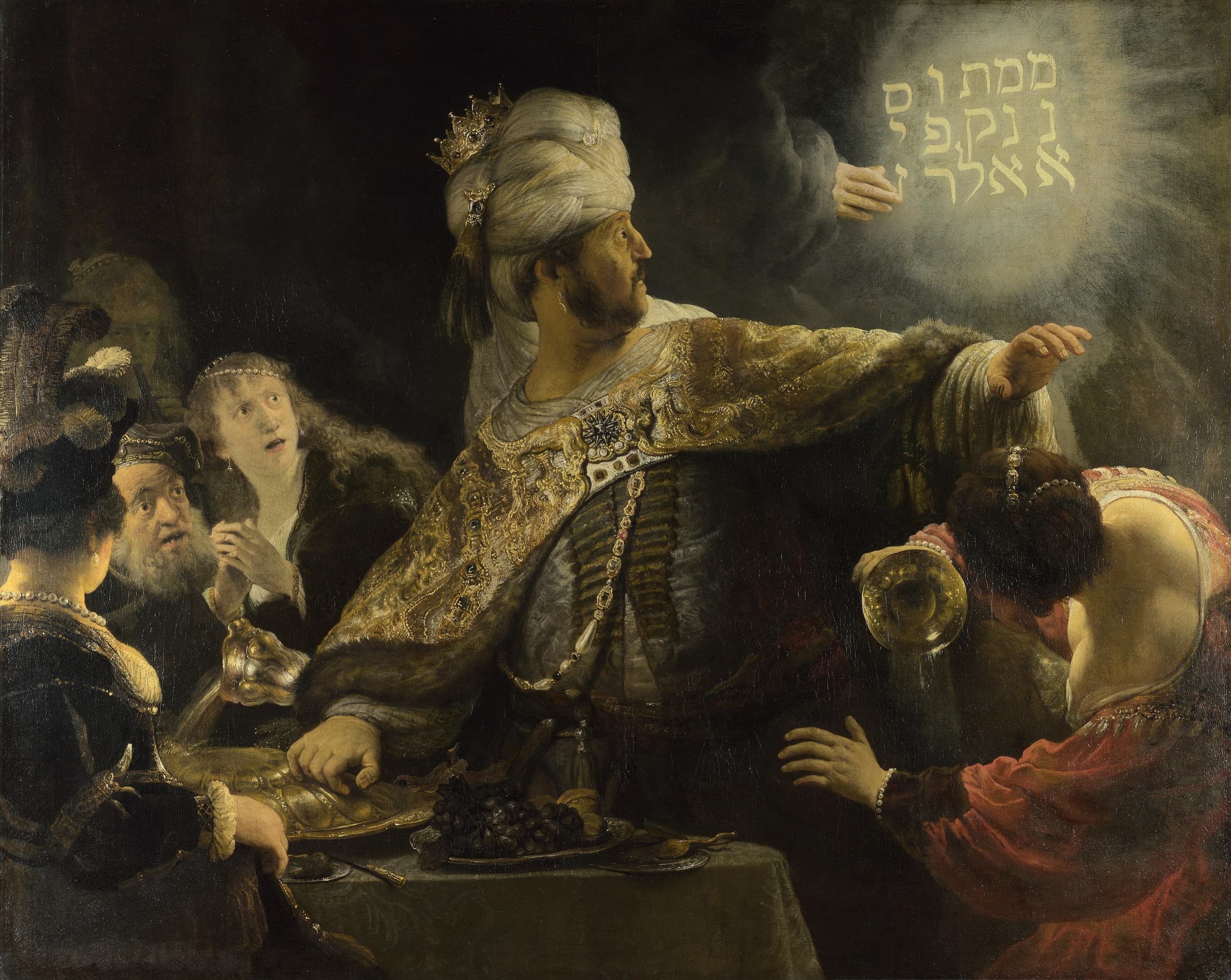
The subject is a single second from the Book of Daniel: the moment judgment becomes visible. Rembrandt builds the whole picture around a few glowing characters and a body in shock.
At a glance
- Artist
- Rembrandt
- Date
- 1636
- Medium
- Oil paint on canvas
- Size
- 167.6 × 209.2 cm (6 ft 10 in)
- Collection
- National Gallery, London
- Inventory
- NG6350
Look closer
The king's turn
Belshazzar fills the centre of the canvas, not as a still profile but as a body caught mid-reaction. His torso twists one way, his head the other; one hand flies up, the other steadies a goblet that has already begun to tip. The face is lit from the direction of the wall, so the features read as alarm before the gesture fully settles. Everything else in the room is arranged around this pivot.
Light that writes
The brightest area is not a window or a lamp but the inscription itself, high on the wall to the right. Characters appear as if drawn in pale fire, and that light falls back across faces, sleeves and metal. Rembrandt makes the divine message the principal light source in the scene, so the theology of the story becomes the optical logic of the painting.
Plate under pressure
Along the table sit heavy gold and silver vessels — dishes, a tall covered cup, a wide basin — crowded into the lower half of the picture. They catch the same cold light as the writing. In the narrative these are the sacred vessels taken from the Temple in Jerusalem and put to ordinary use at the feast; here they sit as solid, reflective objects, almost too present, while the human figures around them flinch and scatter.
The story
Belshazzar's Feast shows a story from the Book of Daniel at the exact point where the banquet fails. The Babylonian king has been drinking with his court when a hand appears and writes on the palace wall. The words announce judgment; the kingdom will fall. Rembrandt does not illustrate the aftermath or the interpretation. He holds the first second of recognition, when the writing is still new and no one yet knows what it means.
The canvas is wide — just over two metres across — and the composition runs left to right like a broken procession. Figures cluster at the table; colour and shine gather on Belshazzar's cloak and turban; beyond him the wall opens into darkness broken only by the glowing script. Guests lean away. A woman in rich dress turns so sharply that the eye follows the line of her shoulder before it finds her face. The space feels shallow and loud, packed with fabric, metal and sudden movement rather than calm architectural depth.
As religious art of the Dutch Golden Age, the picture belongs to a tradition of history painting that treated biblical narrative as a stage for human drama. Rembrandt paints the sacred event as something that happens to bodies in a room: a wrist jerked back, wine about to spill, eyes catching an unnatural light. The moral weight of the story is carried by those physical facts. You do not need the full text of Daniel to see that authority has been interrupted.
The making is oil on canvas, worked so that bright passages — the inscription, the king's jewellery, the polished vessels — sit against broader, quieter darks. Faces nearest the writing are modelled with that light; faces further off fall toward shadow. Nothing in the supplied record tells us the precise sequence of layers or changes, but the finished surface still reads as a single concentrated event rather than a steady ceremonial scene.
What the painting withholds is almost as clear as what it shows. There is no calm explanatory figure pointing at the wall for our benefit. The viewer stands where a guest might stand, close enough to feel the jolt, not far enough away to master the whole room. The feast is still laid; the judgment has only just begun to be legible.
Why it mattered then
In the mid-1630s Rembrandt was working within Dutch Golden Age painting at a moment when large religious and historical subjects still carried ambition. A canvas of this width, filled with a court at crisis, was a claim on the serious end of the market: not a small devotional panel, not a quiet genre interior, but a public-scale drama drawn from scripture. Belshazzar's story suited that aim. It offered costume, metalwork, a royal central figure and a supernatural interruption that could be staged with light rather than with a crowd of angels. For a painter establishing a reputation in history subjects, the feast was a chance to show that biblical narrative could be made urgent, physical and optically coherent in oil.
Why it matters now
The painting remains in the National Gallery in London, where its size and abrupt light still stop a casual walk through the rooms. Close looking rewards patience: the tipped goblet, the direction of every gaze, the way the inscription both blinds and illuminates. It also remains a clear example of how a religious subject can be told almost entirely through human reaction. Viewers who know the Book of Daniel and those who do not meet on the same ground — a room full of people who have just seen something they cannot yet explain. That shared second of incomprehension is still legible on the surface.
The surprising detail
The picture is catalogued under the plain inventory number NG6350, a bureaucratic label for an image of royal panic. Its measured dimensions — 167.6 centimetres (5 ft 6 in) high by 209.2 wide — fix on paper a scene that is all imbalance: a king off-axis, a drink half-lost, light arriving from words rather than from any lamp the guests could have lit themselves.
What is disputed
Wikidata records the inception as 1636, and that date is used here. Broader accounts often place the work more loosely between the mid and late 1630s; the precise year is not settled beyond that clustering.
Remember this
Rembrandt turns a biblical judgment into a problem of light and bodies: the writing shines, and the feast falls apart around it.
Test yourself
Why does making the inscription the main light source change how we read the story, beyond simply making the Hebrew letters visible?
Because it forces every human reaction in the room to be lit by the very thing that condemns the king. Faces, sleeves and gold plate do not glow from a neutral lamp; they take their visibility from the divine writing. The optical structure of the painting and the moral structure of the narrative become the same fact: judgment is what allows us to see the feast at all.
Go deeper
Image: Rembrandt, Public domain. Licence: Public domain. Source.