II · THE DISCOVERY · HISTORY OF SCIENCE
Nitrogen
You are breathing nitrogen right now — more of it than oxygen. Yet the body ignores it entirely, and for well over a century no one knew what to do with it.
At a glance
- Discovered
- 1772, in the United Kingdom
- Discoverer
- Daniel Rutherford, a Scottish physician
- Symbol
- N, atomic number 7
- Named after
- Nitre and the concept of life
Look closer
The gas that does nothing
Nitrogen makes up roughly 78 per cent of the air we breathe, yet it passes through the lungs without reacting. Rutherford's isolation method worked precisely because nitrogen is inert under ordinary conditions: he removed oxygen by letting things burn and rust in a closed container, removed carbon dioxide by absorbing it in a solution, and what remained was a gas in which nothing would burn and nothing would live. That unreactive quality is what makes it useful for flushing oxygen out of food packaging today.
Two names, two ideas
The name nitrogen — meaning 'nitre-former' — came from the French chemist Jean-Antoine-Claude Chaptal in 1790, after nitrogen was found in nitric acid and nitrates. Antoine Lavoisier preferred azote, from the Greek for 'no life', because the gas is an asphyxiant: it will not support breathing. English adopted nitrogen, but azote survives in other languages and in English words like hydrazine and azides, where the 'az' still points to nitrogen.
The bond that resists
Two nitrogen atoms bond to form N₂, the diatomic molecule that floats in air. That bond is a triple bond — three pairs of electrons shared between the atoms — and it is extremely strong. Breaking it requires significant energy, which is why converting atmospheric nitrogen into compounds organisms or factories can use is difficult. But the same strength means that when nitrogen compounds decompose back into N₂, they release large amounts of energy, which is why so many explosives contain nitrogen.
The story
In 1772, Daniel Rutherford, a Scottish physician, isolated nitrogen by a process of elimination. He placed a mouse in a sealed container until it died, then burned a candle in the same air until it went out. Both processes consumed oxygen and produced carbon dioxide. He absorbed the carbon dioxide in a solution, and what remained was a gas that would support neither breathing nor burning. Rutherford had separated nitrogen from the rest of the air.
Nitrogen is a nonmetal, the lightest member of group 15 of the periodic table. At ordinary temperature and pressure, two nitrogen atoms bond to form N₂, a colourless, odourless gas. That gas is the most abundant chemical species in Earth's atmosphere. The bond holding N₂ together is a triple bond, one of the strongest bonds between any two atoms in a molecule, and that strength shapes much of nitrogen's chemistry.
Because the bond is so strong, nitrogen gas is chemically inert under ordinary conditions. It does not react with most substances at room temperature. This makes it abundant in the atmosphere but relatively rare in the solid parts of the Earth, where compounds form more readily. The same inertness makes nitrogen compounds volatile — they break down easily — so nitrogen cycles between the air, living organisms, and the ground rather than accumulating in rock.
Nitrogen occurs in all living organisms. It is a constituent of amino acids, which form proteins, and of nucleic acids — DNA and RNA — which carry genetic information. It appears in adenosine triphosphate, the molecule that transfers energy within cells. The human body is roughly 3 per cent nitrogen by mass. Yet the body cannot use nitrogen directly from the air. The strong triple bond in N₂ must be broken and the nitrogen converted into compounds like ammonia before organisms can incorporate it into proteins and other molecules.
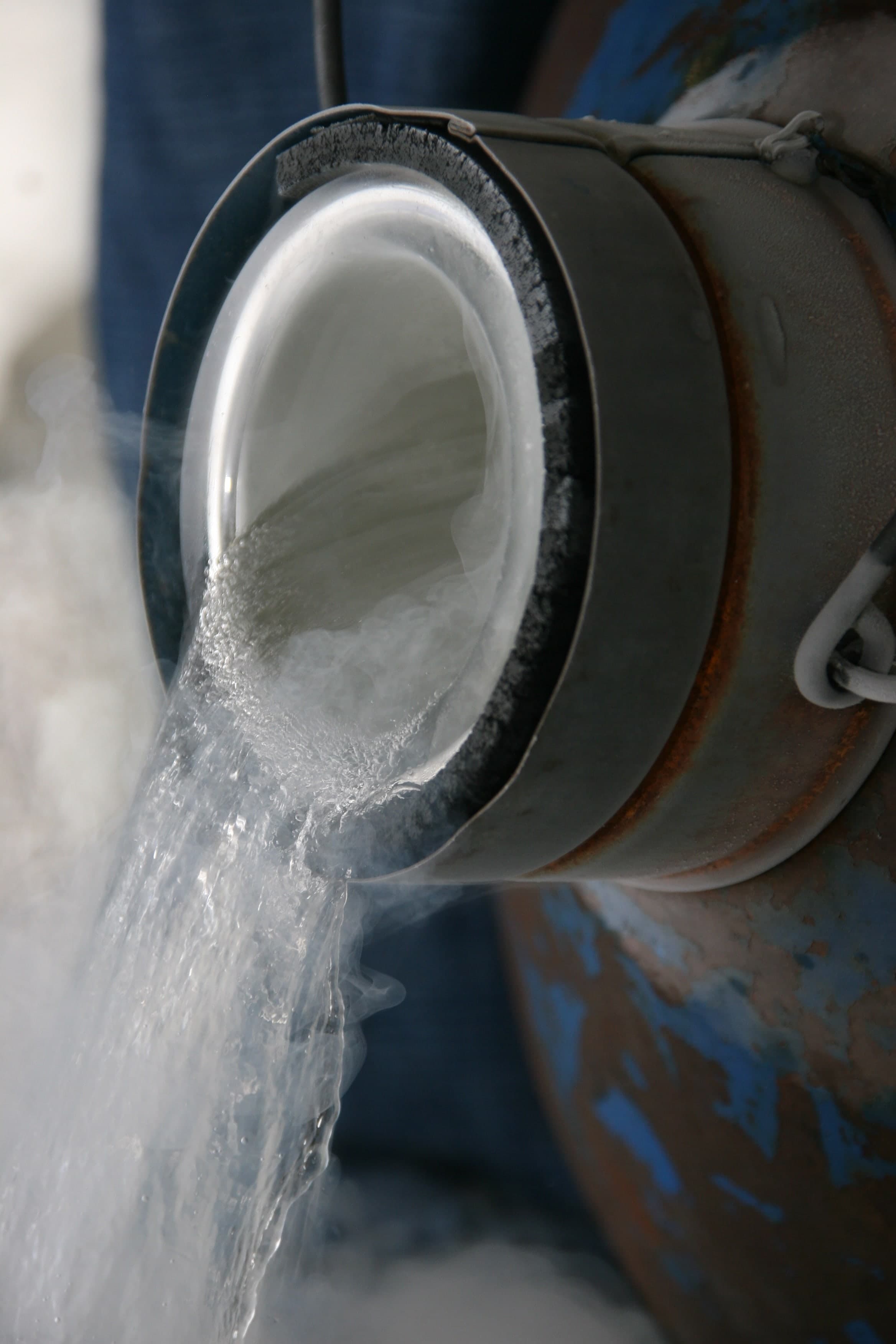
Industrially, breaking that bond is difficult. Much of the elemental nitrogen produced commercially is used without breaking it at all: as an inert gas for food packaging, or as liquid nitrogen for cryogenic applications, where its coldness is the useful property rather than its chemistry. When nitrogen is converted into compounds, the products include ammonia, nitric acid, and organic nitrates used as propellants and explosives. The energy required to break the bond is stored in these compounds, and when they decompose back into nitrogen gas, that energy is released.
Nitrogen fertilisers — synthetically produced ammonia and nitrates — are key to modern agriculture, though the runoff from those fertilisers is a major pollutant in water systems, causing eutrophication. Nitrogen also appears in high-strength fabrics like aramids and in cyanoacrylate, the adhesive in superglue. It is a constituent of every major class of pharmaceutical drug, including antibiotics, and many drugs mimic natural nitrogen-containing molecules: organic nitrates like nitroglycerin control blood pressure by breaking down into nitric oxide, and stimulants like caffeine and amphetamines act on receptors for nitrogen-containing neurotransmitters.
Why it mattered then
Before 1772, air was understood as a single substance or a mixture of ill-defined components. Rutherford's isolation of nitrogen demonstrated that air was a mixture of distinct gases with different properties. Nitrogen would not support combustion or breathing, unlike the oxygen that others were investigating at roughly the same time. The discovery contributed to the dismantling of the phlogiston theory — the idea that combustion released a substance called phlogiston — and to the construction of modern chemistry, in which elements combine and separate according to measurable rules. Lavoisier's alternative name, azote, reflected the immediate practical observation: this was the part of air that suffocated.
Why it matters now
Nitrogen is central to two of the most pressing concerns of industrial society: feeding people and managing pollution. The Haber-Bosch process, developed in the early twentieth century, converts atmospheric nitrogen into ammonia, which is then used to make fertilisers. Those fertilisers support roughly half the world's food production, but the nitrogen that runs off fields into rivers and seas causes algal blooms and dead zones. Nitrogen is also a constituent of every major class of drug, from antibiotics to blood pressure medications to stimulants, and it appears in explosives, plastics, and high-strength materials. The inert gas Rutherford isolated is chemically passive, but the compounds it forms are anything but.
The surprising detail
Nitrogen makes up more than three-quarters of the air, yet it took until 1772 for anyone to isolate it, and for well over a century after that no one knew how to convert it from the air into compounds on an industrial scale. The problem was the triple bond: strong enough to make nitrogen gas stable and unreactive, but difficult enough to break that living organisms rely on bacteria to do it, and factories required high temperatures and pressures before the Haber-Bosch process made ammonia synthesis practical. The most abundant gas in the atmosphere was chemically out of reach.
What is disputed
The reference material states that nitrogen was discovered independently by Carl Wilhelm Scheele and Henry Cavendish at about the same time as Rutherford, but the verified facts from Wikidata credit only Daniel Rutherford. The encyclopaedia article and the database are not in agreement on whether the discovery should be attributed to one person or several. This lesson follows the verified facts, which name Rutherford alone.
Remember this
Nitrogen is everywhere in the air, yet chemically inert. Breaking its bond to make useful compounds took another century and a half.
Test yourself
Nitrogen is the most abundant gas in the atmosphere and a constituent of all living organisms, yet Rutherford's method of isolating it in 1772 was to remove everything that would react. Why was nitrogen so hard to use?
The two nitrogen atoms in N₂ are held together by a triple bond, one of the strongest bonds in any molecule. That strength makes nitrogen gas chemically inert under ordinary conditions: it will not burn, will not support breathing, and will not react with most substances at room temperature. Organisms cannot use nitrogen directly from the air; they rely on bacteria to break the bond and convert nitrogen into ammonia and other compounds. Industrially, breaking the bond required high temperatures and pressures, and it was not until the early twentieth century that the Haber-Bosch process made it possible to convert atmospheric nitrogen into ammonia on a large scale. The gas was abundant, but chemically locked.
Go deeper
Image: Robin Müller. Licence: CC BY-SA 3.0. Source.