II · THE DISCOVERY · HISTORY OF SCIENCE
Lithium
The element named for stone is a metal lighter than water, reactive enough to need sealed storage, and essential to the rechargeable batteries in billions of devices.
At a glance
- Discovered
- 1817, in Sweden
- Discoverer
- Johan August Arfwedson
- Named after
- Stone (Ancient Greek: λίθος, líthos)
- Atomic number
- 3
- Found in minerals
- Lithiophilite, amblygonite, hectorite, jadarite
Look closer
It is named for stone but does not occur as pure metal
The name comes from the Ancient Greek word for stone, líthos, because Arfwedson found it while analysing a mineral. Yet lithium metal does not exist freely in nature. It is too reactive: it corrodes quickly in air and must be stored under oil or in an inert atmosphere. What occurs naturally are lithium-bearing minerals — lithiophilite, amblygonite, hectorite, jadarite — and lithium dissolved as ions in seawater and brines. The metal itself is isolated by passing electricity through a molten mixture of lithium chloride and potassium chloride.
It is the lightest metal and the lightest solid element
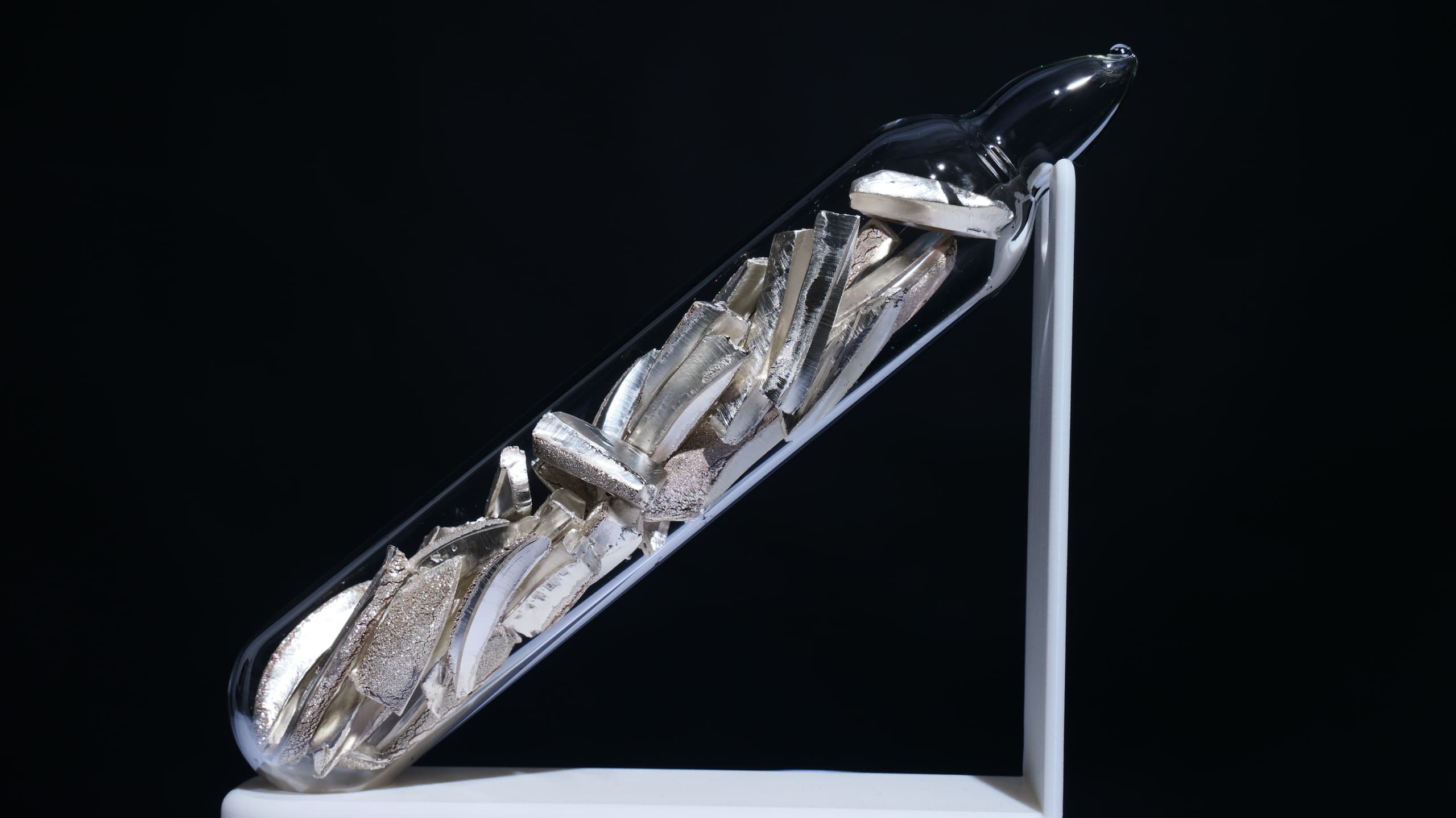
Lithium is a silvery-white metal when freshly cut, and soft enough to be shaped by hand. It is the least dense of all metals and the least dense solid element under ordinary conditions. That lightness is part of what makes it useful in batteries: a lithium-ion cell can store substantial energy for its weight.
Its nucleus is unusually unstable for a light element
The two stable isotopes of lithium that occur in nature have low binding energies per nucleon — a measure of how tightly the nucleus holds together. That relative instability means lithium is less common in the Solar System than many heavier elements, despite having a very light nucleus. The same nuclear properties made lithium useful in early nuclear physics: in 1932, lithium atoms were transmuted to helium in a controlled laboratory reaction.
The story
Johan August Arfwedson discovered lithium in 1817 while analysing a mineral sample in Sweden. He identified a new element, but did not isolate the pure metal. That came later, once chemists worked out how to extract it by electrolysis — passing an electric current through molten lithium chloride mixed with potassium chloride.
Lithium is a chemical element with the symbol Li and atomic number 3. It is a soft, silvery-white alkali metal, and the lightest of all metals. Under ordinary conditions it is also the least dense solid element. When freshly cut, it has a metallic shine, but it corrodes quickly in air to a dull grey and then black. Because it is so reactive, it must be stored under oil or in a sealed container filled with an inert gas.
The element does not occur freely in nature. Instead, it is found in minerals such as lithiophilite, amblygonite, hectorite and jadarite, which were once the main sources. Today, much of the lithium used commercially is obtained from brines — salty water where lithium is dissolved as ions. Ocean water contains lithium too, though in lower concentrations.
The name comes from the Ancient Greek word for stone, líthos, reflecting the fact that Arfwedson found it in a mineral. That origin is slightly ironic: lithium metal is light enough to float on water, and reactive enough that it cannot exist as a free metal in the natural environment.
Like all alkali metals, lithium reacts vigorously with water and is flammable. Its atomic nucleus has an unusual property: the two stable isotopes of lithium found in nature have low binding energies per nucleon. That means the nucleus holds together less tightly than you would expect for such a light element. This relative instability makes lithium less common in the Solar System than many heavier elements, despite its low atomic number. The same nuclear properties made lithium useful in early nuclear physics: in 1932, lithium atoms were transmuted to helium in a controlled laboratory reaction.
Why it mattered then
Before 1817, no one knew lithium existed. Arfwedson's discovery added a new element to the periodic table and gave chemists another piece of the puzzle of what matter is made from. The element itself was difficult to work with — reactive, hard to isolate in pure form, and not obviously useful in the decades immediately after its discovery. But it was light, it was an alkali metal like sodium and potassium, and its behaviour helped chemists understand the patterns that would eventually be organised into the periodic table. The nuclear properties of lithium were not understood until much later, but when nuclear physics developed in the twentieth century, lithium became important for experiments: in 1932, lithium was transmuted to helium in a controlled laboratory reaction, a demonstration that one element could be changed into another in a controlled way.
Why it matters now
Lithium is now essential to the rechargeable batteries that power billions of devices. Lithium-ion batteries can store substantial energy for their weight, which is why they are used in phones, laptops, electric vehicles and grid storage. Batteries alone consume more than three-quarters of lithium production. The element also has uses in heat-resistant glass and ceramics, in lubricants, and as a flux additive in the production of iron, steel and aluminium. Lithium compounds are present in biological systems in trace amounts, and lithium-based drugs are used as mood stabilisers in the treatment of bipolar disorder. The element Arfwedson found in a Swedish mineral sample is now part of the infrastructure of modern life, though most people never see the metal itself: it is always locked inside a battery, a compound, or a sealed container.
The surprising detail
Lithium is less common in the Solar System than many heavier elements, despite being the third-lightest element. The reason is nuclear: the two stable isotopes of lithium have low binding energies, meaning their nuclei hold together less tightly than you would expect for such a light element. This makes lithium nuclei relatively fragile, and less likely to survive the conditions inside stars and in the early universe. Heavier elements with tighter nuclei can be more abundant.
What is disputed
The verified facts record the discovery date as 1817 and the location as Sweden, but do not specify where in Sweden the mineral sample was analysed or where it was originally found.
Remember this
The lightest metal, named for stone, now powers rechargeable batteries worldwide.
Test yourself
Lithium is named after the Greek word for stone, yet the pure metal does not occur in nature. Why not?
Lithium metal is too reactive to exist freely in the natural environment. It corrodes quickly in air and reacts vigorously with water, so it must be stored under oil or in an inert atmosphere. What occurs naturally are lithium-bearing minerals — lithiophilite, amblygonite, hectorite, jadarite — and lithium dissolved as ions in seawater and brines. The pure metal is isolated by electrolysis, passing an electric current through molten lithium chloride mixed with potassium chloride. Arfwedson discovered the element by analysing a mineral, which is why he named it for stone, but he did not isolate the metal itself.
Go deeper
Image: AdvancedTinkering, CC BY-SA 4.0. Licence: CC BY-SA 4.0. Source.