III · THE WORK · ART HISTORY
Sacred and Profane Love
▶ Listen · narrated
The coat of arms points to a marriage. The title points to a moral contrast. Neither settles who the two seated women are meant to be.
At a glance
- Artist
- Titian
- Date
- 1514
- Medium
- Oil on canvas
- Dimensions
- 118 × 279 cm (9 ft 2 in)
- Collection
- Galleria Borghese
- Genre
- Allegory
Look closer
Two women, not one subject
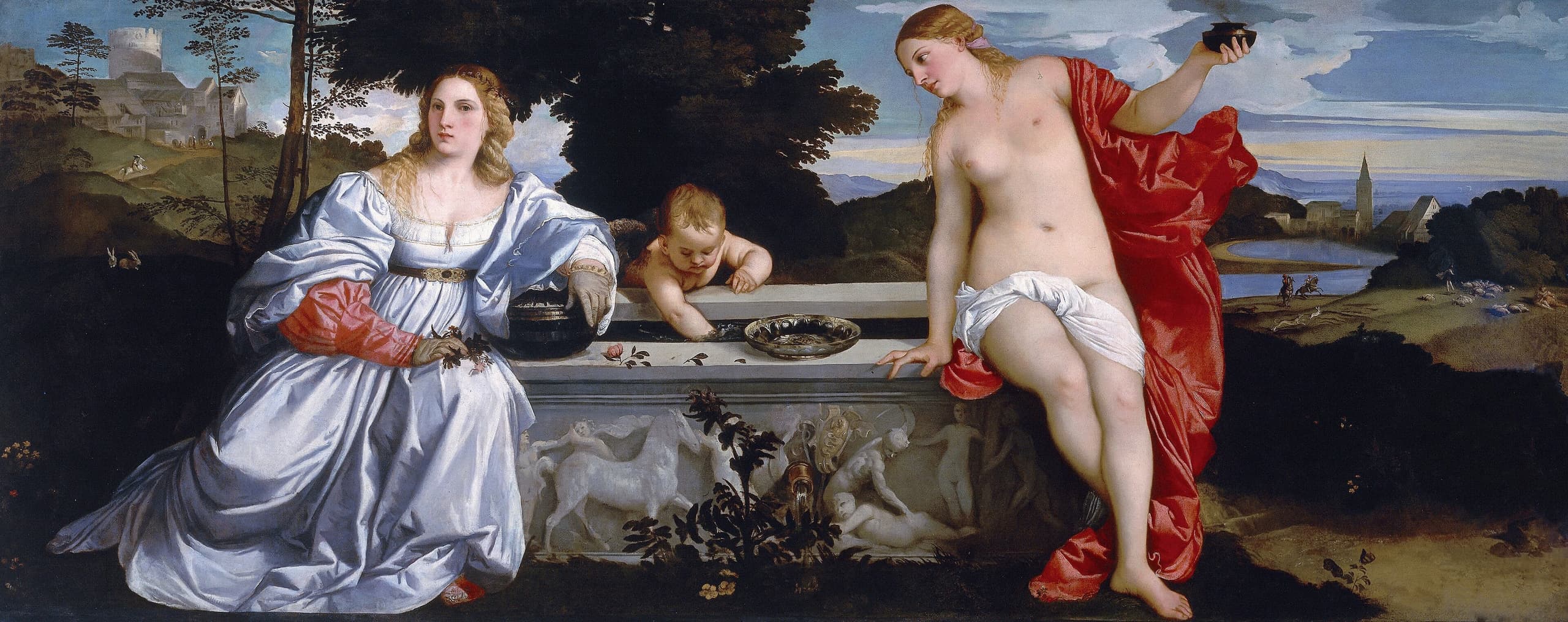
The composition is built around a pair of female figures seated at the same stone vessel. One is described in the surviving accounts as dressed in white and read as a bride; the other is read as Venus. They share the central band of a canvas more than twice as wide as it is high, so the eye moves between them rather than settling on a single heroine. Whatever the allegory is doing, it is doing it by placing these two bodies in deliberate relation.
The vessel between them
Between the women stands a sarcophagus or fountain, solid enough to organise the whole middle of the picture. On it appears the coat of arms of Niccolò Aurelio. That detail is one of the few anchors the painting offers: a real Venetian household marked on an object that also serves as a classical prop. The vessel is at once furniture, emblem and barrier, keeping the two figures close without letting them merge.
Cupid in the gap
Cupid is seated with them at the vessel, the small mythological third party who turns a gathering of women into an allegory of love. His presence is specific and visible, not an afterthought in the margin. Read with the coat of arms and the bridal white dress, he supports the sense of a marriage picture; read with Venus, he keeps the scene inside the language of classical desire. He does not resolve the tension between those readings.
The story
Sacred and Profane Love is an oil painting on canvas by Titian, made in 1514, early in his career. It is a long horizontal work — 118 centimetres (3 ft 10 in) high and 279 centimetres (9 ft 2 in) wide — now in the Galleria Borghese in Rome, where it belongs to the Borghese Collection and carries the inventory number 147. The genre is allegory; the movement is High Renaissance.
The picture is presumed to have been commissioned by Niccolò Aurelio, a secretary to the Venetian Council of Ten, to mark his marriage to the young widow Laura Bagarotto. His coat of arms appears on the sarcophagus or fountain that stands at the centre of the composition. That is the firmest documentary foothold the painting offers. Around it gathers a scene of two women and Cupid. One common reading takes the figure in white as the bride and her companion as the goddess Venus, with Cupid binding the group to the theme of love. The reading is coherent, and it fits a marriage commission, but it is not closed.
The title by which the work is known does not come from Titian’s hand. It is first recorded in 1693, when an inventory listed the painting as Amor Divino e Amor Profano — Divine Love and Profane Love. That wording may not represent the original concept at all. The canvas itself supplies no labels, no inscriptions that fix sacred against profane, bride against goddess. What it supplies is arrangement: two differently presented women, a child-god of love, and a stone vessel bearing a living family’s arms.
Art historians have spilled a great deal of ink on the iconography. Some measure of consensus has formed around parts of the interpretation, yet basic aspects of the intended meaning, including the identity of the central figures, remain disputed. The painting rewards close looking precisely because it will not convert that looking into a single named solution. It keeps the viewer inside the space between a Venetian marriage, a classical allegory, and a title invented almost two centuries later.
Why it mattered then
In 1514 Venice, a secretary to the Council of Ten ordering a large allegory from a rising painter was a way of giving a marriage public and private weight at once. The coat of arms on the vessel ties the image to Niccolò Aurelio’s household; the presence of Cupid and the proposed figure of Venus lifts the occasion into classical language rather than leaving it as a plain double portrait. An allegory could hold virtue, desire and alliance in one field without stating them as plain facts. Whether or not every figure can now be named, the picture belonged to a moment when High Renaissance painting was expected to carry meaning through myth and arrangement, and when a wide canvas could stage that meaning as a calm encounter rather than a crowded narrative.
Why it matters now
The painting still matters because the gap between what can be seen and what can be securely named has not closed. Viewers meet two women, Cupid and a titled opposition — sacred and profane — that the inventory of 1693 supplied and that Titian is not known to have authorised. That makes the work a lasting lesson in how later labels settle on Renaissance pictures, and how allegory can keep working after its original key is lost or disputed. It also keeps attention on composition itself: on width, on the shared vessel, on dress and proximity, rather than on a caption. Looking at it carefully is still an exercise in holding several plausible readings at once.
The surprising detail
The English title everyone uses is an inheritance from a 1693 inventory entry, Amor Divino e Amor Profano, not a name fixed in 1514. The painting may never have been designed as a neat contest between sacred and profane love. The familiar opposition is later scaffolding. Underneath it, the identities of the two central figures remain genuinely open, which is why the iconography has absorbed so much argument without producing a final roll-call of who sits where.
What is disputed
The identities of the two central figures remain disputed, and basic aspects of the intended meaning are still argued over. The commission by Niccolò Aurelio for his marriage to Laura Bagarotto is presumed, resting in part on the coat of arms on the vessel. The title Sacred and Profane Love dates from a 1693 inventory and may not reflect the concept Titian intended.
Remember this
The title dates from 1693; the two women at the vessel have still not been securely identified.
Test yourself
Why should the familiar title Sacred and Profane Love be treated as a later interpretation rather than as a key supplied by the painting?
Because it is first recorded only in 1693, in an inventory that listed the work as Amor Divino e Amor Profano, and may not represent Titian’s original concept at all. The canvas carries no labels that fix the two women as sacred and profane love. Treating the title as inherited wording keeps the disputed identities of the central figures properly open, and keeps attention on what the picture actually shows: two women, Cupid, and a vessel bearing Niccolò Aurelio’s arms.
Go deeper
Image: Titian, Public domain. Licence: Public domain. Source.