I · THE OBJECT · BRITISH MUSEUM
Two Tahitian Women
▶ Listen · narrated
This painting matters because it shows how a museum record can be precise about an object’s making yet silent about many stories viewers may want to know.
At a glance
- Artist
- Paul Gauguin
- Made
- 1899
- Medium
- Oil paint on canvas
- Size
- 94 × 72.4 cm (2 ft 5 in)
- Museum
- Metropolitan Museum of Art
Look closer
Two figures
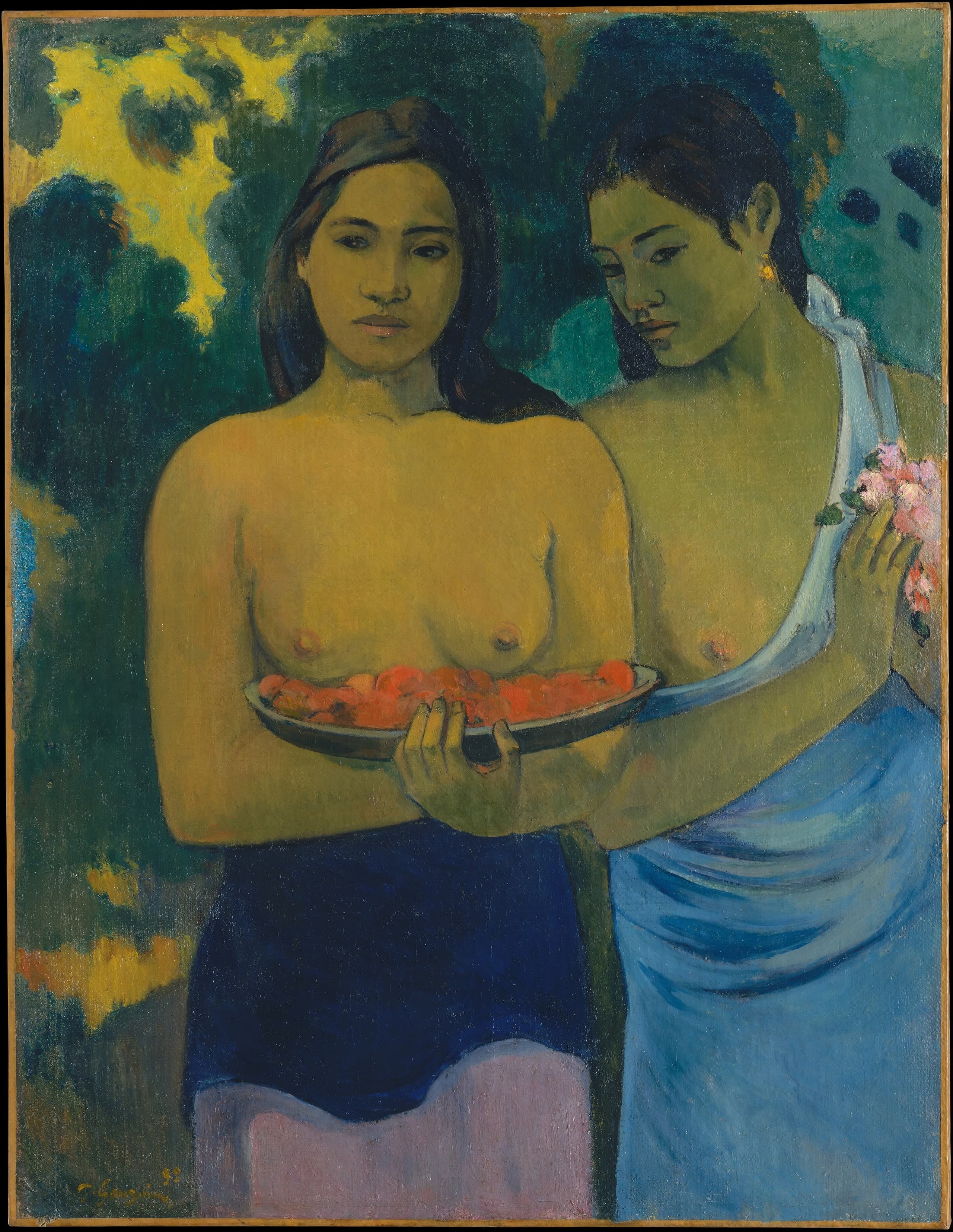
The composition centres on two women. Their bodies are presented directly rather than concealed by elaborate dress, making the encounter with the viewer an important part of what the picture stages.
Uncovered upper bodies
Both women are shown topless. This is not a marginal detail: the exposed upper bodies establish the painting’s immediate visual subject and shape the viewer’s awareness of looking.
Mango blossoms
One woman holds mango blossoms. The small cluster of flowers gives the painting a concentrated point of attention within a scene otherwise organised around the presence of the two figures.
The story
Two Tahitian Women is a painting by Paul Gauguin, made in 1899. It is oil paint on canvas, measuring 94 centimetres (3 ft 1 in) high and 72.4 centimetres (2 ft 5 in) wide. The work is classified as genre art and belongs to the collection of the Metropolitan Museum of Art, where it is also located.
The title directs attention to the two women shown in the painting. Both are depicted with uncovered upper bodies; one holds mango blossoms. Those few elements are enough to establish a scene of looking: two figures face the viewer’s attention, while the flowers offer a smaller, more delicate object to notice. The painting’s scale is close enough to make the figures a sustained presence rather than a passing detail.
Its catalogue facts are unusually clear about certain essentials. We know its maker, date, medium, dimensions, collection and inventory number, 49.58.1. Those details identify a physical object and locate it within a museum collection. They do not, by themselves, explain the circumstances in which it was first encountered, acquired, exhibited, or interpreted.
That limit matters. A painting can seem familiar because its subject is easy to name, yet the historical route from studio to museum may remain outside a short object record. Here, the supplied information identifies the work as part of the Metropolitan Museum of Art’s collection, but does not document how it reached the museum. It also does not provide an account of any earlier ownership.
Looking closely therefore means holding two kinds of knowledge together. One is concrete: an 1899 canvas, painted in oil, with two women and mango blossoms. The other is provisional: the larger histories that might frame these figures are not established by the material provided here. Precision about what is known is part of responsible looking.
Why it mattered then
The painting was made in 1899, in the nineteenth century. Its classification as genre art places it, at least in catalogue terms, among pictures concerned with scenes of human life rather than with a named historical event or a purely formal subject. That designation does not settle what the scene meant in its own moment. The supplied facts do not provide an account of Gauguin’s intentions, the identities of the women, or the picture’s first audience. What can be said is narrower and useful: the work presented two Tahitian women as its central subject, using oil paint on canvas at a scale that gives their figures considerable visual weight.
Why it matters now
The painting remains in the Metropolitan Museum of Art’s collection, where its catalogue number, 49.58.1, ties the image to a particular museum object. Its material facts are not incidental. Oil paint on canvas, a date of 1899, and dimensions of 94 by 72.4 centimetres (2 ft 5 in) give viewers a basis for distinguishing the object itself from reproductions, captions and assumptions. It also remains a useful test of visual discipline. A title can supply a place and a subject; a picture can make bodies and flowers visible; a catalogue can establish maker, date and medium. None of those things alone supplies the full history of the work. The gap is not an invitation to invent certainty. It is a reason to ask which claims are grounded in the object record and which require further evidence.
The surprising detail
The most memorable fact here may be the limit of the record. It securely identifies a painting made by Paul Gauguin in 1899, now at the Metropolitan Museum of Art, but the supplied material does not explain how it entered that collection. A museum inventory number can be exact while a larger ownership history remains unprovided.
What is disputed
The supplied material does not identify the women, explain the work’s initial reception, or provide circumstances of its discovery or early ownership.
How it got here
The supplied facts place the painting in the collection and location of the Metropolitan Museum of Art. They do not provide an acquisition route, earlier ownership history, or information about contested ownership or repatriation claims.
Remember this
A precise object record identifies this 1899 canvas, but it does not by itself tell the full story of its journey or meaning.
Test yourself
Why is it important to distinguish between what this painting visibly shows and what its catalogue record proves about its history?
Because the two forms of evidence answer different questions. The image supports observations about the two women, their uncovered upper bodies and the mango blossoms. The catalogue facts establish its maker, date, medium, dimensions, collection and inventory number. Neither source, as supplied here, establishes every detail of the painting’s ownership, first display or intended meaning. Keeping those boundaries clear makes interpretation more reliable.
Go deeper
Image: Paul Gauguin, Public domain. Licence: Public domain. Source.