II · THE DISCOVERY · HISTORY OF SCIENCE
Helium
Most elements were discovered in rocks or liquids here on the ground. Helium was detected in the spectrum of the Sun, a yellow line no known substance could explain.
At a glance
- Discovery date
- 18 August 1868
- Credited to
- Pierre Janssen, Norman Lockyer, William Ramsay (contested)
- Named after
- Helios, the Greek word for sun
- Type
- Chemical element, noble gas, atmophile element
Look closer
The credit is contested
The discovery is attributed to Pierre Janssen, Norman Lockyer, and William Ramsay, but the record marks this as contested. Janssen recorded the spectral line during the solar eclipse of 1868. Lockyer observed it from Britain and proposed it was a new element, naming it after the Sun. Ramsay isolated it on Earth in 1895 from a uranium ore. The question of who discovered helium depends on whether you count detecting an unknown line in sunlight, naming it as a new element, or isolating the substance itself.
A yellow line in the Sun's spectrum
Helium was detected as a yellow spectral line signature in sunlight during a solar eclipse in 1868. Several observers saw it: Georges Rayet, Captain C. T. Haig, Norman R. Pogson, and Lieutenant John Herschel all recorded the unknown line, and French astronomer Jules Janssen confirmed it. A spectral line is a specific colour of light that appears when you split sunlight through a prism or similar instrument; each element produces its own pattern of lines. This yellow line did not match any element known at the time.
Isolated from a uranium ore
The element was formally discovered on Earth in 1895 by chemists William Ramsay, Per Teodor Cleve, and Nils Abraham Langlet, who found helium emanating from the uranium ore cleveite. Cleveite is no longer regarded as a separate mineral species, but as a variety of uraninite — a uranium oxide mineral. The helium they detected had been produced by radioactive decay inside the ore: the alpha particles emitted by decaying uranium and thorium are helium-4 nuclei, so the gas accumulates in rocks containing those elements.
The story
Helium is a chemical element with symbol He and atomic number 2. It is a colourless, odourless, non-toxic, inert gas — inert meaning it does not react chemically with other substances — and a member of the noble gas group in the periodic table. Its boiling point is very low, and it does not have a melting point at standard pressures.
The element was detected in sunlight during a solar eclipse on 18 August 1868. Several observers recorded an unknown yellow spectral line — a specific colour of light that appears when you split sunlight through a prism. Georges Rayet, Captain C. T. Haig, Norman R. Pogson, and Lieutenant John Herschel all saw the line, and French astronomer Jules Janssen confirmed it. Janssen is often jointly credited with detecting the element, along with Norman Lockyer, who observed it from Britain. However, only Lockyer proposed that the line was due to a new element, which he named after the Sun: helium, from the Ancient Greek word helios.
The formal discovery of the element on Earth was made in 1895 by chemists William Ramsay, Per Teodor Cleve, and Nils Abraham Langlet, who found helium emanating from the uranium ore cleveite, which is no longer regarded as a separate mineral species but as a variety of uraninite. The helium had been produced by radioactive decay: the alpha particles emitted by decaying uranium and thorium are helium-4 nuclei, so the gas accumulates in rocks containing those elements.
Helium is the second-lightest and second-most abundant element in the observable universe, after hydrogen. It is present at about 24% of the total elemental mass in the universe, which is more than twelve times the mass of all the heavier elements combined. The most common isotope, helium-4, was formed in vast quantities during the Big Bang, and large amounts of new helium are created by nuclear fusion of hydrogen in stars.
On Earth, helium is relatively rare — 5.2 parts per million by volume in the atmosphere. Most terrestrial helium is created by the natural radioactive decay of heavy elements such as thorium and uranium. This radiogenic helium — helium produced by radioactive decay — is trapped with natural gas in concentrations as great as 7% by volume, from which it is extracted commercially by a low-temperature separation process called fractional distillation. In 1903, large reserves of helium were found in natural gas fields in parts of the United States, by far the largest supplier of the gas.
Terrestrial helium is a non-renewable resource because once released into the atmosphere, it promptly escapes into space. Its supply is thought to be rapidly diminishing, though some studies suggest that helium produced deep in the Earth by radioactive decay can collect in natural gas reserves in larger-than-expected quantities, in some cases having been released by volcanic activity.
Why it mattered then
Before helium was identified, spectral lines in sunlight were the fingerprints of known elements, and an unknown line was a puzzle. The 1868 observation suggested there was a substance in the Sun that did not exist on Earth — or had not yet been found here. That was a strange claim, and it remained unresolved until Ramsay, Cleve, and Langlet isolated the gas from uranium ore in 1895. The discovery mattered because it demonstrated that spectroscopy — splitting light into its component colours and reading the pattern — could identify elements at a distance, even in the Sun. It also added a new member to the noble gases, a group of elements that do not react chemically with others, which was only beginning to be understood in the 1890s. Helium's properties, particularly its very low boiling point and chemical inertness, made it useful in applications that required a non-reactive gas or extremely low temperatures.
Why it matters now
Liquid helium is used in cryogenics — the science of very low temperatures — which is its largest single use, consuming about a quarter of production. Its main commercial application is in cooling superconducting magnets, particularly in MRI scanners used in hospitals. Superconducting magnets only work at temperatures close to absolute zero, and helium is one of the few substances that remains liquid at those temperatures. Helium's other industrial uses account for half of the gas produced. It is used as a pressurising and purge gas, as a protective atmosphere for arc welding, and in processes such as growing crystals to make silicon wafers for electronics. A small but well-known use is as a lifting gas in balloons and airships, because its density is lower than that of air. In scientific research, the behaviour of helium-4 at very low temperatures is important to researchers studying quantum mechanics, particularly the property of superfluidity — a state in which a liquid flows without friction. Helium is also used in studying superconductivity and other phenomena that occur in matter near absolute zero. Because terrestrial helium escapes into space once released into the atmosphere, it is a non-renewable resource, and its supply is thought to be diminishing.
The surprising detail
Helium was discovered in the Sun before it was found on Earth. The yellow spectral line observed during the 1868 eclipse was recorded by several people, but only Norman Lockyer proposed it was a new element. The name comes from Helios, the Greek word for sun, and the element was not isolated on Earth until 1895. That gap between detection and isolation is unusual: most elements were discovered in rocks, liquids, or gases here on the ground, not in the spectrum of a star.
What is disputed
The discovery is credited to Pierre Janssen, Norman Lockyer, and William Ramsay, but the record marks this as contested. Janssen and Lockyer both observed the spectral line in 1868, though Janssen recorded it during the eclipse and Lockyer observed it from Britain; only Lockyer proposed it was a new element. Ramsay isolated the element on Earth in 1895. The question of who discovered helium depends on whether you count detecting the spectral line, proposing it as a new element, or isolating the substance itself, and the sources do not resolve this.
Remember this
Helium was detected in the Sun in 1868 and isolated on Earth in 1895. It was discovered in a star before it was found here.
Test yourself
Why is helium considered a non-renewable resource on Earth, even though it is the second-most abundant element in the universe?
On Earth, helium is rare — only 5.2 parts per million by volume in the atmosphere. Most terrestrial helium is produced by radioactive decay of heavy elements like uranium and thorium, and it accumulates in natural gas reserves from which it is extracted. Once released into the atmosphere, helium promptly escapes into space because it is so light. Unlike oil or coal, which stay in the ground until extracted, helium that escapes cannot be recovered, so the supply is thought to be diminishing. The abundance in the universe does not help us here: that helium is in stars and interstellar space, not accessible from Earth.
Go deeper
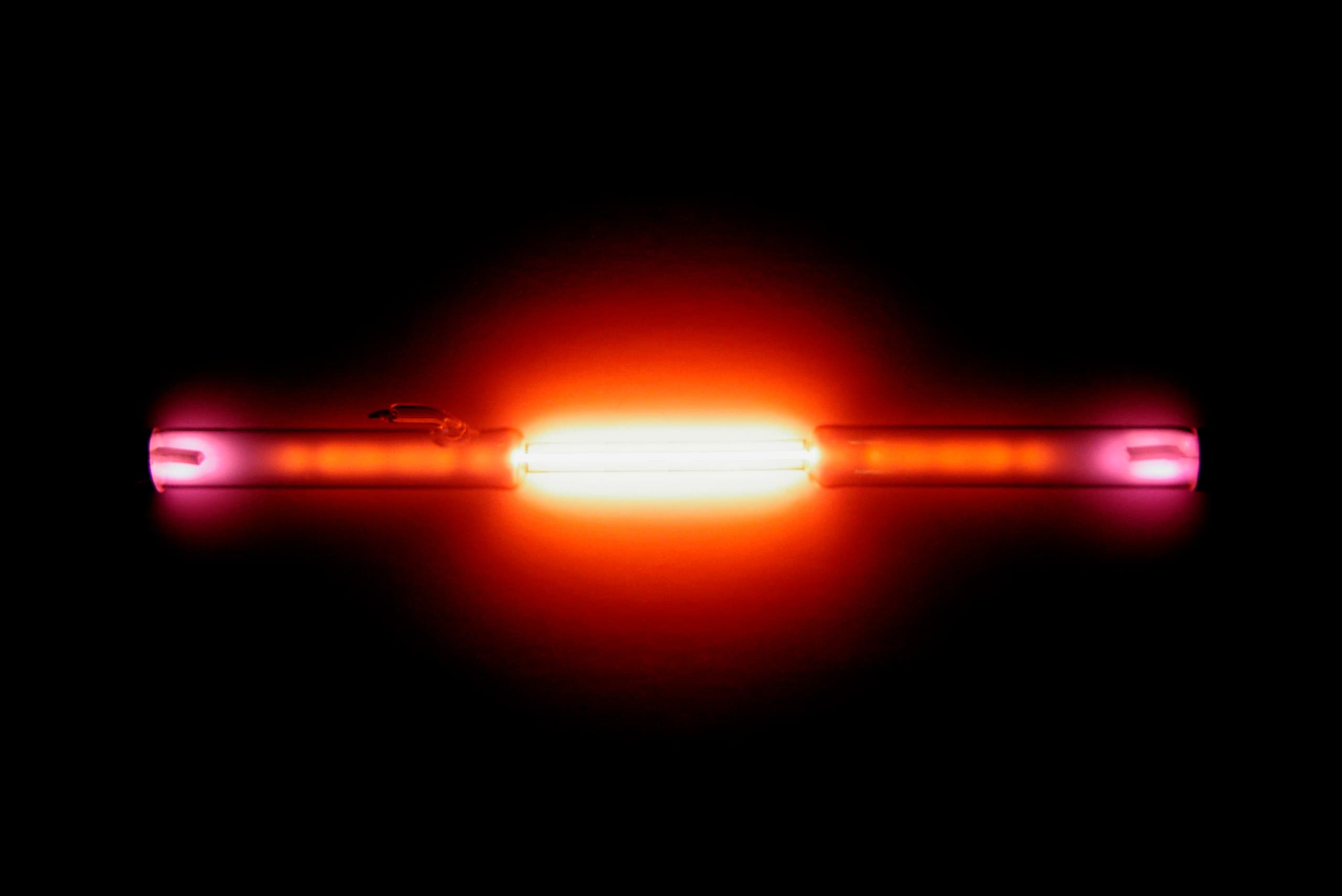
Image: Alchemist-hp ( talk ) ( www.pse-mendelejew.de ), GFDL 1.2. Licence: GFDL 1.2. Source.