I · THE OBJECT · BRITISH MUSEUM
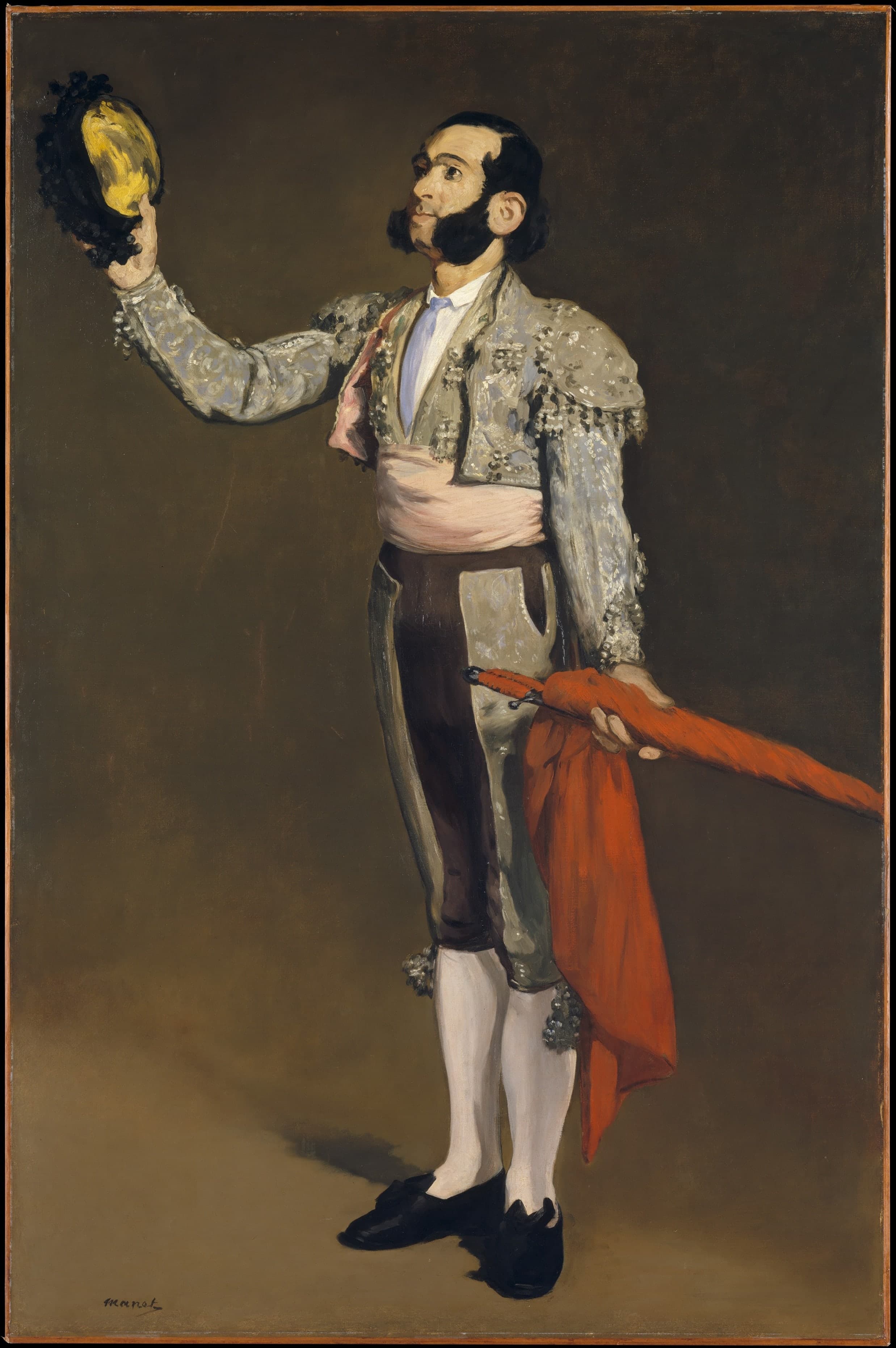
The Matador Saluting
▶ Listen · narrated
Refused by the Paris Salon, painted after a Spanish journey, and large enough to give a buyer pause — this canvas still asks what a modern painter could take from Velázquez.
At a glance
- Date
- 1866–1867
- Artist
- Édouard Manet
- Material
- Oil on canvas
- Dimensions
- 171.1 × 113 cm (3 ft 8 in)
- Inventory
- 29.100.52
Look closer
One gesture, two readings
The matador stands alone and raises his hat. The painting is usually read as the moment after a kill, when the torero receives the crowd’s applause. Its first buyer, Théodore Duret, read the same pose differently: as the formal request for permission to kill. Nothing in the empty ground settles the question. The figure is the whole drama, and the salute remains ambiguous on purpose or by chance.
A first large format
At 171.1 by 113 centimetres (3 ft 8 in) the canvas is tall enough to meet a viewer almost face to face. It was Manet’s first large-format work. The scale is not incidental. A single figure given this much wall space borrows the gravity of a state portrait or a religious painting and spends it on a bullfighter in costume, standing on bare ground with no arena architecture to explain him.
Spanish sources, French hand
Manet painted the work after his 1865 trip to Spain. The dark ground, the restrained palette, and the isolation of the figure have been linked to the compositions and colour of Diego Velázquez and Francisco de Zurbarán. The admiration is structural rather than illustrative: he is not staging a picturesque Spain so much as testing how far those older Spanish habits of painting could serve a modern subject.
The story
The Matador Saluting is an oil painting on canvas by Édouard Manet, made in 1866 or 1867. It shows a matador, or torero, standing full-length and raising his hat. There is no bull, no barrier, and almost no setting — only the figure and the dark space around him. The French title is Le Matador saluant.
The precise year is not fixed. Charles S. Moffett places the first definite reference to the work in 1867, when Manet showed a group of his paintings at the pavillon de l’Alma. Étienne Moreau-Nélaton and Adolphe Tabarant agree that the model was the painter’s brother Eugène. Whether that identification is certain or only well supported is hard to say from the surviving testimony, but the two early specialists converge on it.
The painting belongs to the aftermath of Manet’s 1865 journey to Spain. Unlike the earlier fantasy of a woman dressed as a bullfighter, this canvas comes after direct contact with Spanish art and custom. Critics have argued that its composition and palette draw on Velázquez and Zurbarán: a single figure held against a deep, relatively unmodulated ground, given the scale and seriousness once reserved for saints and kings. It was Manet’s first large-format picture, and the size is part of the argument. A matador treated at 171 centimetres (5 ft 7 in) high is no longer a costume study or a souvenir. He is a modern subject claiming old-master space.
What the salute means is disputed. The usual reading is that the torero is acknowledging the crowd after killing the bull. Duret, who first bought the painting, insisted instead that the figure is asking the public’s leave to kill. The canvas itself offers no blood, no corpse, and no spectators to decide the matter. The ambiguity is baked into the image: a public ritual reduced to one man and a hat.
The Paris Salon of 1866 refused the work, along with other paintings by Manet. The prefect allowed the artist to show the rejected pictures in his own studio, on condition that the doors were not opened too wide — a half-concession that kept the paintings in circulation without granting them official approval. Private space became a substitute exhibition hall.
From Duret the painting passed to Louisine Havemeyer. She hesitated over the purchase, worried that the format would not suit her husband. Mary Cassatt urged her on, remarking that the size was exactly what Manet had wanted. Henry Osborne Havemeyer not only accepted the canvas but developed a taste for Manet’s large Spanish-period figures, acquiring Young Man Dressed as a Majo as well. In 1929 both works entered the Metropolitan Museum of Art as part of the Havemeyer bequest. They remain there, together with Manet’s earlier bullfighting fantasy, Miss V Dressed as a Bullfighter.
So the painting’s public life has three chapters: refusal by the Salon, defence by a dealer and by fellow artists, and eventual institutional shelter in New York. What hangs on the wall is still the same problem Manet set himself after Spain — how to paint a living Spanish subject with the gravity of the Spanish old masters, without slipping into costume drama or anecdotal local colour.
Why it mattered then
In the mid-1860s Manet was testing how far a contemporary figure could carry the weight of large-scale painting. The Salon system still controlled reputations, and a refusal in 1866 was a real professional setback. Allowing the rejected works into the studio under restricted conditions was a bureaucratic compromise: the pictures could be seen, but not quite as art of public record. Against that backdrop, a full-length matador was not a safe subject. Bullfighting was foreign spectacle to a Paris audience; treating it with the solemnity of Velázquez risked looking either pretentious or merely picturesque. The painting mattered in its moment because it forced that risk into the open — a modern French painter claiming Spanish grandeur for a genre figure, and doing so at a size that made the claim hard to ignore.
Why it matters now
The canvas still matters as a document of how artists borrow. Manet does not copy a Velázquez or a Zurbarán; he takes habits of isolation, dark ground, and restrained colour and spends them on a living type. That transaction — old formal means, new social subject — remains a live problem for painters. The work also preserves a small history of taste and collecting. A Salon rejection, a dealer’s reading of the gesture, a collector’s fear of size, and a fellow artist’s reassurance all shaped whether the picture survived in public view. Standing before it now, a visitor sees not only a matador but the chain of decisions that kept a refused painting from disappearing into private neglect.
The surprising detail
Louisine Havemeyer nearly declined the painting because she thought it too large for her husband. Mary Cassatt’s insistence that the format was precisely what Manet intended reversed the decision. Henry Osborne Havemeyer then became absorbed by large-format works and bought another Spanish-period Manet, Young Man Dressed as a Majo. The two canvases travelled together into the Metropolitan Museum in 1929. A hesitation about wall space, settled by one friend’s remark, is why both pictures hang in the same collection today.
What is disputed
The year is not fixed with precision; sources give 1866 and 1867, and the first firm reference is placed in 1867. Two early specialists identify Eugène Manet as the model, but that rests on their agreement rather than on a documented sitting. The meaning of the salute is openly disputed: applause after the kill, or a request for leave to kill. The original exhibition circumstances after the Salon refusal are known only in outline.
How it got here
The painting’s first buyer was Théodore Duret. Louisine Havemeyer later purchased it from him, after hesitation over its size and encouragement from Mary Cassatt. It was bequeathed, with Young Man Dressed as a Majo, to the Metropolitan Museum of Art in 1929 as part of the Havemeyer gift, where it remains under inventory number 29.100.52.
Remember this
A Salon-refused matador, painted after Spain at a new large scale, whose salute still divides viewers — and whose size nearly cost it a buyer.
Test yourself
Théodore Duret and later commentators disagree about what the matador’s raised hat means. Why does that disagreement matter for how we read the painting?
Because the canvas withholds every narrative clue that would settle it — no bull, no blood, no crowd. If the salute is applause after the kill, the picture is a triumph held in silence. If it is a request for permission to kill, the picture is suspended before violence. Same pose, opposite tense. The dispute shows how much meaning Manet loaded onto a single public gesture, and how little the surrounding space does to police that meaning.