I · THE OBJECT · BRITISH MUSEUM
The Third-Class Carriage
▶ Listen · narrated
Third class was where most people actually rode. Daumier made that ordinary compartment the subject of serious painting, and one version still shows the work incomplete.
At a glance
- Artist
- Honoré Daumier
- Date
- Inception recorded as 1862 and 1868
- Medium
- Oil paint on canvas
- Dimensions
- 65.4 × 90.2 cm (3 ft)
- Accession
- 29.100.129
- Collection
- Metropolitan Museum of Art
Look closer
A carriage, not a salon
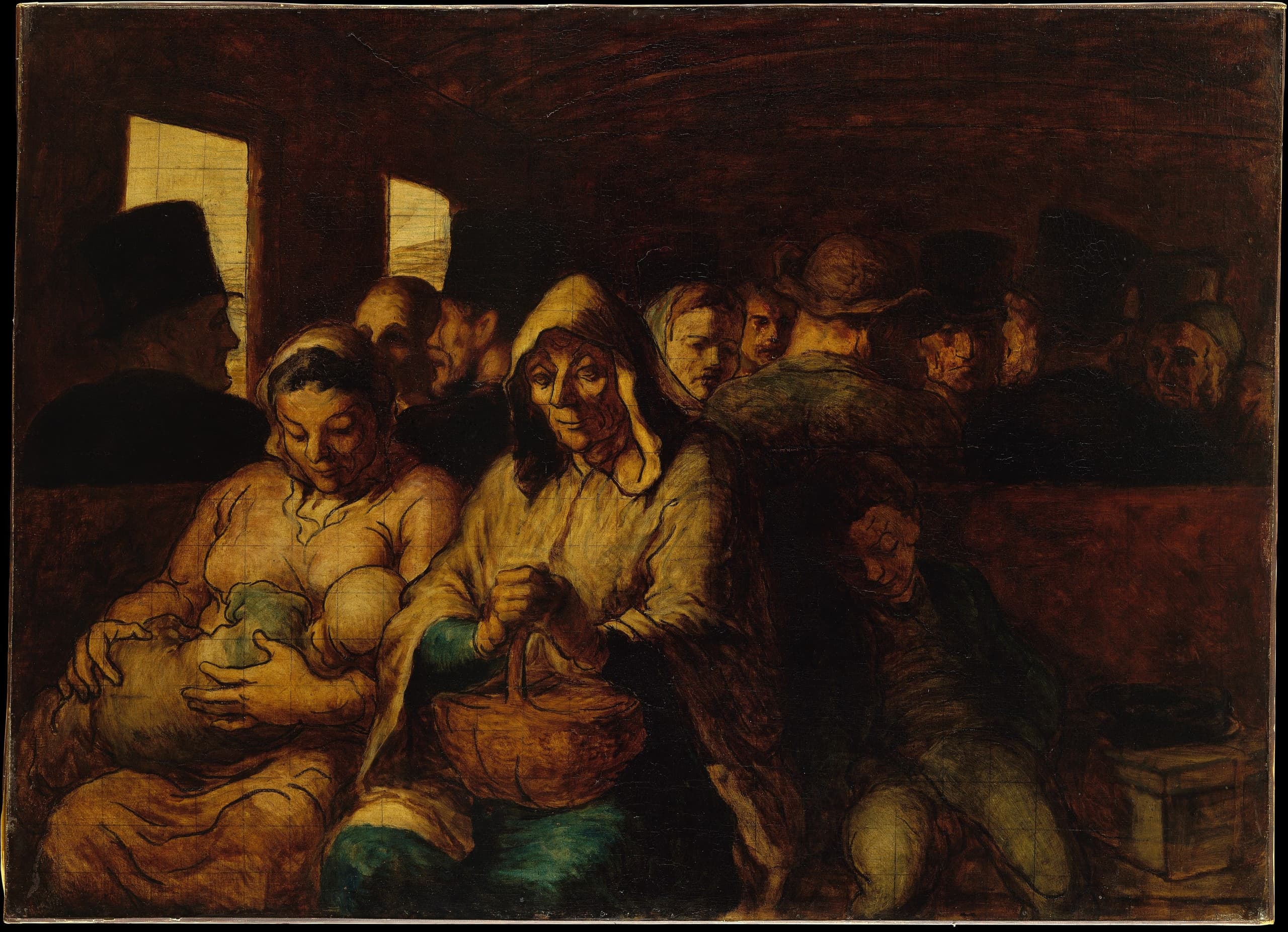
The subject is a third-class railway compartment and the people who sat in it. Genre art of this kind treats ordinary travel as worthy of oil on canvas. The setting is public and cramped rather than private or ceremonial, which is part of what places the picture inside French Realism rather than academic history painting.
Left unfinished
The Metropolitan canvas is unfinished. That matters because the surface still carries the look of work in progress: areas that never received the final resolving touches expected of a completed exhibition picture. The incomplete state is not a loss of subject so much as a record of how far Daumier took this particular version.
One title, several canvases
At least three oil paintings share the title. The New York version sits beside a similar but completed painting in Ottawa and an earlier oil-on-panel version in San Francisco, whose main figures are arranged differently. The repeated title shows Daumier circling the same social scene rather than settling it in a single definitive image.
The story
The Third-Class Carriage is an oil painting on canvas by the French artist Honoré Daumier. It is in the collection of the Metropolitan Museum of Art, inventory number 29.100.129, and measures 65.4 centimetres (2 ft 2 in) high by 90.2 centimetres (3 ft) wide. Wikidata records its inception under the dates 1862 and 1868; published accounts of the New York picture commonly place it in the early 1860s and note that it was left unfinished.
Daumier is here working in French Realism and in genre art: the painting of everyday life. The scene is a third-class railway carriage. By the middle of the nineteenth century the train had become ordinary transport, and third class was the fare most working passengers could pay. Hard seating, close quarters and little comfort were part of that experience. Daumier makes that compartment his subject without turning it into anecdote or caricature alone, though his long practice as a lithographer and social observer sits behind the seriousness of the look.
This is not a unique image. Under the same French title, Le Wagon de troisième classe, Daumier produced at least three oil versions. The Metropolitan’s canvas is the unfinished one generally tied to about 1862–1864. A similar composition, carried further to completion and usually dated a little later, is in the National Gallery of Canada in Ottawa. A third version, painted in oil on panel and placed earlier, around the later 1850s, belongs to the Fine Arts Museums of San Francisco and rearranges the principal figures. Exact years remain elastic; the documentary trail does not fix each canvas to a single firm date.
What the New York painting offers, then, is less a polished manifesto than a sustained attention to class and transit, stopped short of finish. The people in third class occupy the full field of a substantial canvas. Nothing in the verified record requires us to claim more than that about individual faces or props; the force of the work, as described in the sources, lies in the realistic treatment of poverty and fortitude among working-class travellers. The museum holds it as a painting — genre art, Realist in movement — and as one node in a small group of related oils rather than as an isolated masterpiece claim.
How the canvas first left the studio and by what path it reached the Metropolitan is not set out in the facts supplied here. What is clear is its present home, its materials, its scale and its place among Daumier’s repeated returns to the same railway bench.
Why it mattered then
In Daumier’s moment the railway was still a relatively new organiser of daily life, and class was built into the carriages themselves. Third class was not a metaphor; it was a ticket type and a physical space. French Realism made a programme of attending to such spaces when academic taste still ranked history, myth and elevated portraiture above the working poor in transit. To paint the third-class compartment in oil was to argue, quietly, that those passengers belonged on the wall as subjects of serious looking. Daumier’s repetition of the theme across several versions suggests the subject held him: not a single commission closed and forgotten, but a social fact he kept restating in paint.
Why it matters now
The painting still matters because the problem it names has not vanished. Public transport remains a place where inequality is visible in posture, luggage, fatigue and the quality of the seat. An unfinished Realist canvas also matters as evidence of process: museums and viewers now often value the incomplete surface for what it shows of decision and stoppage, not only for what a final varnish would have sealed. And the existence of sister versions in Ottawa and San Francisco keeps the New York picture honest. It is one statement among several, not a solitary icon. That plurality is useful whenever a single image is asked to stand for a whole class of experience.
The surprising detail
The familiar title covers at least three different oils, not one. The Metropolitan’s is unfinished; Ottawa’s is a completed near relation; San Francisco’s is earlier, on panel, and rearranges the main figures. Daumier did not fix the scene once and move on. He rebuilt it.
What is disputed
Dating is not firm. Wikidata lists inception as both 1862 and 1868; published ranges for the Metropolitan canvas and its related versions differ by several years. The New York picture is described as unfinished; the Ottawa version as completed; the San Francisco panel as earlier and differently arranged. Precise studio chronology remains partly open. Provenance from studio to museum is not detailed in the facts supplied here.
Remember this
A Realist oil of third-class rail travellers, left unfinished in New York, and only one of several versions Daumier painted under the same title.
Test yourself
Why does it matter that the Metropolitan’s Third-Class Carriage is unfinished and that other oil versions of the subject also survive?
Because the unfinished surface preserves the look of work stopped mid-course, and the sister versions show Daumier treating the third-class carriage as a problem he returned to rather than a single closed image. Together they resist the habit of reading one museum canvas as the definitive statement. The subject was social and repeatable; the New York picture is one serious attempt among several.
Go deeper
Image: Honoré Daumier, Public domain. Licence: Public domain. Source.