III · THE WORK · ART HISTORY
The Anatomy Lesson of Dr. Nicolaes Tulp
▶ Listen · narrated
A circle of living faces and one dead body share a single canvas. Rembrandt arranges them so that the drama is not only the dissection but the act of looking itself.
At a glance
- Artist
- Rembrandt
- Date
- 1632
- Medium
- Oil on canvas
- Dimensions
- 169.5 × 216.5 cm (7 ft 1 in)
- Collection
- Mauritshuis
- Genre
- Group portrait
Look closer
The demonstrator’s hands
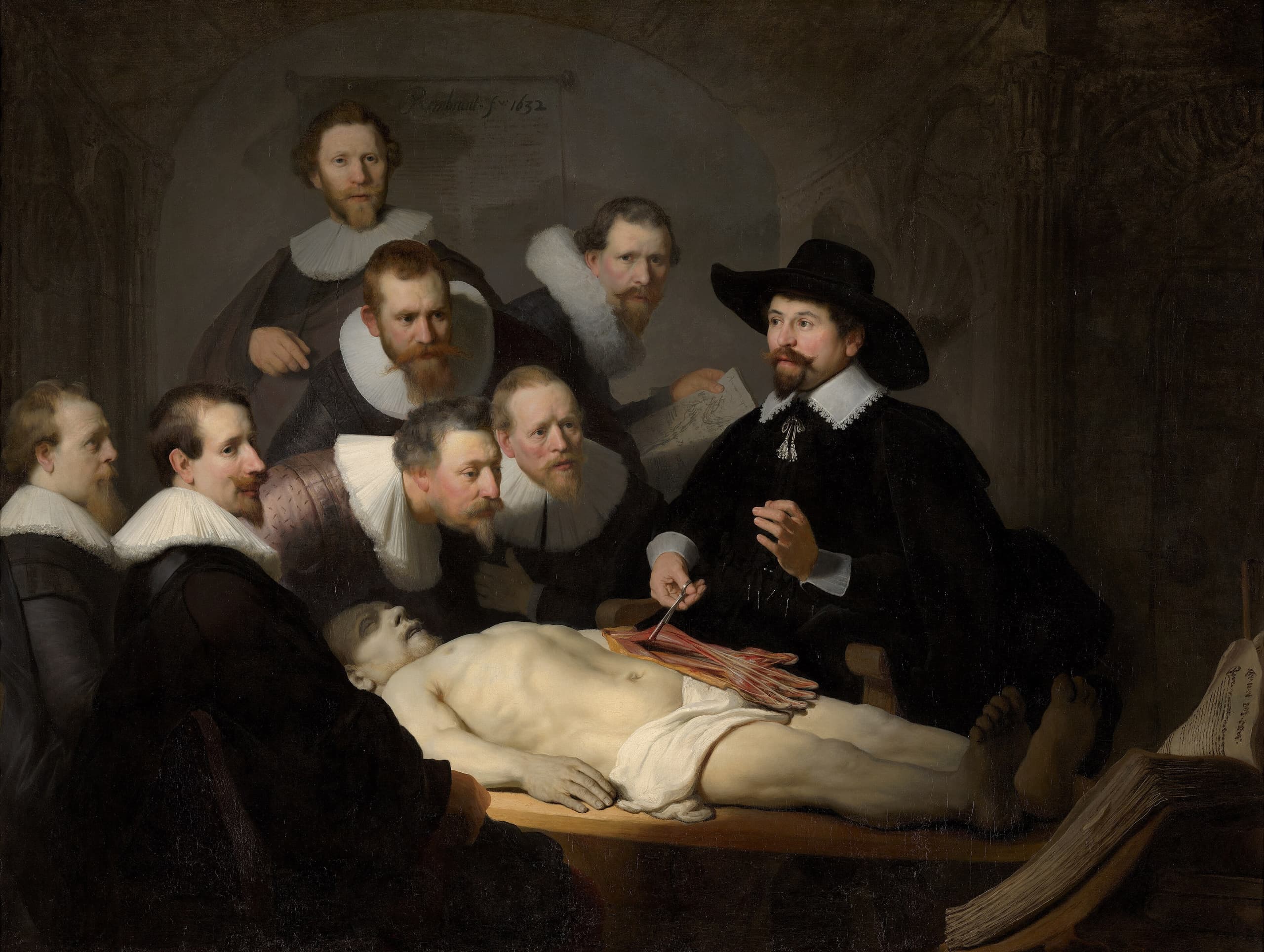
Nicolaes Tulp sits a little apart from the cluster of colleagues, dressed more formally, and works the open forearm of the corpse with forceps. The painting’s action is concentrated in those two hands: one instrument, one gesture, and a clear claim that this is a lesson, not a casual gathering. The musculature of the arm is the stated subject; Tulp’s calm authority is the pictorial one.
A group that does not look alike
The other figures do not form a polite row. They lean, craning toward the dissection or glancing out toward us, each face differently lit and differently engaged. Several of the spectators paid to be included. Rembrandt treats that commercial fact as a compositional opportunity: individuality is part of the commission, and the variety of attention keeps the eye moving around the corpse rather than settling on a single hero.
The body as the quiet centre
The cadaver lies almost parallel to the lower edge of the canvas, pale against dark clothing and a dim room. Unlike the animated surgeons, he has no gesture and no gaze to return. Everything active in the picture—the forceps, the leaning heads, the open book sometimes associated with the lesson—orbits this still form. The group portrait is built on a person who cannot sit for one.
The story
The Anatomy Lesson of Dr. Nicolaes Tulp is an oil painting on canvas, made in 1632 and now in the Mauritshuis. It belongs to Dutch Golden Age painting and sits at the meeting point of two genres the period handled with particular care: the group portrait and the portrait of professional men at work.
What we see is a demonstration. Nicolaes Tulp, a leading figure among the surgeons, explains the musculature of the arm while a cluster of colleagues gathers round the body. The corpse occupies the foreground almost like a table; the living men rise behind and beside it in a loose pyramid of heads and collars. Light picks out faces, paper, and the opened flesh of the forearm. The rest of the room falls away into brown shadow. Nothing in the verified record requires us to invent a grand hall or a theatrical crowd. The drama is close-range and professional.
The picture was made to be shown by the Surgeons’ Guild in their meeting room. That origin matters for how it is built. This is not a private cabinet painting. It had to carry across a communal space, identify its sitters, and dignify the guild’s public work. Group portraits of civic bodies were already a familiar Dutch form; Rembrandt’s contribution is to bind the likenesses to a single intelligible action. Instead of a row of equal faces, he gives a lesson in progress. Rank and payment still shape who appears and how prominently, but the eye is led by the forceps and the tendons, not by a coat of arms.
Some of the spectators paid commissions to be included. That practice was ordinary for such portraits, and it explains the careful differentiation of the heads: each man needed to be recognisable to his peers. Rembrandt does not flatten them into types. He varies angle, expression, and degree of engagement so that the group feels assembled rather than stamped. The corpse, by contrast, is anonymous in function even if the historical body had a name. He is the occasion for the living to be painted.
In the top-left corner the work is signed “Rembrant. f[ecit] 1632.” The form of the signature has drawn notice because it may be an early instance of Rembrandt signing with his forename, in its original spelling, rather than with the monogram RHL. The point is not romantic genius; it is a craftsman’s mark changing shape at a moment when his reputation was rising. Whether or not it is truly the first such signature, the painting already shows a young artist taking on a complex multi-figure commission and organising it with unusual clarity.
Compositionally the canvas is wide—more than two metres across—and the figures fill it without crowding the corpse off the stage. Tulp’s isolation to one side, the converging attentions of the others, and the pale diagonal of the body create a circuit of looking that includes the viewer. We stand roughly where a latecomer to the lesson might stand. The painting does not ask us to admire anatomy as abstract science so much as to witness a profession presenting itself: skilled, collective, and unembarrassed by the dead.
Why it mattered then
In 1632 a surgeons’ guild needed more than a list of members. It needed an image that could hang in a meeting room and make the company’s work look ordered, learned, and worthy of civic respect. Public dissections were regulated occasions; the painted lesson translated that regulated spectacle into a permanent group portrait. Commissioning Rembrandt served a double purpose. The sitters who paid to appear secured their own likenesses inside a scene of professional dignity. The guild as a whole secured a picture in which anatomy was not a private craft but a demonstrated science, led by Tulp and witnessed by his peers. Placing the action around the arm kept the violence of dissection legible and contained. Everyone could see what was being taught. Everyone could also see who belonged in the room. For Rembrandt, still early in his career, the canvas was a public proof that he could handle many portraits inside one coherent drama. The signature with his forename, if it does mark a shift from the older monogram, fits that ambition: a name written in full on a guild painting meant to be seen by colleagues for years.
Why it matters now
The painting still works because it refuses to separate likeness from labour. Modern viewers who know nothing of seventeenth-century guild politics can still read the difference between the man who teaches, the men who watch, and the body that cannot watch back. That hierarchy of attention remains unsettling and clear. It also remains a useful check on how group portraits behave. Many official pictures freeze their sitters into equal dignity. This one admits money, status, and curiosity into the same frame and still holds together. Looking closely at who leans in, who turns away, and who holds the instrument is a way of practising slow attention—exactly the skill the painted lesson pretends to teach. Housed in the Mauritshuis, it continues to function as both a historical document of Dutch Golden Age portraiture and a composition problem that has not gone stale: how to make a crowd of paying faces serve one visible idea.
The surprising detail
The painting is signed at the top left “Rembrant. f[ecit] 1632.” Scholars have noted that this may be the first time Rembrandt signed a painting with his forename—in that spelling—rather than with the monogram RHL (Rembrandt Harmenszoon of Leiden). The claim is hedged for good reason: firsts are hard to prove from a partial survival of work. Even so, the change of mark on a major guild commission is a small, concrete sign of an artist adjusting how he named himself in public, at the same moment he was organising one of his most ambitious early group portraits.
What is disputed
The idea that the 1632 forename signature is Rembrandt’s first use of that form, replacing the monogram RHL, is a scholarly suggestion rather than a settled fact. It depends on how completely the earlier work survives and how strictly one defines a change in signing practice. Present it as possible, not proven.
Remember this
A guild paid for likenesses; Rembrandt gave them a lesson. The opened arm is what stops the group portrait from becoming a mere row of faces.
Test yourself
Several of the doctors paid to appear in the painting. How does that commercial fact show up in the way the group is composed, rather than merely in the fact that they are present?
Because payment bought recognisability, Rembrandt differentiates the heads—angles, expressions, degrees of engagement—instead of treating the surgeons as a uniform chorus. The composition can afford variety: each sitter needs to be readable as himself, while Tulp’s demonstration still supplies a single action that binds the paid portraits into one scene. The money does not sit outside the picture; it helps explain why individuality and collective focus are held in tension.
Go deeper
- The Anatomy Lesson of Dr. Nicolaes Tulp · Wikipedia
- The Anatomy Lesson of Dr. Nicolaes Tulp — Wikidata · Wikidata
Image: Rembrandt, Public domain. Licence: Public domain. Source.