I · THE OBJECT · BRITISH MUSEUM
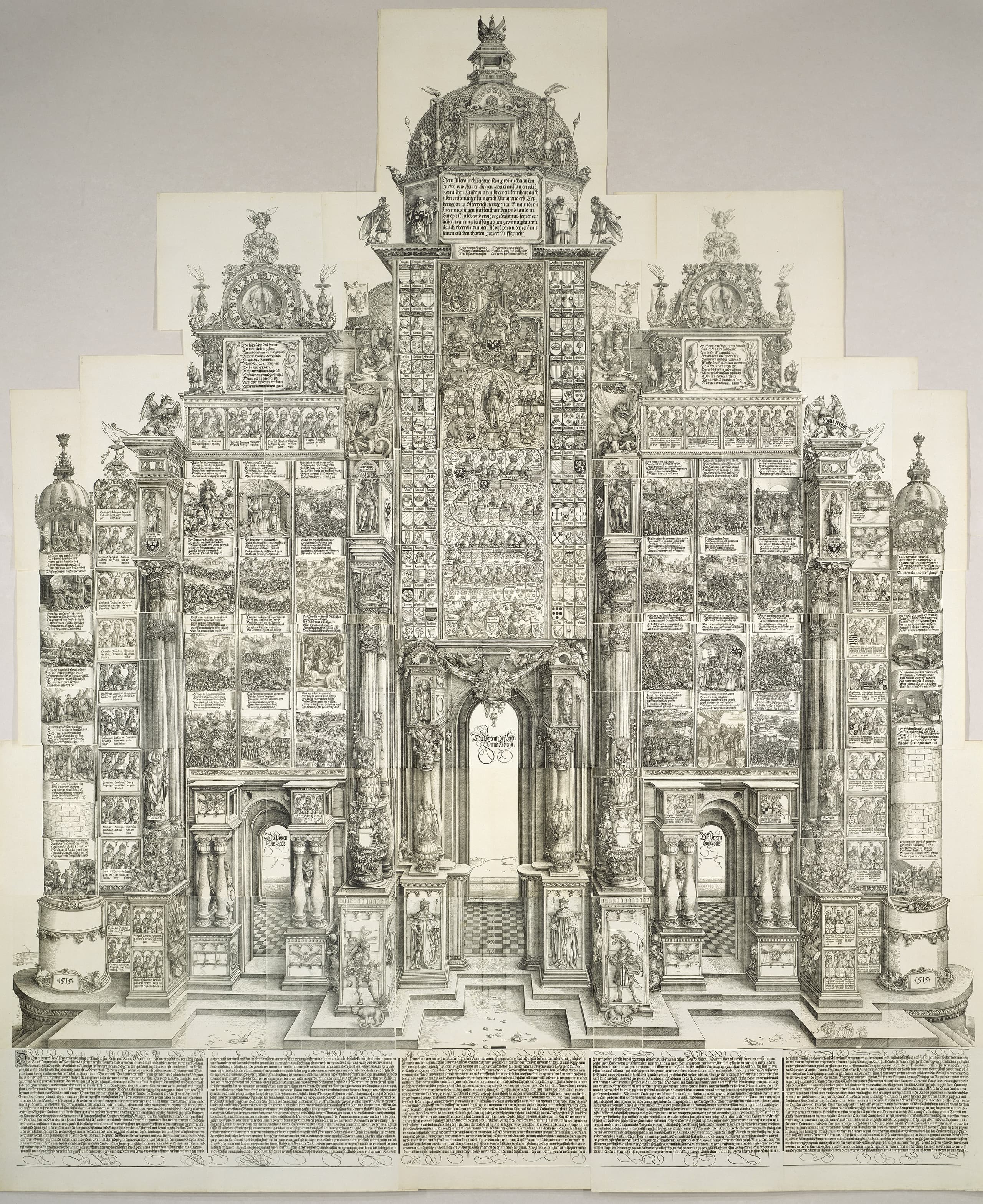
Triumphal Arch
▶ Listen · narrated
Its scale and mixed print techniques make this Renaissance work a useful test of how images can claim architectural presence without becoming buildings.
At a glance
- Date
- 1512
- Type
- Woodcut print; series of prints
- Size
- 354 × 298.5 centimetres (9 ft 10 in)
- Material
- Laid paper
- Location
- Germanisches Nationalmuseum
Look closer
Paper at architectural scale
The recorded height is 354 centimetres (11 ft 7 in) and the width 298.5 centimetres (9 ft 10 in). Those measurements make scale central to the work’s identity: this is a print on laid paper, yet its title invokes an arch, a form normally associated with built space and durable materials.
A careful set of labels
The object is classified as a woodcut print and as a series of prints. Its fabrication fields also name the wood engraving technique and etching. The record therefore places several printmaking terms beside one another, rather than reducing the work to a single process.
Four makers named together
Albrecht Dürer, Wolf Traut, Hans Springinklee and Albrecht Altdorfer are all listed as creators. The supplied record does not divide their respective contributions, but the four names make authorship itself part of what must be noticed.
The story
Triumphal Arch is recorded as a German Renaissance work made in 1512. It is an instance of a woodcut print and a series of prints, made on laid paper. Its dimensions, 354 centimetres (11 ft 7 in) high and 298.5 centimetres (9 ft 10 in) wide, give the title a particular force. The object is a print, not an architectural structure, but its scale and name bring paper and building into close proximity.
Four creators are identified: Albrecht Dürer, Wolf Traut, Hans Springinklee and Albrecht Altdorfer. The supplied facts do not say how labour was divided between them. It would therefore be unsafe to assign a design, carving, printing or other task to any one name. What can be said is that the catalogue records the work through a group of makers rather than a single author.
Its technical description also needs to be read closely. Laid paper is the stated material. The work is classified as a woodcut print, while the fabrication methods include wood engraving technique and etching. These terms are preserved in the supplied record, but it does not explain their precise relationship here.
The record names the Germanisches Nationalmuseum as the location, and also lists the Germanisches Nationalmuseum, the Prints in the National Gallery of Art and the Metropolitan Museum of Art under collection. It supplies no account of the object’s discovery or recovery. Nor does it identify where it was first kept, how it travelled, or the circumstances in which the named institutions acquired their holdings. That silence matters: a compelling title does not fill gaps in the documented history.
Why it mattered then
Its inception is recorded as 1512, within the German Renaissance. At 354 centimetres (11 ft 7 in) high, this work made scale a defining part of a printed object. The title Triumphal Arch offered an architectural frame for something made on paper, while the catalogue classified it as a woodcut print and a series of prints. That combination is enough to show an ambitious encounter between format, image-making and the public language of architecture. The supplied facts do not identify a patron, intended setting or audience, so those larger purposes remain unconfirmed.
Why it matters now
Triumphal Arch still rewards close reading because its catalogue facts resist easy simplification. It is at once a paper object, a woodcut print, a series, a work of German Renaissance art and a record bearing four creators’ names. Its dimensions also challenge the assumption that a print must be small or private in scale. Just as importantly, the incomplete account of its finding and movement is a reminder that museum records can be precise about some aspects of an object while remaining silent about others.
The surprising detail
The catalogue data joins a seemingly architectural title to a print on laid paper measuring 354 centimetres (11 ft 7 in) high. It also classifies the work as a woodcut print while listing both wood engraving technique and etching among its fabrication methods. Rather than smoothing out those categories, the record leaves their complexity visible.
What is disputed
The supplied facts identify the work’s date, makers, material, dimensions and present location, but provide no account of how it was found. They also do not specify the respective roles of the four listed creators or explain the relationship between the listed printmaking methods.
How it got here
The supplied record names the Germanisches Nationalmuseum as the location and lists the Germanisches Nationalmuseum, the Prints in the National Gallery of Art and the Metropolitan Museum of Art under collection. It does not provide acquisition dates, ownership history, a route into any museum, or information about contested ownership or repatriation.
Remember this
A huge paper print can borrow the authority of architecture without becoming a building.
Test yourself
Why is it risky to describe Triumphal Arch as the work of one artist, even though one of its listed creators is Albrecht Dürer?
Because the supplied record names four creators: Albrecht Dürer, Wolf Traut, Hans Springinklee and Albrecht Altdorfer. It does not state what each person contributed. Naming one maker alone would turn an incomplete record of shared authorship into a certainty the evidence does not support.