II · THE DISCOVERY · HISTORY OF SCIENCE
Electricity
Electricity was studied for centuries before anyone could explain how a spark, a magnet, and a current were parts of the same thing.
At a glance
- Discovery date
- 1821
- What it is
- Phenomena associated with the presence and motion of electric charge
- Related to
- Magnetism, as part of electromagnetism
- Common examples
- Lightning, static electricity, electric heating, electric discharges
Look closer
Two kinds of charge produce one kind of field
The presence of either a positive or negative electric charge produces an electric field around it. That field is the region in which another charged particle would feel a force. The strength and direction of that force, at any position, is what Coulomb's law determines in most applications. The field is not the charge itself but the effect the charge has on the space around it.
Moving charge makes a magnetic field
An electric current — the motion of electric charge carriers — produces a magnetic field. This is the link between electricity and magnetism: a static charge produces only an electric field, but a moving charge produces both. The two phenomena are parts of a single framework called electromagnetism, described by Maxwell's equations.
Electric potential is work done against the field
Electric potential is the work done to move an electric charge from one position to another within an electric field. It is typically measured in volts. The potential tells you how much energy it costs to move a charge through the field, which is why a battery's voltage tells you how much energy each unit of charge can deliver when it flows through a circuit.
The story
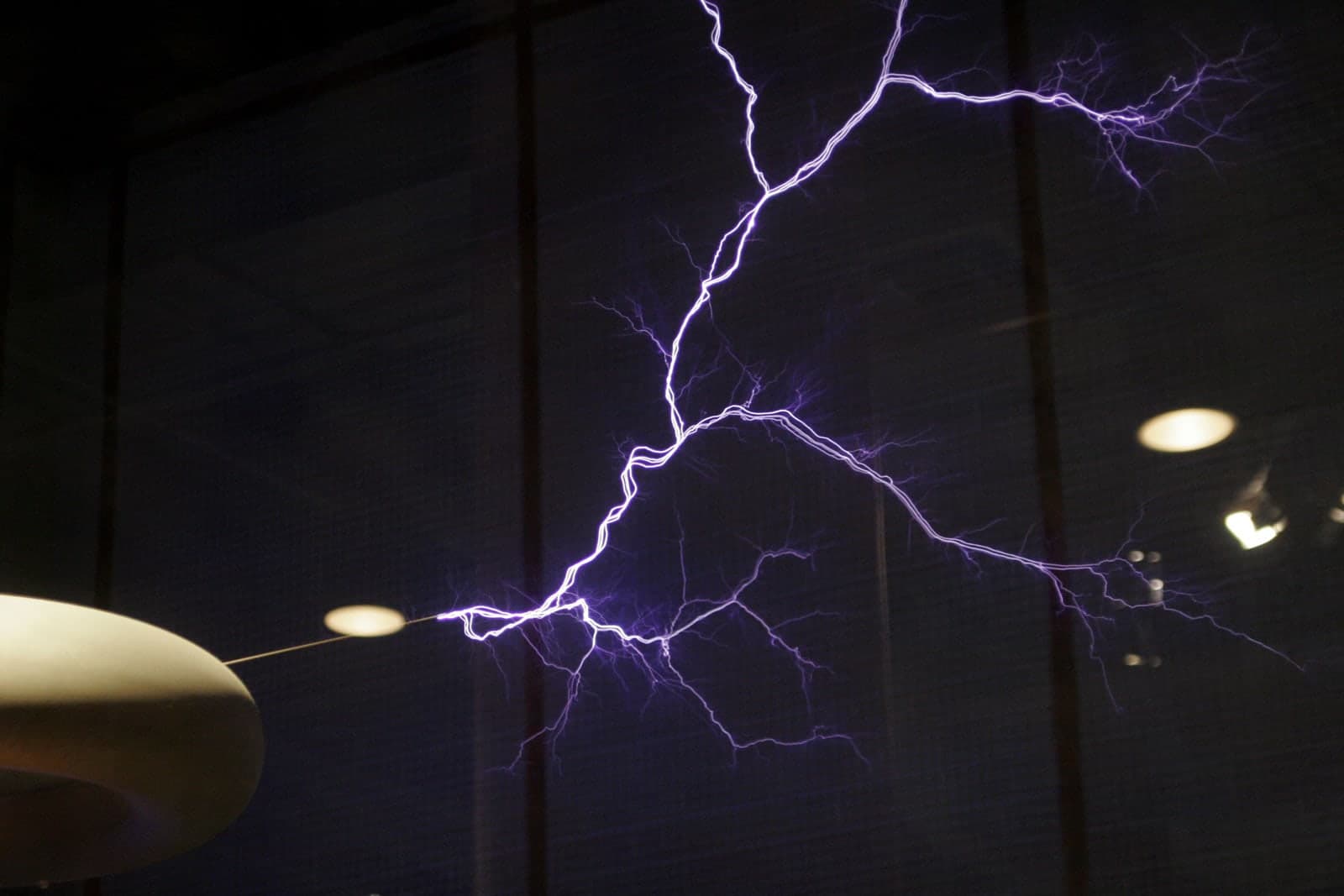
Electricity is the set of physical phenomena associated with the presence and motion of matter possessing an electric charge. That definition is broad because the phenomena themselves are varied: lightning, static electricity, electric heating, and electric discharges are all examples of electricity, and they do not look much like one another until you have a theory that unifies them.
The presence of an electric charge — positive or negative — produces an electric field around it. The field is the region in which another charged particle would feel a force. The motion of electric charge carriers is an electric current, and that current produces a magnetic field as well as an electric one. Electricity and magnetism are related phenomena, both part of what is called electromagnetism, described by Maxwell's equations.
The study of electrical phenomena dates back to antiquity, but theoretical understanding progressed slowly until the 17th and 18th centuries. The development of the theory of electromagnetism in the 19th century marked significant progress. The date recorded for the discovery of electricity is 1821, which places it in the period when the relationship between electricity and magnetism was being worked out.
In most applications, Coulomb's law determines the force acting on an electrically charged particle. Electric potential is the work done to move an electric charge from one position to another within an electric field, typically measured in volts. The potential tells you how much energy it costs to move a charge through the field, which is why a battery's voltage tells you how much energy each unit of charge can deliver when it flows.
Electricity plays a central role in many modern technologies. It serves in electric power, where electric current is used to energise equipment, and in electronics, which deals with electrical circuits involving active components such as vacuum tubes, transistors, diodes and integrated circuits, and associated passive interconnection technologies. The versatility of electricity has driven transformations in both industry and society, making it the foundation of modern industrial life.
Why it mattered then
The development of the theory of electromagnetism in the 19th century made electricity's industrial and residential application possible. Electrical engineers were applying electricity by the century's end, and that rapid expansion in electrical technology was the driving force behind the Second Industrial Revolution. Before the theoretical framework was in place, electrical phenomena were curiosities — sparks, shocks, and magnetic attractions that could be demonstrated but not harnessed reliably. Once the relationship between electricity and magnetism was understood, and once the laws governing electric fields and currents were written down, engineers could design systems that delivered power where it was needed. The world could not do that before the theory was assembled, and the change in the years just after was visible in factories, homes, and streets.
Why it matters now
Electricity is integral to applications spanning transport, heating and cooling, lighting, communications, and computation. It is the foundation of modern industrial society. Electric power energises equipment in nearly every setting where work is done. Electronics — circuits involving transistors, diodes, and integrated circuits — underpin the devices that process information, from computers to mobile phones. The versatility that made electricity transformative in the 19th century is still what makes it indispensable now: it can be generated in one place, transmitted to another, and converted into light, heat, motion, or computation wherever it arrives.
The surprising detail
The date recorded for the discovery of electricity is 1821, which is surprisingly late given that electrical phenomena — static shocks, lightning, magnetic attractions — had been observed for centuries. What the date reflects is not the moment people noticed electricity existed, but the moment the theoretical framework that unified those phenomena was established. The discovery was not of the phenomena themselves but of the structure that explained them.
What is disputed
The date 1821 is recorded in Wikidata as the discovery date for electricity, but the reference text describes the study of electrical phenomena as dating back to antiquity, with theoretical understanding progressing slowly until the 17th and 18th centuries, and the development of the theory of electromagnetism marking significant progress in the 19th century. The date 1821 likely refers to a specific theoretical or experimental milestone in that development, but the reference text does not specify which one, and the lesson reflects that ambiguity by treating the date as marking the establishment of the theoretical framework rather than a single observation.
Remember this
Electricity is not a single thing but a set of related phenomena, all involving electric charge and the fields it produces.
Test yourself
Why does a moving electric charge produce a magnetic field, while a stationary charge does not?
A stationary electric charge produces only an electric field — the region in which another charged particle would feel a force. When the charge moves, creating an electric current, it produces a magnetic field as well. This is the link between electricity and magnetism: the two are not separate phenomena but parts of a single framework called electromagnetism. The magnetic field is a consequence of the motion of charge, which is why a wire carrying a current will deflect a compass needle, while a wire with no current will not.
Go deeper
Image: fir0002 flagstaffotos [at] gmail.com Canon 20D + Tamron 28-75mm f/2.8, GFDL 1.2. Licence: GFDL 1.2. Source.