III · THE WORK · ART HISTORY
Disputation of the Holy Sacrament
▶ Listen · narrated
In 1509 Raphael began a fresco nearly eight metres wide for a room used as a private papal library. The subject is less a story than a structure of belief.
At a glance
- Artist
- Raphael
- Date
- 1509
- Medium
- Fresco
- Dimensions
- 500 × 770 cm (25 ft 3 in)
- Movement
- High Renaissance
- Collection
- Vatican Museums
Look closer
The split wall
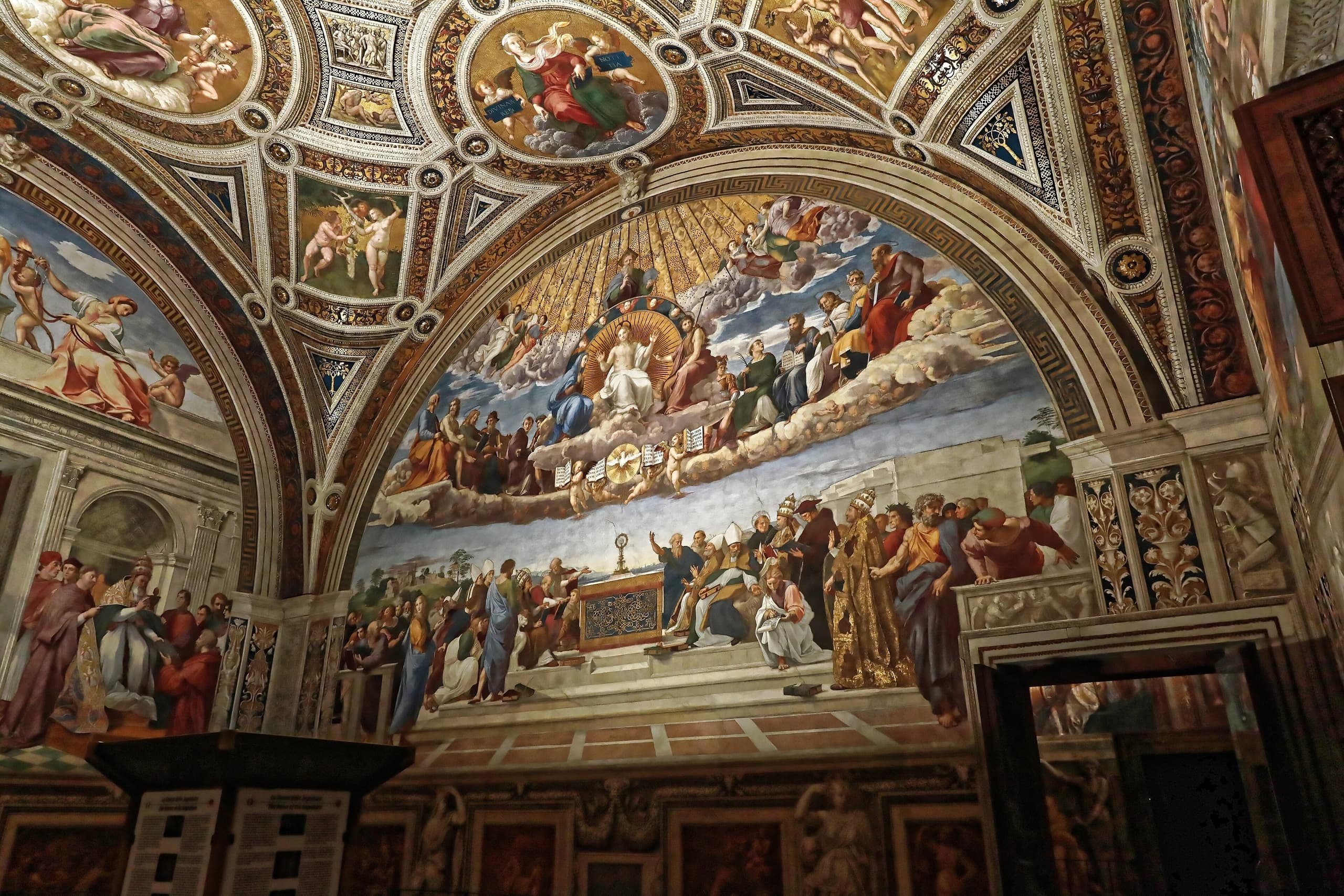
The fresco is divided into two broad horizontal zones. Above, a curved arrangement of figures occupies a luminous, almost architectural heaven. Below, a denser group stands and sits on solid ground around a central altar. The join between the two registers is not a hard line so much as a change of light, space and density. Reading the painting means holding both halves in view at once, because the argument of the image runs vertically as well as across the crowd.
The small centre
For a wall nearly eight metres wide, the earthly focus is deliberately modest: an altar and the sacrament set upon it. Figures lean, gesture and turn toward that point rather than toward any single human speaker. The composition does not dramatise a miracle in progress. It organises attention around an object that is small in the field and large in meaning, so that the eye keeps returning to a quiet vertical axis.
Bodies built for a room
At five metres high the figures are scaled to a real interior, not to a portable panel. Lower bodies stand near the viewer’s own height; upper ones recede into a painted vault of gold and cloud. The fresco was made for the Apostolic Palace itself, so the painted architecture and the room’s actual walls were meant to be experienced together. Standing before it is less like looking into a window than like finding the chamber continued upward into another order of space.
The story
The Disputation of the Holy Sacrament is a fresco by Raphael, begun in 1509, on a wall of the Apostolic Palace. It belongs to the suite of rooms later called the Stanze di Raffaello and was the first part of his commission to decorate them. The room itself was then known as the Stanza della Segnatura. It served as a private papal library and as a place where the supreme papal tribunal met. The painting is religious art in the High Renaissance manner, executed in true fresco, and it measures five hundred centimetres in height by seven hundred and seventy in width. It remains in the Vatican Museums’ care, still on the wall for which it was made.
What the fresco shows is not a single narrative episode with a clear before and after. Its subject, named in the title, is a disputation concerning the Holy Sacrament: a gathering of minds around the Eucharist, set beneath a vision of the divine. The wall is organised in two registers. The upper zone presents a heavenly company arranged in a broad curve, lit with a gold that behaves almost like architecture. The lower zone is earthly, crowded, and more tightly locked to the floor plane. Between them, and binding them, runs a central axis that leads the eye to the sacrament on the altar below and to the corresponding focus above.
That double structure is the painting’s main invention as a piece of looking. The upper register does not simply illustrate doctrine; it supplies a second space in which the same truth is already held without argument. The lower register supplies the argument: gestures, books, turning heads, the ordinary work of interpretation. Because both zones share one wall and one continuous light, the fresco treats heaven and the Church as participants in a single composition rather than as separate pictures stacked for convenience.
The making matters to the effect. Fresco painting fixes pigment into wet plaster, so the design had to be carried in measured sections and committed as the wall set. On this scale — a surface well over seven metres across — the method favours clear large rhythms over fussy incident. Raphael’s figures are grouped so that clusters read from a distance, while individual poses still reward a closer stand. The lower edge meets the room; the upper edge dissolves into painted gold. A viewer in the Stanza does not confront a framed easel picture but a wall that has been turned into a theological interior.
Nothing in the secure facts requires us to treat every identity in the crowd as settled, and the painting does not depend on a complete roll-call to work. What it does depend on is the relationship between the sacrament as a small, stable centre and the surrounding human activity as motion and speech. The eye is repeatedly sent back to that centre, then released again into the throng, then drawn upward. The fresco is less a record of one debate than a diagram of how belief, teaching and vision were imagined to occupy the same room — which, in a papal library that also housed a tribunal, was not an abstract idea.
As the opening campaign of Raphael’s work in these apartments, the Disputation also sets a standard for how the later walls would have to behave: monumental, lucid, and keyed to the functions of the chamber rather than to private devotion alone. It is High Renaissance religious art in the strict sense that doctrine is given the clarity and balance of a public order, painted where those who governed the Church already read, judged and decided.
Why it mattered then
In 1509 the Stanza della Segnatura was not a museum gallery. It was a working room in the Apostolic Palace: a private papal library and the meeting place of the supreme papal tribunal. A fresco of the sacrament on that wall placed the central mystery of the Church inside the very space where learning and judgement were exercised. The choice of subject suited a library. Disputation was a formal method of theological argument; the painting turns that method into a permanent environment rather than a passing event. At roughly five by seven point seven metres, the work also announced the ambition of Raphael’s new Vatican commission. It was the first of the room decorations later known as the Stanze, and it had to prove that fresco on this scale could hold doctrine, human variety and architectural calm in one view. For a High Renaissance court culture that prized lucid order, that combination was not decoration only. It was a claim about how truth should look when it is taught and defended.
Why it matters now
The fresco still hangs in the Apostolic Palace, in the care of the Vatican Museums, so the relationship between painted wall and real room has never been broken by relocation. That continuity is part of its present interest. Much later religious painting is encountered as a portable object; this one remains an installed argument about space. Its two-register design also continues to teach a way of looking. Viewers must decide how to hold heaven and earth in a single act of attention, and how a small central object can organise a surface nearly eight metres wide without theatrical excess. In an age that often separates image, text and institution, the Disputation keeps visible a moment when a library wall was expected to stage theology as something one stood inside. It matters less as a souvenir of Raphael’s name than as a surviving model of how a public faith once asked to be seen: balanced, communal, and built into the architecture of power and study.
The surprising detail
The fresco’s first home was not a chapel. It was painted for a room used as a private papal library and as the seat of the supreme papal tribunal — a chamber of books and judgement rather than of liturgy alone. The sacrament at the centre of a disputation therefore sat, from the beginning, among the ordinary instruments of reading and decision. The wall that seems to open into heaven was made for people who came there to work.
What is disputed
Wikidata gives the inception date as 1509; the wider dating sometimes offered for the wall runs into 1510. The secure facts also do not settle every individual identity in the lower crowd, and the painting should not be treated as if it did. What is firm is the artist, the medium, the dimensions, the palace location, and the work’s place as the first part of Raphael’s Stanze commission.
Remember this
A library wall in the Apostolic Palace becomes a two-storey diagram of the sacrament: heaven above, argument below, one quiet centre holding both.
Test yourself
Why does it change the meaning of the fresco that it was made for the Stanza della Segnatura — a papal library and tribunal room — rather than for an altar wall in a chapel?
Because the setting turns the subject from a focus for sacramental ritual into a permanent environment for thought and judgement. In a chapel the sacrament is encountered in liturgy. In a library-tribunal the same image stands among reading and legal decision, so the painted disputation mirrors the room’s own work: interpreting, teaching, and settling questions. The two registers then read differently as well. Heaven is not only a vision above an altar; it is the authority imagined to preside over study. The lower crowd is not only a congregation; it is a picture of argumentative labour in a place built for that labour. Location is part of the iconography.
Go deeper
- Disputation of the Holy Sacrament · Wikipedia
- Disputation of the Holy Sacrament — Wikidata · Wikidata
Image: Burkhard Mücke, CC BY-SA 4.0. Licence: CC BY-SA 4.0. Source.