III · THE WORK · ART HISTORY
Norra skenet
▶ Listen · narrated
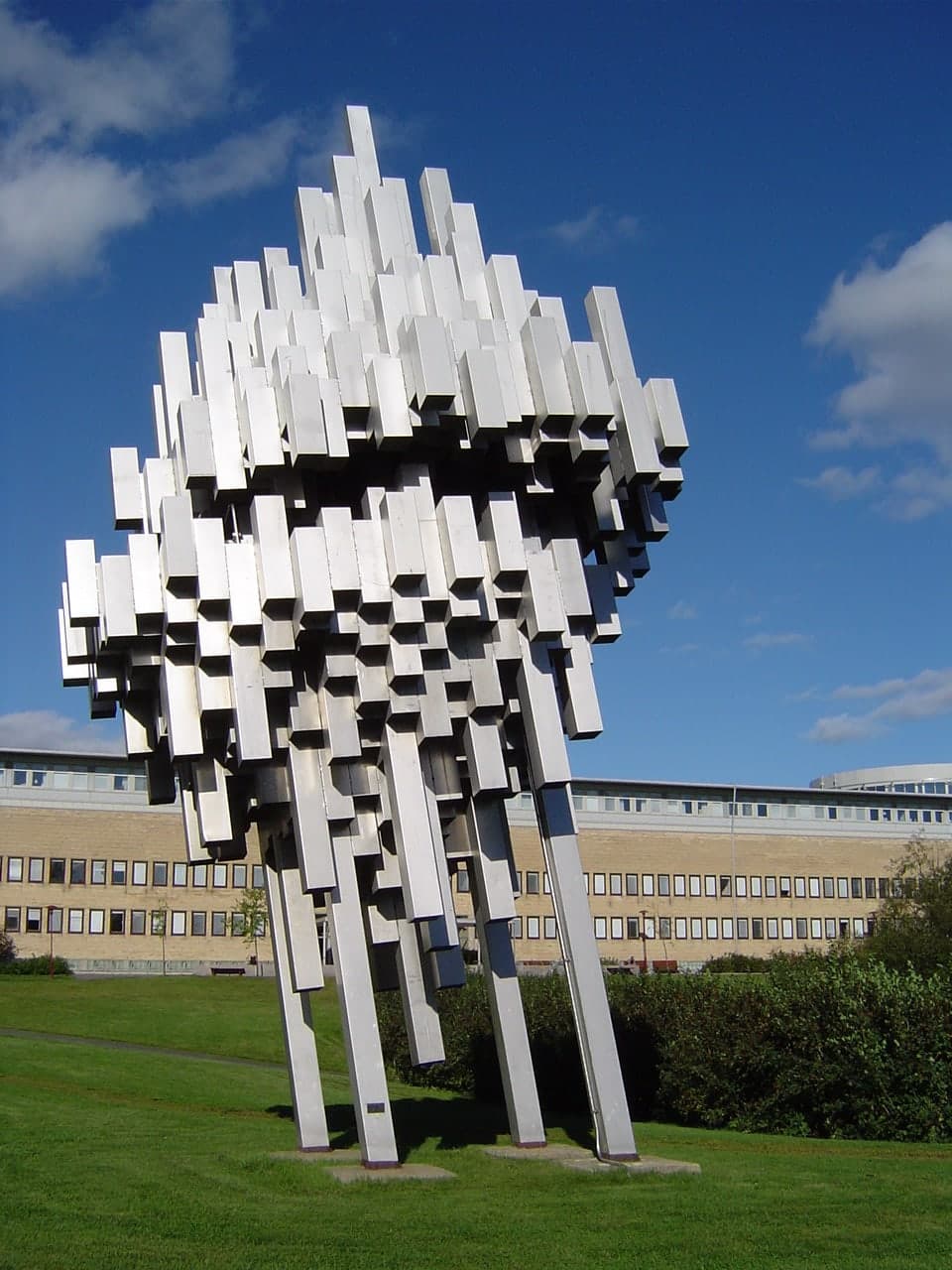
Public art has nowhere to hide. Ernst Nordin’s Norra skenet, finished in stainless steel in 1969, stands on the ground students and staff already use.
At a glance
- Artist
- Ernst Nordin
- Date
- 1969
- Material
- Stainless steel
- Location
- Umeå University
- Type
- Public sculpture
Look closer
Steel in the open
The work is made of stainless steel and sited outdoors on a university campus. That pairing is not incidental. Stainless steel does not ask for a climate-controlled room; it can take weather, light and the ordinary traffic of people walking past. Whatever else the sculpture does formally, its material already announces that it was meant to stay outside and keep its surface.
A campus, not a plinth room
Norra skenet is public art at Umeå University. The setting matters as much as the object. A sculpture on a campus is met by people who did not set out to visit a museum: students, staff, visitors moving between buildings. The work has to hold attention without a ticket desk or a label wall beside it, and without the quiet that galleries assume.
A date fixed to a place
The sculpture’s inception is given as 1969. That year pins the work to a specific moment in the life of the campus rather than to a touring exhibition or a private collection. Once installed, a public piece of this kind tends to become part of how the ground itself is remembered: not a loan, but a fixture.
The story
Norra skenet is a sculpture by Ernst Nordin. It was made in stainless steel and dates from 1969. It stands at Umeå University and is classed as public art: an object meant to be encountered in shared outdoor space rather than behind gallery doors.
Those few facts already shape how the work asks to be looked at. Stainless steel is a hard, reflective industrial material. Used for a freestanding sculpture, it keeps a cool surface that changes with daylight and weather. It does not soften into stone’s matt absorption or bronze’s familiar dark patina; it stays bright, and it can look almost provisional one hour and severe the next, depending on the sky. Nothing in the supplied record describes the exact silhouette or the joints, so any close looking has to begin with what can be stated without invention: metal, mass, and an open site.
The campus location is part of the composition in a broad sense. Public sculpture does not control its audience. People arrive sideways, on the way to somewhere else, in groups or alone, in snow or in glare. Nordin’s work has to survive that casual, repeated viewing. Its title, Norra skenet, ties the piece by name to a northern phenomenon of light, but the sculpture itself remains a physical object in steel, fixed to university ground in Sweden.
As modern public art from the late 1960s, the piece sits in a period when many artists and commissioners were testing how abstract or non-figurative forms could occupy civic and institutional space. The verified record does not spell out the brief, the commission process, or contemporary reactions. What it does confirm is the outcome: a named stainless-steel sculpture, dated 1969, still identified with the Umeå University campus.
Looking, then, is less about decoding a hidden narrative than about attending to presence. The work occupies real volume. It meets weather. It shares paths and sightlines with buildings and planting. Its meaning is bound up with remaining where it was put—available, durable, and part of the ordinary route across the site.
Why it mattered then
In 1969 a stainless-steel sculpture installed on a university campus was a clear statement about where art could live. The choice of material suited permanent outdoor display. The choice of site treated the university not only as a place of study but as a public landscape that could carry a major work without a museum frame. For a campus community, the arrival of such a piece marked the ground with a contemporary object rather than a borrowed historical one. Even without a detailed paper trail of the commission in the facts to hand, the date, material and location together show an institution willing to fix modern sculpture into daily circulation.
Why it matters now
Norra skenet still matters because it continues to do the ordinary, difficult work of public art: it stays put. Generations of people pass it without buying a ticket. Stainless steel, if maintained, keeps the work legible outdoors decades after 1969. In debates about whether universities are only interiors of teaching or also civic terrains, a permanent sculpture on campus remains a quiet argument that looking belongs in the open, among routes people already walk. The piece also reminds us how little a spare factual record can hold. Name, maker, material, date and place are enough to locate the work, and not enough to exhaust it.
The surprising detail
The factual record for Norra skenet is strikingly spare for an object that occupies a university campus: maker, year, material, place, and the status of public sculpture. There is no supplied account of measurements, cast or fabrication method, or a documented unveiling. The work is highly visible in daily life and thinly described on paper—an imbalance typical of some public pieces that are lived with more than they are written up.
What is disputed
The supplied facts confirm creator, date, material, location and public-art status, but they do not describe the sculpture’s exact form, dimensions, fabrication method or early reception. Close visual claims beyond the presence of stainless steel in an outdoor campus setting should be treated as unavailable here rather than filled in by guesswork.
Remember this
Norra skenet is Ernst Nordin’s 1969 stainless-steel sculpture—public art fixed to the open ground of Umeå University.
Test yourself
Why does calling Norra skenet “public art” change what counts as its setting, beyond the simple fact that it stands outdoors?
Because public art is defined by shared access, not only by weatherproof materials. On a university campus the sculpture is met by people who may not have come to see art at all. Its setting is therefore the circulation of the campus itself—paths, schedules, seasons—rather than a dedicated gallery room. Stainless steel supports that condition, but the genre names the social arrangement: the work remains available without a ticket and without controlling who arrives.
Go deeper
Image: Yogb21. Licence: CC BY-SA 3.0. Source.