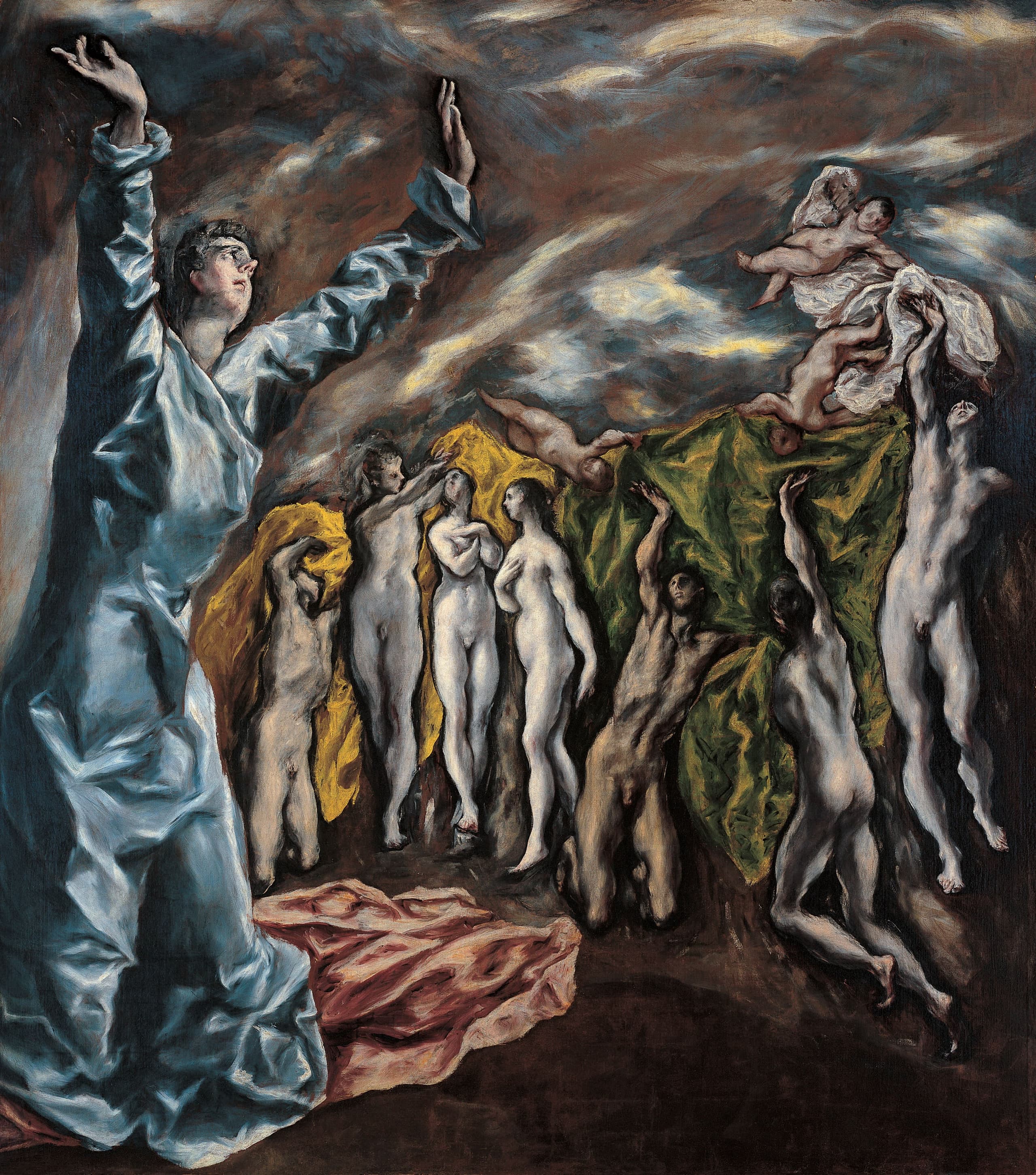
I · THE OBJECT · BRITISH MUSEUM
Opening of the Fifth Seal
▶ Listen · narrated
A large oil on canvas from 1610, unfinished and much abraded, still carries the force of a late Mannerist vision made for a church beyond Toledo’s walls.
At a glance
- Date
- 1610
- Material
- Oil paint on canvas
- Dimensions
- 222.3 × 193 cm (6 ft 4 in)
- Genre
- Religious art
- Movement
- Mannerism
- Collection
- Metropolitan Museum of Art
Look closer
Unfinished and abraded
The Metropolitan Museum states plainly that the picture is unfinished and much damaged and abraded. What remains is therefore not a polished final statement but a late work stopped short, its surface worn. Looking becomes an act of reading through loss: the composition still holds, yet the paint does not everywhere complete the forms it began.
A name that shifted
Before 1908 the painting was referred to as Profane Love. Manuel B. Cossío doubted that title and proposed Opening of the Fifth Seal instead. The change is not a small label correction; it moves the work from a secular reading to a specific passage of the Apocalypse and to the Vision of Saint John. The canvas itself did not change. The framework around it did.
Altar scale, side chapel
At 222.3 centimetres (7 ft 4 in) high and 193 centimetres (6 ft 4 in) wide, the painting was made for a side-altar of the church of Saint John the Baptist outside the walls of Toledo. The size suits devotion at close range rather than a distant high altar. Mannerism here serves a liturgical brief: religious art designed to hold a worshipper’s eye in a particular niche of a particular church.
The story
The Opening of the Fifth Seal is an oil painting on canvas by El Greco, dated to 1610 and now in the Metropolitan Museum of Art under the inventory number 56.48. It stands 222.3 centimetres (7 ft 4 in) high and 193 centimetres (6 ft 4 in) wide. It is religious art, aligned with Mannerism, and it belongs to the last years of the painter’s life.
It was made for a side-altar of the church of Saint John the Baptist outside the walls of Toledo. That setting matters. The work was not a gallery piece or a private cabinet picture; it was an altar painting for a church dedicated to the saint whose vision it shows. Alternative titles recorded for it include The Fifth Seal of the Apocalypse and The Vision of Saint John. The subject, once recognised, ties the canvas to the Book of Revelation and to the moment when the fifth seal is opened.
For a long time that recognition was not the one in use. Before 1908 the painting had been referred to as Profane Love. The scholar Manuel B. Cossío had doubts about that title and suggested Opening of the Fifth Seal. The older name implied a secular allegory; the newer one restored a scriptural programme suited to an altar in a church of Saint John. Evidence for how firmly either title was fixed in earlier centuries is thin beyond this scholarly correction, and the shift itself shows how far a painting’s identity can depend on the words attached to it.
The Metropolitan Museum comments that the picture is unfinished and much damaged and abraded. Those conditions are part of what the visitor meets. Passages remain unresolved; the surface has suffered. The work that survives is therefore both a late Mannerist religious painting and a damaged, incomplete object. Its force does not rest on perfect preservation. It rests on the ambition of the commission, the clarity of the Apocalyptic subject once the title was reconsidered, and the stubborn presence of a large canvas that never received its last layer of finish.
Why it mattered then
In its own moment the painting answered a local liturgical need. A side-altar in the church of Saint John the Baptist outside Toledo’s walls required an image that could speak to the dedication of the church and to the end of sacred history. El Greco, working in the Mannerist idiom of his late career, supplied a vision of Saint John and the fifth seal. The choice of subject bound altar, saint, and scripture together. Scale and placement kept the work within the ordinary economy of church furnishing: large enough to command a chapel, specific enough to belong there and nowhere else. Whether the painting was left unfinished by design, by interruption, or by the painter’s final years is not settled in the record given here; what is clear is that it was conceived as religious art for active devotion, not as a fragment for later museums.
Why it matters now
It still matters because it sits at the crossing of three durable problems: how we title what we cannot fully document, how we look at unfinished and damaged pictures, and how Mannerism carries religious urgency rather than mere stylish stretch. The move from Profane Love to Opening of the Fifth Seal is a reminder that scholarship can reverse a painting’s meaning without touching a brush to the canvas. The museum’s own note on its unfinished, abraded state keeps viewers honest about what is missing. And the work’s survival in the Metropolitan Museum of Art, far from the Toledo side-altar for which it was painted, asks what remains of a sacred commission when the church context is gone and only oil, canvas, and a contested name are left.
The surprising detail
For years the painting went under a title that pointed away from scripture altogether. Profane Love framed it as secular allegory. Only when Manuel B. Cossío questioned that name and proposed Opening of the Fifth Seal did the Apocalyptic reading take hold—before 1908 the older title was the one in use. The canvas had not changed; the story told about it had.
What is disputed
The Metropolitan Museum notes that the picture is unfinished and much damaged and abraded; how much of the present appearance belongs to the painter’s stopping-point and how much to later loss is not separated in the available record. The pre-1908 title Profane Love and Cossío’s proposed replacement show that the subject was open to doubt; the original documentation that would settle every detail of the commission is not supplied here.
Remember this
A late El Greco altarpiece, unfinished and abraded, once called Profane Love and renamed when a scholar read it as the Fifth Seal.
Test yourself
Why does the change from the title Profane Love to Opening of the Fifth Seal matter more than a simple correction of catalogue wording?
Because the earlier title steered viewers toward a secular allegory, while Cossío’s suggestion restored a scriptural subject—the Vision of Saint John and the fifth seal—suited to a side-altar in a church of Saint John the Baptist. The paint stayed the same; the framework that made the image legible as religious art did not. Titles do not only label pictures; they decide which story the eye is prepared to see.