III · THE WORK · ART HISTORY
Emerald Buddha
▶ Listen · narrated
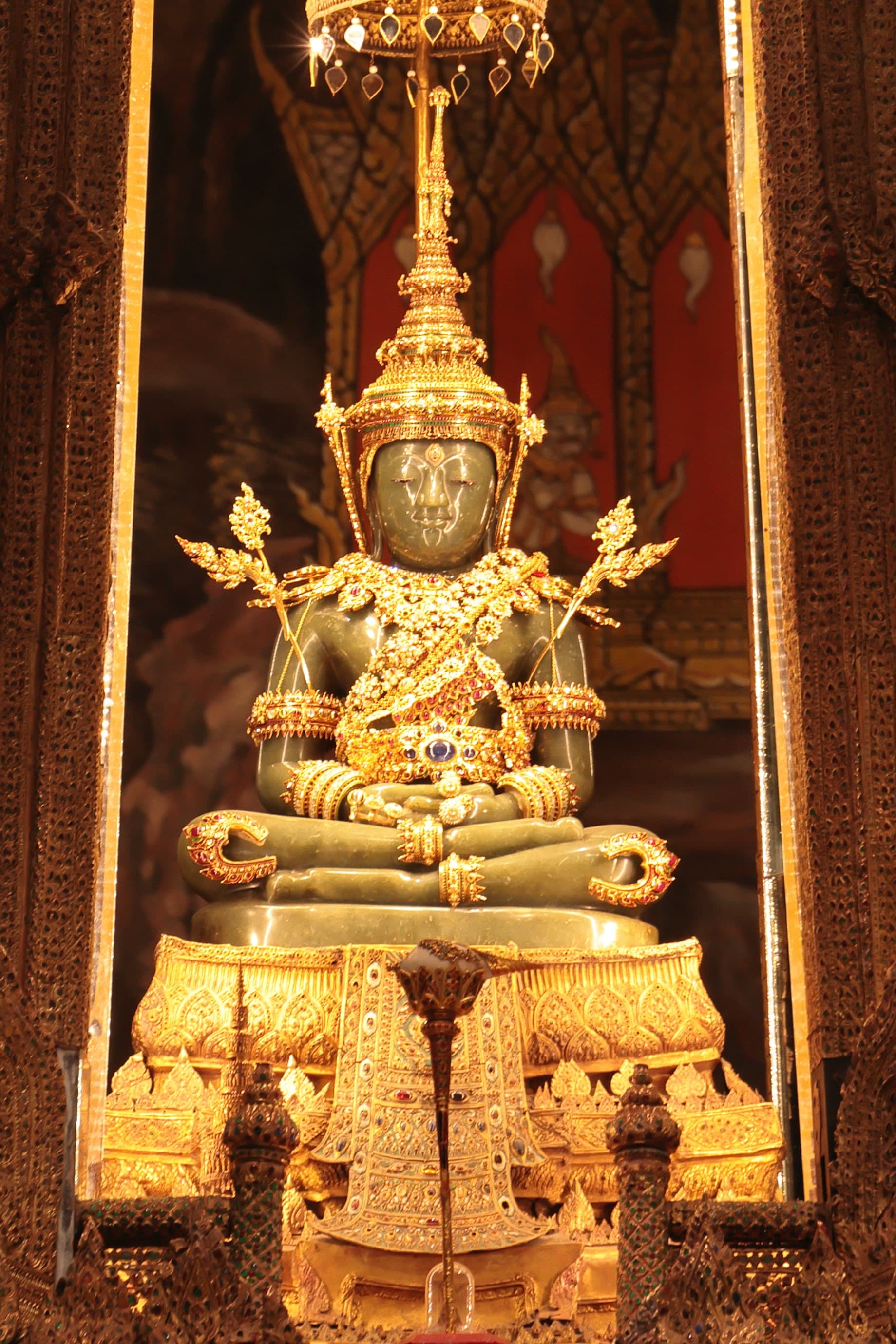
The sculpture is not emerald. It is nephrite, made in the sixteenth century in the Lanna kingdom, and its scale is intimate: sixty-six centimetres tall by forty-eight across.
At a glance
- Origin
- Lanna
- Date
- 16th century
- Material
- Nephrite
- Height
- 66 centimetres (2 ft 2 in)
- Width
- 48.3 centimetres (1 ft 7 in)
- Location
- Chapel of the Emerald Buddha
Look closer
A body built for stillness
The figure is a seated Buddha in meditation, compact enough to hold almost within an arm’s span. At sixty-six centimetres high and a little over forty-eight wide, the proportions favour a broad, settled base rather than vertical drama. What the carving asks of the viewer is close attention, not distance: the pose is closed, the limbs drawn in, the whole mass organised around a single unbroken silhouette.
Stone that is not what it is called
The sculpture is cut from nephrite, a hard green stone. The name Emerald Buddha does not describe the mineral. Nephrite takes a polish that can look deep and almost waxy; it is dense enough to hold crisp edges in the folds of the robe and the planes of the face, yet the colour itself shifts with the light that falls on it. The misnomer is part of how the object has always been spoken about.
Lanna work, later chapel
The piece belongs to Lanna art and is recorded as originating in the Lanna kingdom. It now sits in the Chapel of the Emerald Buddha. The gap between those two facts matters for looking: the carving is not a product of the building that houses it. Genre, material and scale all point back to a northern workshop tradition; the chapel is the setting in which that older object is now encountered.
The story
The Emerald Buddha is a small sculpture: sixty-six centimetres high, forty-eight point three centimetres wide, cut from nephrite. It represents the Buddha seated in meditation. Nothing about those measurements suggests a monumental cult image meant to dominate a vast hall from afar. The figure is scaled for a room in which the viewer can stand near enough to read the stone itself — its colour, its polish, the way light moves across the carved surfaces.
It is Lanna work, from the sixteenth century, and it is classed as Lanna art. That origin is not a minor catalogue note. Lanna was a kingdom with its own sculptural habits; to call the piece Lanna is to place its making in a specific northern tradition rather than in the later capital where it is now kept. The object is also listed as an archaeological artefact as well as a statue, a reminder that its biography includes recovery, movement and rehousing, not only continuous temple use from the day it left the carver’s hands.
The material is the most stubborn fact of all. Nephrite is a tough, fine-grained green stone, capable of a soft lustre when polished and strong enough to take the shallow modelling of a monastic robe and the quiet geometry of a meditating face. It is not emerald. The English name — and the Thai names that likewise lean on the idea of a green jewel — fix the object in language as something rarer and more translucent than the stone actually is. Looking closely means holding that mismatch in mind: what you see is nephrite; what the title promises is a gem.
The sculpture’s present home is the Chapel of the Emerald Buddha. That setting shapes every contemporary encounter. The chapel frames the figure, controls approach, and turns a sixteenth-century Lanna carving into the fixed centre of a later ritual architecture. Composition, in that sense, is no longer only the arrangement of limbs and drapery on the block. It is also the relationship between a small green statue and the room built to hold it — a room that insists the viewer’s attention stop on this one object and nowhere else.
What can be said with confidence stops roughly there. The verified record gives date, material, dimensions, origin and location. It does not settle every story attached to the image’s travels, nor does it resolve how the popular name overtook the mineral fact. For close looking, that thinness is useful. It returns attention to what is actually present: a compact meditating figure in nephrite, made in Lanna in the sixteenth century, now seated in a chapel that bears its name.
Why it mattered then
In the sixteenth century a Lanna workshop produced a meditating Buddha small enough to be moved and dense enough, in nephrite, to survive handling. Scale and material together made the image portable without making it fragile. Within Lanna art that combination mattered: a figure of this size could serve as a focused object of devotion rather than as architectural sculpture fixed to a wall or niche. Its later status as a named palladium was not written into the stone at the moment of carving, but the carving’s compactness and durability were conditions that later politics and ritual could use. The object was made to be looked at closely; that is what the measurements still show.
Why it matters now
The sculpture still forces a simple correction every time it is described. People arrive expecting emerald and meet nephrite. That gap between title and substance is not a trivial error; it is a lesson in how sacred objects accumulate names that outrun their materials. Standing before a sixty-six-centimetre figure in a dedicated chapel also recalibrates what “important” looks like. Monumentality here is not a matter of height. It is a matter of attention organised by a room around a single small body of green stone. For anyone trying to read religious sculpture without being dazzled by later myth, the Emerald Buddha remains a useful test case: origin, material and scale are still legible, and they still cut against the glamour of the name.
The surprising detail
The object universally called the Emerald Buddha is not made of emerald. The verified material is nephrite. The English title, and the older jewel-names attached to the image, describe a gem the carver never used. The mismatch has not displaced the name; it has simply travelled with it, so that every accurate material description has to begin with a quiet refusal of the title.
What is disputed
Popular accounts often call the stone jade or jasper rather than emerald; the verified material here is nephrite. Stories about the image’s discovery, travels and installation are fuller in later tradition than in the sparse factual record and should not be treated as settled.
Remember this
A sixteenth-century Lanna Buddha in nephrite, sixty-six centimetres high — green stone whose famous name does not match what it is made of.
Test yourself
Why does knowing the sculpture is nephrite, not emerald, change how you read both the object and its setting?
Because the chapel and the popular title both present the figure as a jewel-like treasure, while the stone itself is a tough, opaque green mineral used in Lanna carving. Once the material is clear, the “emerald” of the name becomes part of the object’s later reputation rather than a fact of its making. You start to separate what the sixteenth-century carver produced — a compact meditating Buddha in nephrite — from what centuries of naming and housing have asked that Buddha to mean.
Go deeper
Image: Mastertongapollo, CC BY-SA 4.0. Licence: CC BY-SA 4.0. Source.