I · THE OBJECT · BRITISH MUSEUM
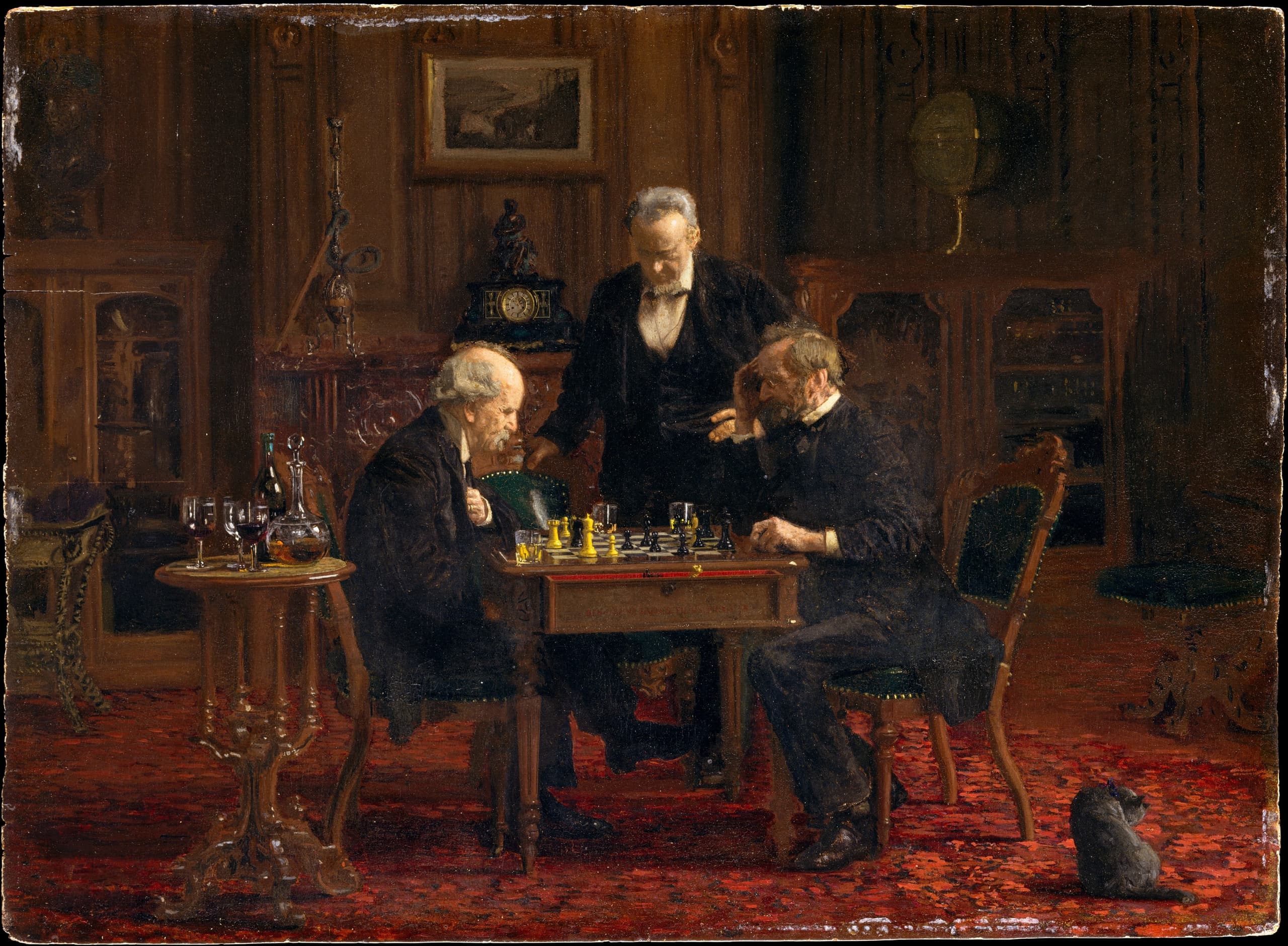
The Chess Players
▶ Listen · narrated
A United States genre painting from 1876, oil on a wooden panel, asks for close looking rather than spectacle, and still hangs in the Metropolitan Museum of Art.
At a glance
- Date
- 1876
- Artist
- Thomas Eakins
- Material
- Oil paint on wood
- Dimensions
- 29.8 × 42.6 cm (1 ft 5 in)
- Genre
- Genre art
- Collection
- Metropolitan Museum of Art
Look closer
Oil laid on wood
The support is wood, not canvas. Oil paint on a panel can take a smooth, hard ground and fine edges; it also keeps the object thin and compact. At this size the choice of wood is practical as well as technical: the painting is built for near viewing, not for holding a wall from across a room.
A deliberately small field
The panel is 29.8 centimetres (1 ft) high and 42.6 centimetres (1 ft 5 in) wide. Those measurements matter. They fix the work as something you approach, not something that advances on you. Genre scenes often lived at this domestic scale, where the subject could stay ordinary without looking trivial.
Genre, by classification
The record classes the painting as genre art: a scene of everyday life rather than history, allegory or formal portraiture. The title names chess as the action. Beyond that, the verified facts do not describe the room, the light or the number of figures. What is secure is the category, and the category shapes how the work was meant to be read.
The story
The Chess Players is a painting by Thomas Eakins, made in 1876. It is oil paint on wood, 29.8 centimetres (1 ft) high and 42.6 centimetres (1 ft 5 in) wide. The country of origin is the United States. The work is genre art, and it belongs to the Metropolitan Museum of Art, inventoried as 81.14.
Those are the facts that can be stated without stretching the record. They are enough to place the object, if not to furnish a full scene-by-scene account of what the brush recorded. The title supplies the subject in outline: people at chess. The genre label supplies the register: ordinary life, not public myth. The materials supply the means: oil, still the dominant medium for serious painting in the later nineteenth century, carried on a wooden panel rather than stretched cloth.
Eakins is named as the creator. No co-painter, studio hand or later intervenor appears in the verified data. The inception date, 1876, fixes the work in a single year without explaining the commission, if there was one, or the first owner. Nothing here describes how the panel was found, recovered or first exhibited. It is simply a finished painting that later entered a major public collection and has remained there.
The scale is worth sitting with. Under thirty centimetres in height, the surface cannot rely on grandeur. It has to hold attention through concentration of means: the weight of oil, the grain and stability of wood, the choice of a quiet subject. Chess suits that ambition. It is a game of long pauses and small gestures, already a social situation before anyone paints it. A genre painter did not need a battlefield or a throne room to justify the labour.
The museum context is part of the object’s later life. Collection and location are both given as the Metropolitan Museum of Art. The inventory number ties the panel to that institution’s cataloguing system. From the supplied facts one cannot reconstruct the path from studio to accession; one can only note that the painting is now a permanent-collection work in New York, available to be seen beside other American paintings of its century.
Restraint is useful here. Secondary literature has more to say about Eakins, about sitters and about catalogue numbers, but those details fall outside the facts fixed for this lesson. What remains is clear enough: an American genre painting of 1876, oil on wood, modest in size, made by Thomas Eakins, and kept under a museum number that still identifies it.
Why it mattered then
In 1876 a genre painting offered a way to treat contemporary life without the apparatus of history painting. Chess gave Eakins a subject already rich in attention, pause and social exchange. Oil on a small wooden panel suited private or close viewing as much as public display. The work’s American origin matters in its moment: it is a United States painting of ordinary leisure, not an imported European subject in American hands. Whether it was made for a particular patron is not recorded in the facts given; what is recorded is the choice of genre, medium and scale in that year.
Why it matters now
The painting still matters because it is a dated, attributed object that shows what one American painter did with oil, wood and a quiet subject in 1876. Its dimensions remain a corrective to the habit of equating seriousness with size. Held by the Metropolitan Museum of Art, it can be set beside other genre scenes and other works by Eakins in public collections. The secure facts are few; that scarcity is itself instructive. It forces attention back onto medium, measure, genre and custody rather than onto anecdotes the record does not support.
The surprising detail
For a work in a major museum, the core verified record is strikingly spare. Maker, year, materials, measurements, genre, country and inventory number are secure. The arrangement of the players, the room they occupy and the route by which the panel reached the Metropolitan Museum of Art are not stated in the facts supplied. The object is famous enough to carry a stable title and a museum number; the public certainty around it is narrower than the title alone might suggest.
What is disputed
The verified facts do not describe the figures, setting, light or early ownership. How the painting was first shown, sold or transferred into the Metropolitan Museum of Art is not given. Secondary accounts exist elsewhere; they are outside the facts fixed here, so sitters, room details and a find story are omitted rather than guessed.
Remember this
A small American genre painting of 1876: Thomas Eakins, oil on wood, 29.8 by 42.6 centimetres (1 ft 5 in), now Metropolitan Museum of Art 81.14.
Test yourself
The painting is oil on wood and under thirty centimetres high. What does that combination suggest about how it was meant to be looked at, and why is that fitting for genre art?
A wooden panel at this scale rewards near viewing: you come to it rather than reading it from across a gallery. Genre art treats everyday life, not public ceremony, so an intimate surface matches the subject. The materials do not prove a private commission—that is unstated—but they do show a work built for concentration, which suits a scene of chess.