II · THE DISCOVERY · HISTORY OF SCIENCE
Telephone
Before 1876, if you wanted to speak to someone out of earshot, you sent a letter or walked. The telephone made conversation instant across distance.
At a glance
- Discovery date
- 1876
- Credited to
- Johann Philipp Reis, Elisha Gray, Alexander Graham Bell, Antonio Meucci
- Credit status
- Contested
- Function
- Converts voice into electrical signals transmitted via wire
Look closer
The name says what it does
The word telephone comes from two Greek roots: tēle, meaning far, and phōnē, meaning voice. Distant voice. The name is a plain description of the function: it lets you hear someone speaking when they are too far away to be heard directly. Most of the technical terms for nineteenth-century inventions work this way — they name the thing by what it makes possible rather than how it works.
Two pieces doing opposite jobs
A working telephone needs two parts. The transmitter — now called a microphone — converts sound waves into electrical signals. The receiver — now called an earphone or speaker — does the reverse, converting electrical signals back into sound. Early telephones built both into a single handset held to ear and mouth. The signals travel along wires or, later, as radio waves, but the essential mechanism is the same: sound becomes electricity, travels, becomes sound again.
Credit is formally contested
The discovery date is recorded as 1876, and four men are named: Johann Philipp Reis, Elisha Gray, Alexander Graham Bell, and Antonio Meucci. The record explicitly marks the credit as contested, meaning there is no scholarly consensus on who invented the telephone. Bell received the United States patent in 1876, but that is a legal fact, not a scientific one. The others built devices that transmitted voice electrically, and the historical record does not settle who did so in a way that makes the others' work derivative.
The story
A telephone works by turning sound into electrical signals, sending those signals along a wire or through the air, and turning them back into sound at the other end. The transmitter — the part you speak into — vibrates when sound waves hit it, and those vibrations are converted into a varying electrical current. That current travels to a receiver, where it causes a membrane to vibrate in the same pattern, producing sound again. The result is that a voice spoken in one place can be heard in another, however far apart the two devices are, as long as they are connected.
The principle was worked out by several people in the 1870s. Johann Philipp Reis, Elisha Gray, Alexander Graham Bell, and Antonio Meucci are all credited with the discovery, and the credit is formally contested — there is no agreement on who should be called the inventor. Bell was granted a United States patent in 1876 for a device that produced intelligible replication of the human voice at a second device, but a patent is a legal document, not a historical judgment. The others built working devices, and the question of who did so in a way that counts as the invention is still disputed.
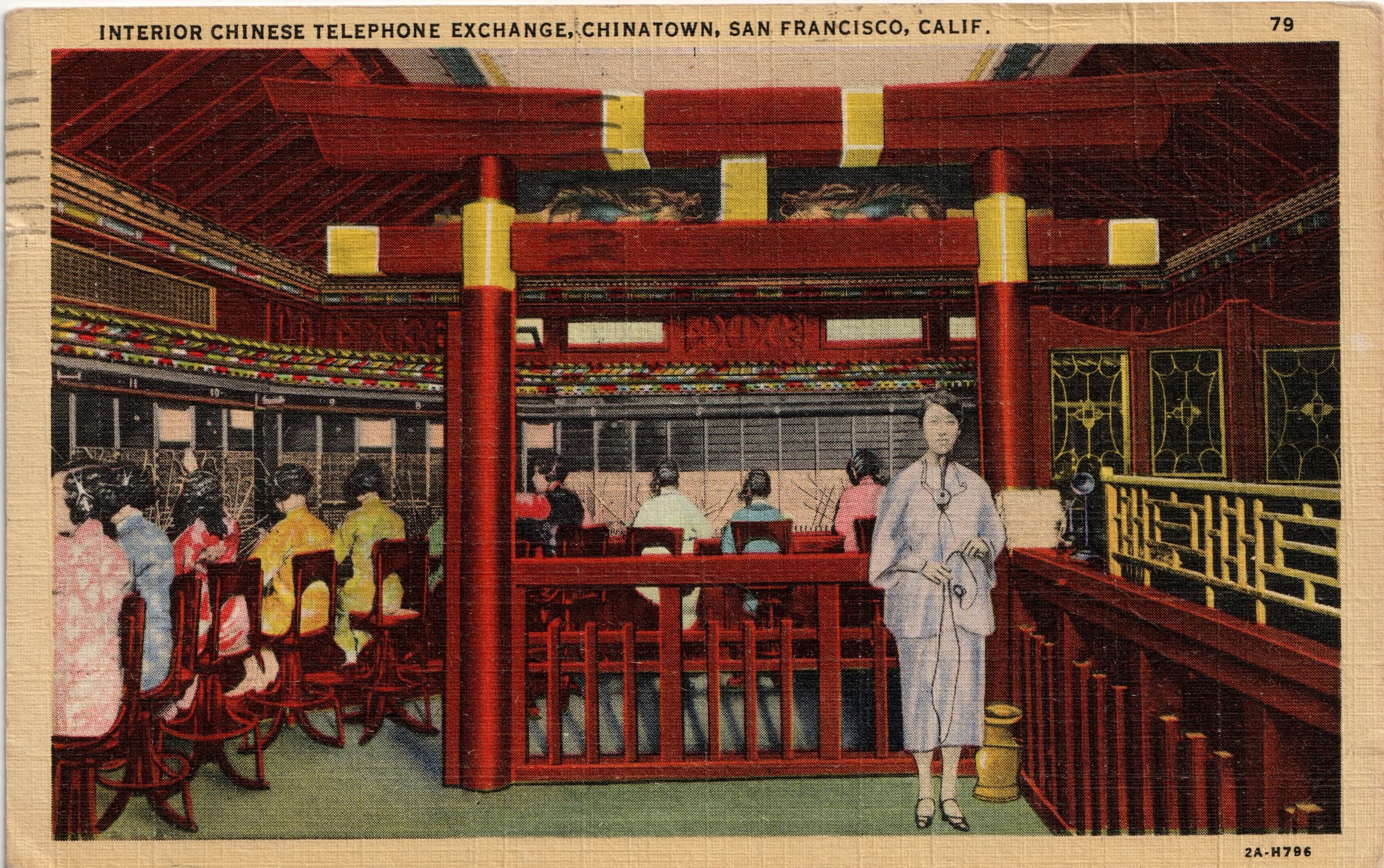
Early telephones connected two locations directly: one customer's office to another's. That works for a handful of users, but no more. The solution was the switchboard, a central location where an operator manually connected calls by plugging wires into the correct sockets. These exchanges were then connected to each other, eventually forming a network that could route a call from any telephone to any other. The system became automated over time, so that dialling a number — entering the address of the telephone you wanted to reach — completed the connection without human intervention.
The basic design remained stable for decades: a handset with a transmitter and receiver, a dial or keypad to enter a number, and a ringer to announce an incoming call. Mobile systems using radio transmission were developed in the mid-twentieth century, first for ships and cars, then as handheld devices starting in 1973. Those analog systems evolved into digital cellular networks, and eventually into the smartphone, which is now the dominant form of telephone.
Modern telephones exist in many forms — fixed-line, cellular, satellite, Internet-based — but they are all part of the same interconnected system, the public switched telephone network. Any telephone can reach any other through a unique number, regardless of the technology used. Some Internet-based services may not connect directly to that network, but they still allow communication across different systems when a connection is made.
Why it mattered then
Before the telephone, communication over distance meant writing a letter or sending a telegraph message — text only, transmitted in code. If you wanted to speak to someone, you had to be in the same room. The telephone made conversation instant and required no special training: you spoke, and the other person heard your voice. That changed how businesses operated, how governments coordinated, and how households stayed in touch. It became indispensable quickly, which is why the network of exchanges and connections grew so fast. The telephone did not just speed up communication; it made a new kind of communication possible, one that preserved tone, inflection, and the back-and-forth rhythm of speech.
Why it matters now
The public switched telephone network is still the backbone of global voice communication. Mobile phones, landlines, and Internet-based calling services are all integrated into it, so that any device with a telephone number can reach any other. The smartphone is now the dominant form, but it is still a telephone — it converts voice into electrical signals and transmits them to another device. The network built in the late nineteenth century, with its system of unique numbers and interconnected exchanges, is what makes it possible to call anyone, anywhere, from a device in your pocket. The principle has not changed: sound becomes electricity, travels, becomes sound again.
The surprising detail
The credit for inventing the telephone is formally contested, with four men named and no consensus on who should be called the inventor. Alexander Graham Bell received the patent in 1876, but Johann Philipp Reis, Elisha Gray, and Antonio Meucci all built devices that transmitted voice electrically. The historical record does not settle the question of whose work was the invention and whose was derivative. A patent is a legal judgment, not a scientific one, and the fact that the credit remains disputed more than a century later suggests that several people were working on the same problem at the same time, each contributing something the others did not.
What is disputed
The discovery is credited to Johann Philipp Reis, Elisha Gray, Alexander Graham Bell, and Antonio Meucci, and the credit is explicitly marked as contested. There is no scholarly consensus on who invented the telephone. Bell received the United States patent in 1876, but that is a legal judgment, not a resolution of the historical question. The others built devices that transmitted voice electrically, and the record does not settle whose work was the invention.
Remember this
The telephone turned sound into electricity so it could travel, then back into sound at the other end. The credit is contested.
Test yourself
Why does the telephone record credit four people and mark it as contested, rather than naming Bell alone as the inventor?
Because several people built devices that transmitted voice electrically in the 1870s, and there is no scholarly consensus on whose work counts as the invention. Bell received the United States patent in 1876, but a patent is a legal fact, not a historical one. Johann Philipp Reis, Elisha Gray, and Antonio Meucci also built working devices, and the question of who did so in a way that makes the others' work derivative is still disputed. The contested credit reflects that uncertainty honestly, rather than choosing one person because they won a legal case.
Go deeper
Image: Unknown author, Public domain. Licence: Public domain. Source.