II · THE DISCOVERY · HISTORY OF SCIENCE
Pluto
The discovery was not about seeing something faint, but about noticing something that had shifted — a method that turned patience and systematic comparison into a new world.
At a glance
- Discovered
- 18 February 1930
- Discoverer
- Clyde Tombaugh
- Location
- Outer Solar System
- Diameter
- 2376 kilometres
- Classification
- Dwarf planet, trans-Neptunian object
Look closer
The date is exact
The discovery is recorded to the day: 18 February 1930. That precision reflects the nature of the work. Tombaugh was not accumulating evidence over months; he was comparing two photographic plates and noting which point of light had moved. The discovery was the moment he identified the moving point, not the night he exposed the plates or the year he began searching.
The diameter is known
Pluto's diameter is recorded as 2376 kilometres. That figure came long after the discovery itself. When Tombaugh found Pluto, he had a moving point of light on two plates — enough to calculate an orbit, not enough to measure a size. The diameter required later observation, including measurements from spacecraft.
Multiple classifications
The facts list Pluto as a plutoid, a dwarf planet, a trans-Neptunian object, and a planet. That multiplicity reflects a change in definition. Pluto was called a planet at discovery and for decades after. The term dwarf planet was adopted later, and the earlier classification was not erased but supplemented.
The story
Clyde Tombaugh discovered Pluto on 18 February 1930 by comparing two photographic plates of the same region of sky, taken six nights apart. The method was systematic: photograph a patch of sky, wait, photograph it again, then examine both plates for any point of light that had shifted position. Stars stay fixed relative to one another; a planet, moving in orbit around the Sun, does not. The work required patience because the shift was small and the number of points of light on each plate was large. Tombaugh was looking for something that moved, not something that shone.
The discovery added a new object to the outer Solar System — the region beyond the orbit of Neptune. Pluto's orbit is recorded as eccentric, meaning it is not a circle but an ellipse, bringing it closer to the Sun at some points and farther away at others. The facts note that light from the Sun takes hours to reach Pluto, a measure of the distance involved. The object itself is made primarily of ice and rock, much smaller than the inner planets.
Pluto has five known moons. The largest, Charon, has a diameter just over half that of Pluto itself. The two are sometimes described as a binary system because the point around which they both orbit — their centre of mass — does not lie inside either body. That arrangement is unusual but not unique.
The classification of Pluto has changed. At discovery, it was called a planet. That status was questioned when additional objects were found in the same region, and the term dwarf planet was adopted to distinguish Pluto and similar bodies from the larger planets. The facts record both classifications without choosing between them, reflecting a change in definition rather than a change in the object itself.
Why it mattered then
The discovery in 1930 extended the known boundary of the Solar System. Before Tombaugh's work, Neptune was the outermost known planet. Pluto added a ninth, farther out, with an orbit that took it beyond Neptune's path. That extension mattered because it suggested the Solar System did not end where Neptune's orbit did — there was more to map. The method mattered as well. Tombaugh's technique of comparing plates to find a moving object was not new, but his success with it demonstrated that patient, systematic searching could find faint objects at great distances. The discovery did not depend on a larger telescope or a clearer night; it depended on taking two photographs, waiting, and looking carefully at the difference between them.
Why it matters now
Pluto remains the clearest example of how definitions in science can change without the object itself changing. The reclassification as a dwarf planet in 2006 was not a demotion in the sense that Pluto had altered; it was a decision about which objects the word planet should cover. That distinction matters because it shows how scientific categories are tools for organising knowledge, not fixed properties of nature. The outer Solar System is now understood to contain many objects, not just Pluto. The region beyond Neptune, called the Kuiper belt, holds bodies made of ice and rock, of which Pluto is one. The discovery in 1930 was the beginning of mapping that region, not the end of it. Spacecraft have since visited Pluto, taking measurements that were impossible from Earth, but the discovery itself remains a product of two photographic plates and the patience to compare them.
The surprising detail
The facts record that Pluto was named after the Roman god of the underworld, but they do not say who proposed the name or why it was chosen. The naming is listed as a significant event, but the details of that event are not given. What is certain is that the name stuck, and that it has been applied to a class of objects — plutoids — defined by their resemblance to Pluto in orbit and composition. The discovery gave its name to a category, not just to a single body.
What is disputed
The reference material states that Pluto's planetary status has been disputed and that many planetary astronomers continue to consider it a planet despite the 2006 reclassification. The facts list both 'planet' and 'dwarf planet' as classifications, reflecting that ongoing disagreement. The lesson presents both terms without resolving the dispute, because the facts themselves do not resolve it.
Remember this
Found by comparing two photographs of the same sky, taken nights apart, and looking for the point of light that had moved.
Test yourself
Tombaugh found Pluto by comparing photographic plates. What was he actually looking for in that comparison?
He was looking for a point of light that had moved between the two exposures. Stars stay fixed relative to one another on the timescale of days, but a planet in orbit around the Sun shifts position. The method did not require seeing something brighter or clearer; it required noticing something that had changed place. That shift, however small, was enough to identify Pluto as an object in the Solar System rather than a distant star.
Go deeper
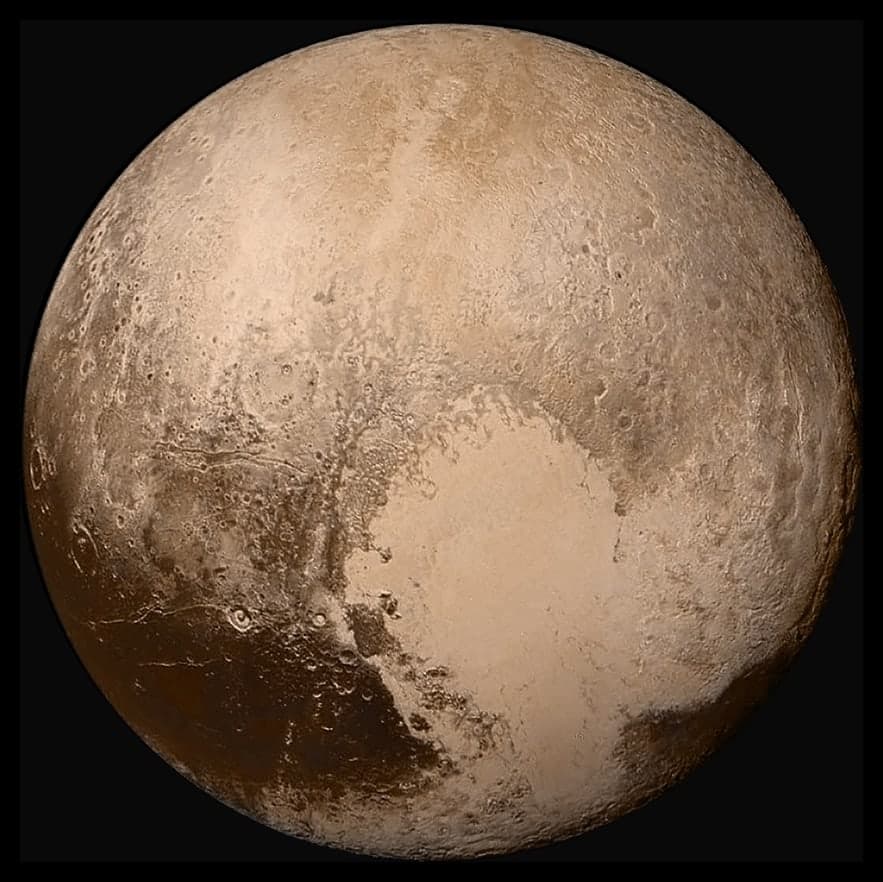
Image: NASA/JHUAPL/SwRI, Public domain. Licence: Public domain. Source.