III · THE WORK · ART HISTORY
Chair of Saint Peter
▶ Listen · narrated
Bernini’s Baroque chair was never only furniture. In bronze and gold leaf it turns a seat into an argument about succession, sight and power.
At a glance
- Creator
- Gian Lorenzo Bernini
- Dates
- 1647; 1658
- Materials
- Bronze; gold leaf
- Location
- St. Peter's Basilica, Vatican City
- Movement
- Baroque
- Type
- Sculpture; cathedra; reredos; ceremonial chair
Look closer
Gold leaf on bronze
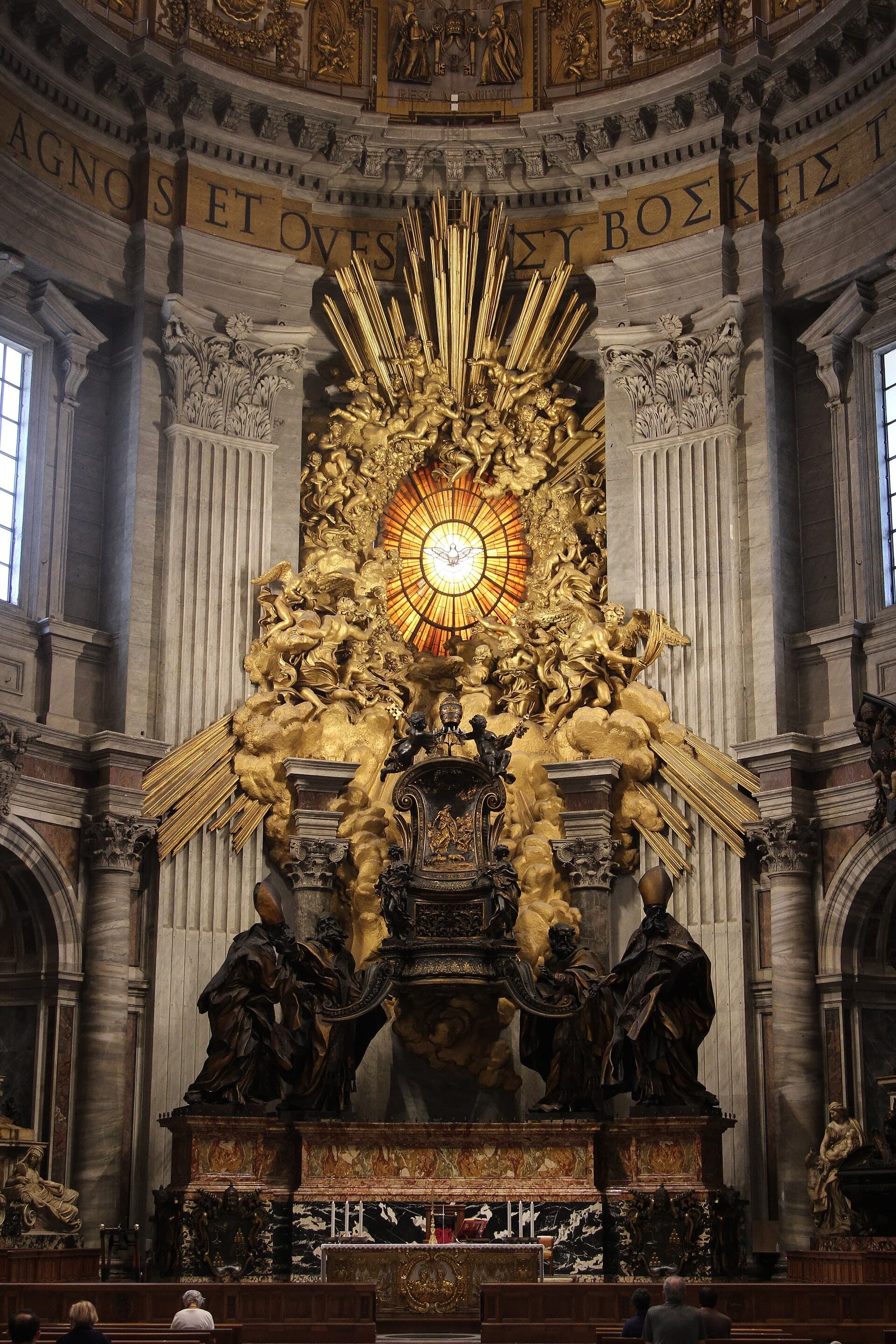
The surface is not a single metal reading. Bronze supplies the body and the structural weight; gold leaf, applied by gilding, catches and throws the light. In a vast interior the gilding does the optical work: it lifts the form out of shadow and makes the chair read from a distance as something other than dark mass. What looks like pure radiance is a layered fabrication — dense metal dressed to behave like light.
Chair, cathedra, reredos
The object is listed as several things at once: sculpture, ceremonial chair, cathedra and reredos. A cathedra is a bishop’s throne; a reredos stands at the back of an altar. Bernini’s work therefore occupies more than one role in the church’s furniture of meaning. It is something you look at as sculpture, something that marks a seat of office, and something that belongs to the altar wall. The categories do not cancel each other; they stack.
Scale against the basilica
The work stands inside St Peter’s Basilica in Vatican City. That setting is not neutral backdrop. A ceremonial chair only becomes an instrument of public claim when the room is large enough, and holy enough, for the claim to matter. The Baroque vocabulary — bronze, gold leaf, emphatic presence — is calibrated to hold its own against the volume of the building rather than to sit quietly within it.
The story
The Chair of Saint Peter that Gian Lorenzo Bernini made is, on the plainest inventory, a Baroque sculpture in bronze and gold leaf. Its inception is given as 1647 and 1658. It stands in St Peter’s Basilica in Vatican City. Those facts alone already place it: a major commission for the central church of the papacy, carried out by the sculptor most closely identified with Roman Baroque, over a span of years rather than months.
What the object is called matters as much as what it is made of. It is a ceremonial chair. It is also a cathedra — the formal seat of a bishop, and here the seat associated with the Bishop of Rome. It is further a reredos, which is to say it belongs to the architecture of an altar, not only to the history of furniture. And it is a sculpture: a work meant to be seen, approached and read in three dimensions. Bernini did not design a private seat. He designed a public emblem that could hold several kinds of meaning without dissolving into any one of them.
The materials do part of that work. Bronze gives the form permanence and mass; it can be cast, joined and modelled at architectural scale. Gold leaf, applied through gilding, changes how that mass behaves in light. In a basilica interior, where daylight is uneven and artificial light was historically limited, a gilded surface becomes a way of directing the eye. The chair does not need to shout in gesture alone; the finish helps it declare itself across distance.
Baroque is the movement to which the work belongs, and the term is useful if kept concrete. Baroque here means an art of address: forms made to confront a viewer inside a charged space, rather than to sit as neutral decoration on a wall. A ceremonial chair treated in this mode stops being a piece of church furniture and becomes an argument in metal about office, continuity and the right to speak from a particular seat.
The location seals the argument. St Peter’s Basilica is not a side chapel. To place a cathedra there, in bronze and gold leaf, is to fix a claim about spiritual authority at the physical centre of papal Rome. Visitors do not encounter the work as a relic of private devotion first. They encounter it as part of the basilica’s public theatre of meaning — sculpture and seat, altar furniture and emblem, all at once.
The two inception dates, 1647 and 1658, are a reminder that the piece was not a single flash of invention. It belongs to a long campaign of making. Whatever the precise stages those years mark, the span itself tells us that Bernini’s chair was built into the life of the basilica over time, not dropped into it finished overnight.
Why it mattered then
In the Early Modern moment that produced it, a gilt-bronze cathedra in St Peter’s was not a neutral artwork. The papacy needed visible forms that could carry claims of continuity and authority inside the chief church of Catholic Rome. Bernini’s language of Baroque sculpture — bronze mass finished with gold leaf, scaled to the basilica — answered that need by making the seat of office impossible to overlook. A ceremonial chair that was also a reredos tied the idea of teaching authority to the altar wall itself. The object did institutional work: it turned succession and jurisdiction into something a congregation could see.
Why it matters now
The work still matters because it shows how materials and typology can carry an argument. Bronze and gold leaf are not only technical choices; they are choices about permanence and visibility. Calling the same object sculpture, cathedra, reredos and ceremonial chair forces us to notice that religious art often refuses a single category. Standing in St Peter’s, it remains a case study in how Baroque form was used to stage authority in space — and how a seat can mean more than sitting.
The surprising detail
The same object is formally a sculpture, a cathedra, a reredos and a ceremonial chair. Those are not loose synonyms. One name stresses looking, one stresses episcopal office, one stresses the altar wall, and one stresses ritual use. Bernini’s work is built to bear all four at once, which is why a plain description as “a chair” always feels too small.
What is disputed
The inception is recorded as both 1647 and 1658. The sources do not, on the facts supplied here, settle what each date marks — commission, campaign, completion or another stage — so the span should be left as a span rather than narrated as a single finished year.
Remember this
Bernini’s Chair of Saint Peter is bronze and gold leaf made to act as sculpture, cathedra and reredos at once inside St Peter’s.
Test yourself
Why does it change our reading of the work to know it is classed not only as a ceremonial chair but also as a reredos?
A ceremonial chair could, in principle, be understood as freestanding furniture tied to office alone. A reredos belongs to the back of an altar: it is part of the altar’s architecture of display. If Bernini’s work is both, then the seat of authority is not placed near the liturgy by accident; it is bound into the altar wall’s visual and theological programme. The object is not beside sacred space. It helps form it.
Go deeper
Image: Fallaner, CC BY-SA 4.0. Licence: CC BY-SA 4.0. Source.