I · THE OBJECT · BRITISH MUSEUM
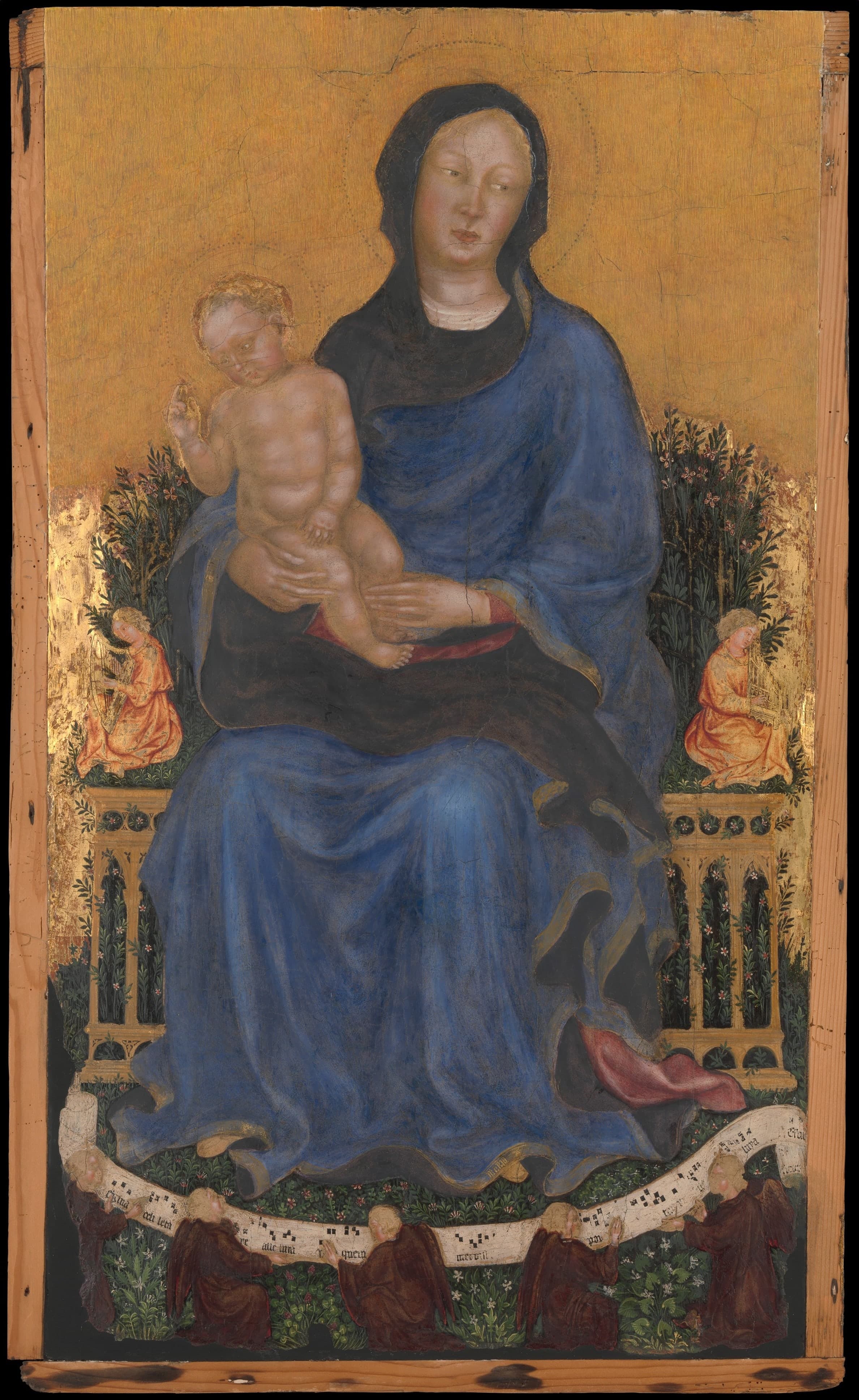
Madonna and Child with Angels
▶ Listen · narrated
Gentile da Fabriano made this Madonna around 1410 in tempera, panel and gold. It is religious art in the International Gothic manner, now in New York.
At a glance
- Date
- c. 1410
- Artist
- Gentile da Fabriano
- Materials
- Tempera on panel, with gold
- Dimensions
- 85.7 × 50.8 cm (1 ft 8 in)
- Movement
- International Gothic
- Accession
- 30.95.262
Look closer
Tempera, panel and gold
The support is a wooden panel. The paint is tempera. Gold forms part of the surface. These three materials were the ordinary luxury of International Gothic religious painting: a stable board, pigment bound for a hard luminous finish, and metal that caught light. Nothing in the recorded facts points to an experimental technique. Gentile worked inside a known and costly craft, not outside it.
A narrow upright field
The panel is 85.7 centimetres (2 ft 10 in) high and 50.8 centimetres (1 ft 8 in) wide — distinctly taller than it is broad. That upright proportion suits a focused sacred group rather than a wide narrative. The scale is modest: under a metre in height, half a metre across. The format itself suggests an intimate hanging, though the original room or chapel is not named in the sources used here.
Two names, one object
The formal title names the subject: Madonna and Child with Angels. The familiar short name, the Davis Madonna, names the modern collector. Theodore M. Davis acquired the panel in Florence early in the twentieth century and left it to the Metropolitan Museum of Art in 1915. One label describes what was painted around 1410; the other describes how the painting entered a public American collection.
The story
Madonna and Child with Angels is a painting by Gentile da Fabriano, made around 1410. It is tempera on panel, with gold. The work measures 85.7 centimetres (2 ft 10 in) in height and 50.8 centimetres (1 ft 8 in) in width. It belongs to the genre of religious art and to the movement known as International Gothic. Today it is in the Metropolitan Museum of Art, New York, under the inventory number 30.95.262.
The same panel is widely called the Davis Madonna. That name is modern. It records Theodore M. Davis, who acquired the painting in Florence early in the twentieth century and left it to the museum in 1915. So the object carries two identities at once: the sacred subject fixed in its formal title, and the collector through whom it reached a public collection in the United States.
Gentile da Fabriano is the securely named maker. The date sits at 1410, treated in related accounts as circa rather than a day-book certainty. International Gothic is the stylistic heading under which the work is placed: a late-medieval taste, shared across parts of Europe, for refined sacred images and rich surfaces, often including gold. The materials here — tempera, panel, gold — fit that heading without strain. They are the expected luxury of the type, not a departure from it.
What the surviving facts do not supply is the original commission. No patron, church, or private chapel is identified. The panel is known by what it depicts, who painted it, roughly when, in which materials, at what size, and by what route it entered the Metropolitan Museum of Art. Those points are firm. The rest of its early life remains outside the record drawn on for this lesson.
In that sense the painting is both complete and incomplete as a historical object. Complete as a dated, attributed, measurable work of religious art in the International Gothic manner. Incomplete as a story of first ownership and first setting. The double name — sacred title and collector’s surname — makes that split visible every time the panel is catalogued or discussed.
Why it mattered then
Around 1410 a Madonna and Child with angels was not an unusual subject. It was a standard form of religious art, made for devotion. Gentile’s use of tempera, panel, and gold placed the image in the elevated register of International Gothic painting, where a precious surface and a sacred theme worked together. For a viewer of that moment, gold was part of how holiness could be shown, not an optional flourish. The modest dimensions would have suited a more intimate setting than a vast altar wall, even if the precise original location is not recorded in the facts used here.
Why it matters now
The panel still matters because it is a dated and attributed example of International Gothic religious painting held in a major public collection. It ties an Italian artist of the early fifteenth century to an American museum through a documented modern bequest. For anyone tracing the taste that preceded the fuller forms of the Renaissance, Gentile da Fabriano marks the older, courtly manner; this Madonna is one concrete instance of that manner, fixed in tempera and gold, rather than a general claim in a survey. The two names under which it travels also keep the history of collecting in view beside the history of making.
The surprising detail
An early-fifteenth-century Italian Madonna is as often identified by an American collector’s surname as by its sacred subject. The Davis Madonna is still Gentile’s panel, still tempera and gold from around 1410 — yet common speech has folded Theodore M. Davis’s ownership into the object’s identity almost as tightly as the Virgin and Child themselves.
What is disputed
The inception is given as 1410; related accounts treat the date as circa 1410. The original commission, patron, and setting are not established in the sources used here. The exact circumstances of Davis’s purchase in Florence, beyond the fact of the acquisition, are likewise not detailed.
How it got here
Theodore M. Davis acquired the painting in Florence early in the twentieth century and left it to the Metropolitan Museum of Art in 1915. It remains in that collection under inventory number 30.95.262.
Remember this
A modest gold-ground Madonna by Gentile da Fabriano, painted around 1410, known both for its subject and for the collector who left it to the Met.
Test yourself
The painting is catalogued as Madonna and Child with Angels and also called the Davis Madonna. What does each name actually record, and what does relying on only one of them leave out?
The formal title records the sacred subject Gentile painted. The Davis name records Theodore M. Davis, who acquired the panel in Florence and left it to the Metropolitan Museum of Art in 1915. Using only the subject title can erase the modern path into the museum; using only the collector’s name can erase the artist, the date, the materials, and the religious genre. The double naming is a small lesson in how museum objects carry making and ownership at once.