II · THE DISCOVERY · HISTORY OF SCIENCE
Copper
Before smelting, metal meant whatever nuggets you found on the ground. Copper changed that: it was extracted from ore by heat, opening a supply no longer limited to surface finds.
At a glance
- Symbol
- Cu, from Latin cuprum
- Atomic number
- 29
- Known since
- Roughly the 7th millennium BC
- Named after
- Cyprus
- Ore minerals
- Chalcopyrite, chalcocite, covellite, bornite
Look closer
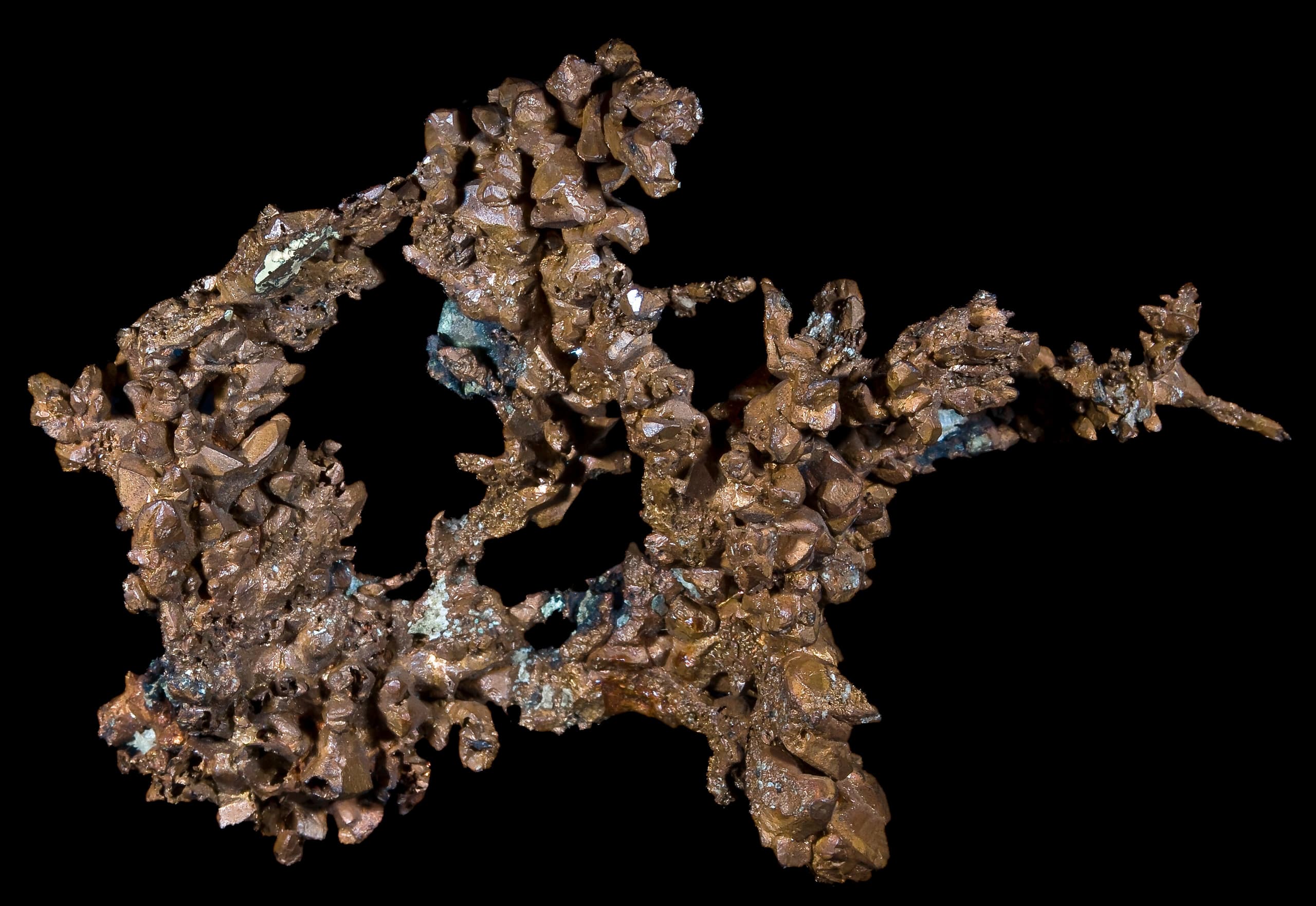
Native metal
Copper is one of the few metals that occur naturally in a form you can use directly, without smelting. A lump of native copper is already metal: malleable, ductile, and workable. That is why copper use begins millennia before copper smelting does. The timeline matters: people were shaping native copper roughly the seventh millennium BC, but smelting copper from sulfide ores — extracting it from rock by heat — came later, roughly the fifth millennium BC.
Pinkish-orange when fresh
A freshly exposed surface of pure copper has a pinkish-orange colour, but that is not the colour most people associate with the metal. Copper used in buildings, usually for roofing, oxidises over time to form a green layer of compounds called verdigris — a patina of copper salts that protects the metal beneath. The green roofs and domes on older buildings are copper that has reacted with oxygen and moisture in the air.
High conductivity
Copper has very high thermal and electrical conductivity, which is why it is used as a conductor of heat and electricity. It is soft, malleable, and ductile — meaning it can be hammered into thin sheets, drawn into wire, and bent without breaking. These properties made it useful in antiquity for tools and ornaments, and today for wiring, plumbing, and heat exchangers.
The story
Copper is a chemical element with the symbol Cu, from the Latin cuprum, and atomic number 29. It is named after Cyprus, though the exact reason for that connection is not detailed in the surviving record.
Copper is one of the few native metals — metals that occur naturally in a directly usable metallic form, not locked inside a compound. A nugget of native copper found on the ground is already metal. You can hammer it, shape it, and use it without further processing. That accessibility explains the early date: copper has been known since roughly the seventh millennium BC.
But native copper is rare. The larger story of copper is the story of extraction. Copper was smelted from sulfide ores — heated in a way that separates the metal from the rock — roughly the fifth millennium BC. The principal copper ores are chalcopyrite, chalcocite, covellite, and bornite, all sulfide minerals. Smelting them requires sustained high heat and some understanding of what happens when you heat rock in the presence of charcoal. Once that process was understood, the supply of copper was no longer limited to the occasional surface find.
Copper was also cast into a shape in a mould, roughly the fourth millennium BC, and purposely alloyed with another metal — mixed with tin to create bronze, roughly the third millennium BC. Bronze is harder than copper, and the bronze alloy gave its name to an entire period of human history.
Copper compounds, particularly copper(II) salts, often impart blue or green colours to minerals. Azurite, malachite, and turquoise are all copper-bearing minerals, and all have been used historically as pigments. Copper is sometimes used in decorative art, both in its elemental metal form and in compounds as pigments. Copper compounds are also used as bacteriostatic agents — substances that stop bacteria from reproducing — as well as fungicides and wood preservatives.
Copper is essential to all aerobic organisms — organisms that use oxygen. It is particularly associated with oxygen metabolism. It is found in the respiratory enzyme complex cytochrome c oxidase, in the oxygen-carrying protein hemocyanin, and in several hydroxylases — enzymes that add oxygen atoms to other molecules. Adult humans contain between 1.4 and 2.1 milligrams of copper per kilogram of body weight.
Why it mattered then
Before copper smelting, metal meant whatever you could find: the occasional nugget of native copper or gold lying on the surface. Smelting changed that. It meant you could take a rock that did not look like metal and extract metal from it by heat. That required recognising the ore, building a furnace hot enough, and understanding the process well enough to repeat it. Once copper could be smelted from sulfide ores, roughly the fifth millennium BC, the supply of metal was no longer limited to rare surface finds. Copper tools and ornaments became more common. Casting copper in moulds, roughly the fourth millennium BC, allowed shapes that could be reproduced and made in quantity. The alloying of copper with tin to create bronze, roughly the third millennium BC, produced a material harder than either metal alone. Bronze could hold a sharper edge than copper, which made it more useful for tools and weapons.
Why it matters now
Copper is used today primarily for its very high electrical and thermal conductivity. Most copper produced now goes into electrical wiring, motors, and electronics. It is also used in plumbing, in heat exchangers, and as a building material, particularly for roofing. Copper alloys remain important. Brass is copper alloyed with zinc. Bronze is copper alloyed with tin. Cupronickel, an alloy of copper and nickel, is used to make marine hardware and coins. Sterling silver, used in jewellery, contains copper. Constantan, an alloy of copper and nickel, is used in strain gauges and thermocouples for temperature measurement. Copper compounds are still used as bacteriostatic agents, fungicides, and wood preservatives. The metal's role in biology — essential to oxygen metabolism in all aerobic organisms — means it appears in enzyme complexes and oxygen-carrying proteins across the living world. The green patina that forms on copper roofing, called verdigris, is a layer of copper salts produced by oxidation. It protects the metal beneath from further corrosion, which is why copper roofs can last for centuries.
The surprising detail
Copper is essential to human biology, but only in small amounts: adult humans contain between 1.4 and 2.1 milligrams of copper per kilogram of body weight. It is particularly associated with oxygen metabolism, appearing in the respiratory enzyme complex cytochrome c oxidase and in several hydroxylases. Without copper, aerobic organisms — organisms that use oxygen — cannot function. The same metal that conducts electricity in wiring conducts electrons in the enzymes that allow cells to use oxygen.
What is disputed
The date precision recorded is 'millennium', and the discovery date reads 'known since roughly the 7th millennium BC'. This reflects the archaeological evidence: copper use is attested from roughly that period, but no specific year or century can be named. The smelting, casting, and alloying dates given in the reference text are similarly approximate, marked with 'c.' for circa, and are not recorded in the verified facts, so they are hedged here with 'roughly' and given as millennia rather than years.
Remember this
Copper was smelted from ore roughly the fifth millennium BC, cast in moulds roughly the fourth, and alloyed with tin roughly the third.
Test yourself
Why does the use of native copper begin millennia before the smelting of copper from ore?
Native copper is metal already. It occurs naturally in a directly usable metallic form, so it can be hammered and shaped without any extraction process. Smelting — heating ore to separate metal from rock — came later because it requires sustained high heat, the right kind of furnace, and an understanding of what happens when you heat sulfide minerals in the presence of charcoal. The gap between the two dates reflects the gap between finding something and learning how to make it.
Go deeper
Image: Didier Descouens, CC BY-SA 4.0. Licence: CC BY-SA 4.0. Source.