III · THE WORK · ART HISTORY
The Last Day of Pompeii
▶ Listen · narrated
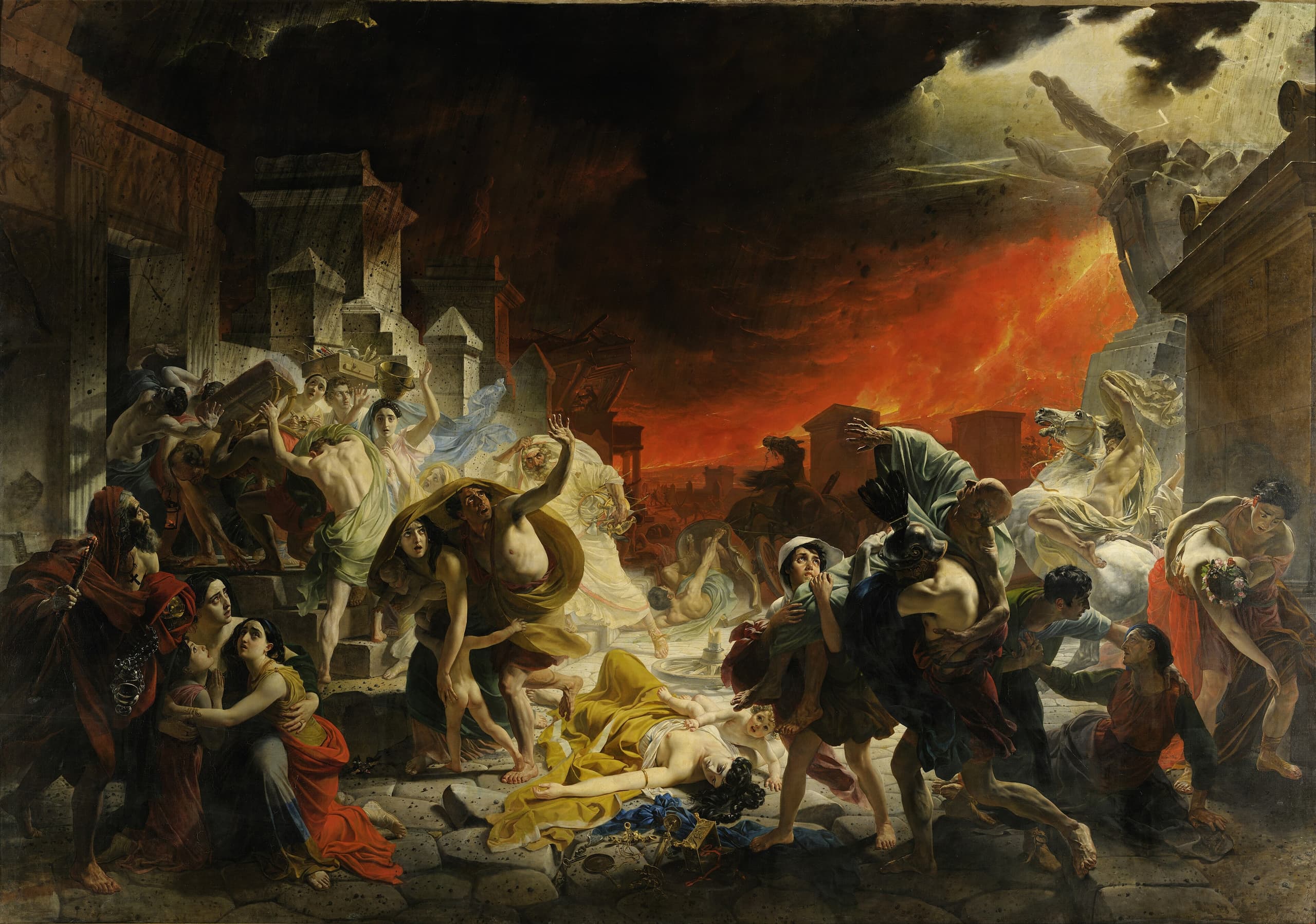
On a canvas taller than a room, classical bodies tumble through ash and falling masonry. Critics praised the skill and still wondered whether perfect flesh belonged in a catastrophe.
At a glance
- Artist
- Karl Bryullov
- Date
- 1833
- Medium
- Oil on canvas
- Dimensions
- 466 × 651 cm (21 ft 4 in)
- Genre
- History painting
- Location
- Russian Museum
Look closer
Bodies built for another kind of picture
Look at the modelling of the flesh and the calm geometry of the limbs. The figures are drawn in a classical manner — balanced, idealised, lit as if they had stepped out of a studio study — even as they scramble through falling masonry. That friction is not accidental. The painting sits between the Neoclassical training dominant in Russia at the time and a Romantic subject: nature overwhelming human order. Critics in France and Russia both noticed the mismatch and wrote about it.
A canvas that works like a stage
At more than six and a half metres across and nearly four and a half high, the surface is large enough to hold a crowd without collapsing into a blur. Figures are arranged in clusters across the width, some pressing forward, some already down, some turning back toward the light and ash above. The composition asks the eye to travel laterally, as if across a frieze, rather than settle on a single quiet centre.
Disaster as the true protagonist
Whatever individual drama unfolds among the people, the painting’s real pressure comes from above and behind them: the eruption, the falling stone, the glare. The human figures are many and carefully finished; the force that scatters them is treated as larger than any one of them. That is the Romantic claim inside a history painting — that nature can erase what people build, and that the canvas can make that scale feel present.
The story
Karl Bryullov’s The Last Day of Pompeii is an oil painting on canvas, finished in 1833 and now in the Russian Museum in St Petersburg. It measures 466 centimetres (15 ft 3 in) high by 651 centimetres (21 ft 4 in) wide. Its inventory number there is Ж-5084. It is a history painting: a large narrative scene drawn from the past rather than from a living sitter or a quiet interior.
The subject is the eruption of Mount Vesuvius in AD 79 and the destruction of Pompeii. Bryullov fills the width of the canvas with people in flight — men, women and children caught mid-motion among collapsing architecture and falling debris. The scale is not decorative. A surface this large lets him stage a crowd as a sequence of groups, each with its own knot of gesture, without reducing the disaster to a distant backdrop.
Stylistically the work sits in an awkward and interesting place. Neoclassicism was still the dominant trained manner in Russia when Bryullov painted it; Romanticism, with its taste for the sublime and for nature’s power over human structures, was already strong in France. The Last Day of Pompeii borrows from both. The bodies are classically modelled, their proportions idealised, their musculature and drapery finished with a care that belongs to academic study. The theme, by contrast, is catastrophe: ash, fire, falling stone, the end of a city. Critics in both France and Russia noticed that the perfection of those bodies seemed out of keeping with the desperate plight they were meant to be suffering. The observation has never quite gone away, because it is visible on the surface rather than hidden in theory.
The painting was received with near-universal acclaim. It made Bryullov the first Russian painter to hold a genuine international reputation. In Russia itself it was taken as proof that Russian art could stand beside the art of the rest of Europe — not as a provincial echo, but as work that Europe would have to take seriously on its own terms. That burden of national proof is part of what the canvas carried in its own century, quite apart from the ancient disaster it depicts.
It also travelled into literature. The painting helped inspire Edward Bulwer-Lytton’s novel The Last Days of Pompeii, a book that spread the subject far beyond the gallery wall. A history painting had become a prompt for a popular narrative, and the title’s echo is not accidental.
The work later passed through the Demidov collection before entering the Russian Museum, where it remains. Seen today, it is still first of all a physical object of unusual size: oil, canvas, a wall of figures under a sky that is doing most of the violence. The scholarly interest has never been only in whether Bryullov got Roman costume right. It has been in how a painter trained in one language of the body used that language to tell a story that pulled against it — and in how that tension was read, almost at once, as both a triumph and a problem.
Why it mattered then
In the early 1830s the painting did two jobs at once. Abroad, it announced a Russian painter who could command the scale and finish expected of major European history painting, and who could do so on a subject that Romantic taste already recognised as powerful. At home, it was seized on as evidence that Russian art was not lagging behind the rest of the continent. The acclaim was not a quiet professional nod; it was treated as a cultural event. Bryullov’s international reputation begins here. So does a particular Russian pride in the work — the sense that a canvas could stand for a nation’s arrival in the European conversation about painting. That the same critics who praised it also flagged the clash between ideal bodies and catastrophic subject only sharpened the discussion. The painting was not merely admired; it was argued over in terms that still describe what one sees.
Why it matters now
The canvas still matters because the problem it poses has not dated. How should a painter show mass death and panic without turning figures into either pure reportage or pure sculpture? Bryullov’s answer — classical modelling inside a Romantic disaster — remains legible and still slightly unresolved on the surface. Standing before a work more than six metres wide also restores something that reproduction flattens: the physical demand of a history painting built to hold a crowd and a collapsing city in a single view. For anyone interested in how national schools measured themselves against European centres in the nineteenth century, this is a primary object, not a side note. It is also a reminder that a painting can change the life of a subject in other media; the leap from this canvas into Bulwer-Lytton’s novel is part of how Pompeii entered modern popular imagination.
The surprising detail
The painting did not only hang on walls; it helped generate a famous novel. Edward Bulwer-Lytton’s The Last Days of Pompeii drew inspiration from Bryullov’s canvas, carrying the eruption into a form that reached readers who might never see the picture. A Russian history painting thus became a prompt for one of the nineteenth century’s widely known popular books — an afterlife few academic canvases manage.
What is disputed
The reference tradition places the painting’s production across 1830–1833; the dated inception used here is 1833. Critical remarks about the clash between idealised bodies and catastrophic subject are well attested in the early reception, but they are judgments, not measurements — worth stating as contemporary response rather than as a settled flaw.
Remember this
Bryullov’s vast canvas made him the first Russian painter with a true international name — and still shows the strain between classical bodies and a Romantic catastrophe.
Test yourself
Critics in France and Russia praised The Last Day of Pompeii but also flagged a single persistent tension in what they saw. What was that tension, and why does it matter to how we read the picture?
They noted that the figures are classically modelled — idealised, carefully finished bodies — even as the subject is desperate flight and destruction. The tension matters because it is not a hidden symbol; it is visible. The painting asks classical form to carry a Romantic theme of nature overwhelming human order, and the slight mismatch between perfect flesh and catastrophic plight is part of what the work is, not a flaw to be smoothed away in description.
Go deeper
Image: Karl Bryullov, Public domain. Licence: Public domain. Source.