I · THE OBJECT · BRITISH MUSEUM
Ia Orana Maria
▶ Listen · narrated
This painting matters because its museum data records a larger tension: one work can be classified as both religious art and genre art.
At a glance
- Artist
- Paul Gauguin
- Date
- 1891
- Medium
- Oil paint; canvas
- Size
- 113.7 × 87.6 cm (2 ft 10 in)
- Museum no.
- 51.112.2
Look closer
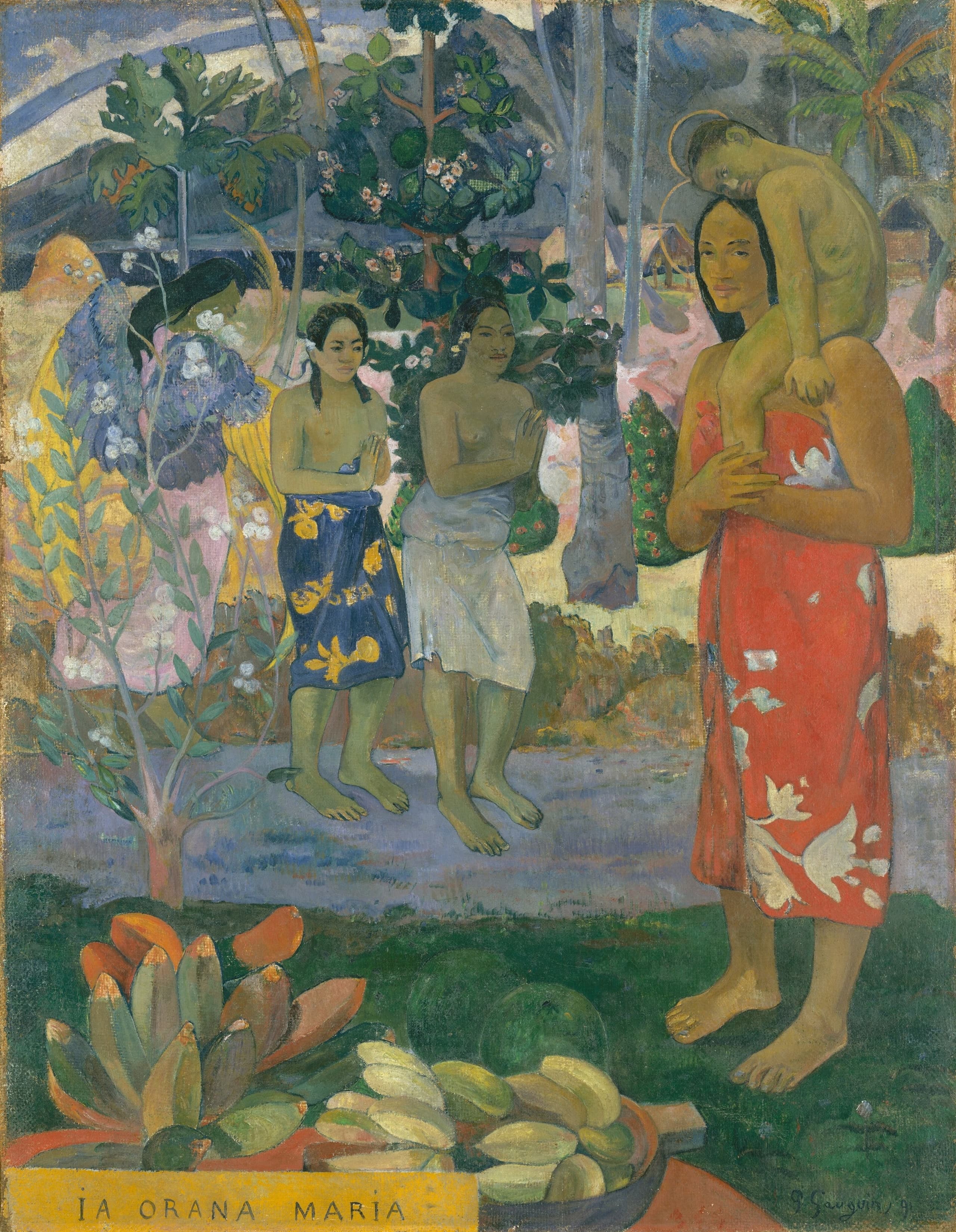
A mother and child
The supplied background describes a mother and child set within the framework of the Madonna and Child. That pairing gives the image a religious structure, while placing its figures in a setting described as Tahitian rather than treating the subject as a conventional European devotional scene.
Two figures greeting
Two Polynesian women are described as greeting the mother and child. Their presence matters to the arrangement: the scene is not presented simply as an isolated sacred pair, but as an encounter involving several figures and an act of recognition.
A double classification
The work is catalogued as both religious art and genre art. Those labels direct attention to two observable kinds of subject matter at once: a Christian mother-and-child framework, and a scene described through people meeting in an everyday local setting.
The story
Ia Orana Maria is a painting made in 1891 by Paul Gauguin. It is painted in oil on canvas and measures 113.7 by 87.6 centimetres (2 ft 10 in). The work is in the collection of the Metropolitan Museum of Art, where it is also located, under inventory number 51.112.2.
The available record classifies it as religious art and genre art. That combination is a useful place to begin. Religious art names the Christian framework supplied in the background description: a mother and child are reimagined through the subject of the Madonna and Child. Genre art, meanwhile, points towards a scene of figures meeting rather than an image restricted to a single sacred pair.
The supplied background describes two Polynesian women greeting a Tahitian mother and child. It also says that Gauguin placed this encounter in a Christian framework while situating it in a local setting. Read carefully, that description does not present the painting as a straightforward illustration of one established image. It describes a work built from crossings: mother and child, greeting figures, religious association, and a setting identified as Tahitian.
Gauguin is listed as the creator, and the painting is associated with Les Nabis. The record gives the object a firm date, medium, maker and present museum home. It does not, however, provide the circumstances in which Gauguin arrived at this particular composition, nor does it provide an account of the painting’s later route into the museum.
That limit is worth retaining. A museum catalogue can establish essential facts without settling every question a picture raises. Here, the basic facts are clear: this is an 1891 canvas by Gauguin. The richer claims about its setting, religious references and cultural encounter depend on the description supplied alongside those facts, and should be read with appropriate care.
Why it mattered then
In 1891, the painting brought together categories that the museum record still preserves separately: religious art and genre art. The supplied background identifies a Christian Madonna-and-Child framework, but describes it as placed in a Tahitian setting and accompanied by greeting figures. That structure appears to have allowed Gauguin to work with a familiar religious subject without presenting it in a conventional form. Its association with Les Nabis also places the work within a named artistic movement. Beyond that association, the supplied facts do not establish what particular aims the painting served for Gauguin or how it was received at the time. What can be said is narrower and more useful: the work’s date, subject description and classifications make it a record of an attempt to bring unlike visual frameworks into one canvas.
Why it matters now
Ia Orana Maria still matters because its classifications do not let the viewer settle too quickly on one way of reading it. It can be approached as religious art, through the Madonna-and-Child framework described in the supplied background. It can also be approached as genre art, through the meeting of figures in a local setting. That doubleness asks for attention to framing. Who is being represented? Which visual traditions are being brought together? What changes when a Christian subject is described through a Tahitian setting? The supplied facts cannot answer all of those questions, but they establish the terms on which they arise: an 1891 painting by Paul Gauguin, now held by the Metropolitan Museum of Art.
The surprising detail
The museum record assigns two genres to one painting: religious art and genre art. This is not merely a technical catalogue detail. It matches the supplied description of a mother and child within a Christian framework, approached by two greeting women in a setting identified as Tahitian. The categories preserve the work’s unresolved double register rather than forcing it into one subject alone.
What is disputed
The supplied facts establish the artist, date, medium, dimensions, movement, collection and present location. They do not establish the painting’s discovery history, detailed making process, contemporary reception or full provenance.
How it got here
The supplied record identifies the Metropolitan Museum of Art as both the collection and current location. It gives no information about how the painting entered the museum, previous ownership, or any ownership claims.
Remember this
Ia Orana Maria is an 1891 Gauguin painting whose religious framework and scene of greeting are both retained in its museum classification.
Test yourself
Why is it useful that Ia Orana Maria is classified as both religious art and genre art, rather than only one of them?
The two labels keep two aspects of the work in view. Religious art directs attention to the Madonna-and-Child framework described in the supplied background. Genre art directs attention to the meeting of several figures in a local setting. Reading with both categories makes it harder to reduce the painting either to a conventional devotional image or to an ordinary social scene.
Go deeper
Image: Paul Gauguin, Public domain. Licence: Public domain. Source.