III · THE WORK · ART HISTORY
The Barque of Dante
▶ Listen · narrated
Painted for the Salon of 1822, this large canvas holds Neo-Classical balance and Romantic violence in the same frame, and declines to choose between them.
At a glance
- Artist
- Eugène Delacroix
- Date
- 1822
- Medium
- Oil paint on canvas
- Size
- 189 × 241.5 cm (7 ft 11 in)
- Location
- Louvre, Room 700 (INV 3820)
- Movement
- Romanticism
Look closer
The upright pair
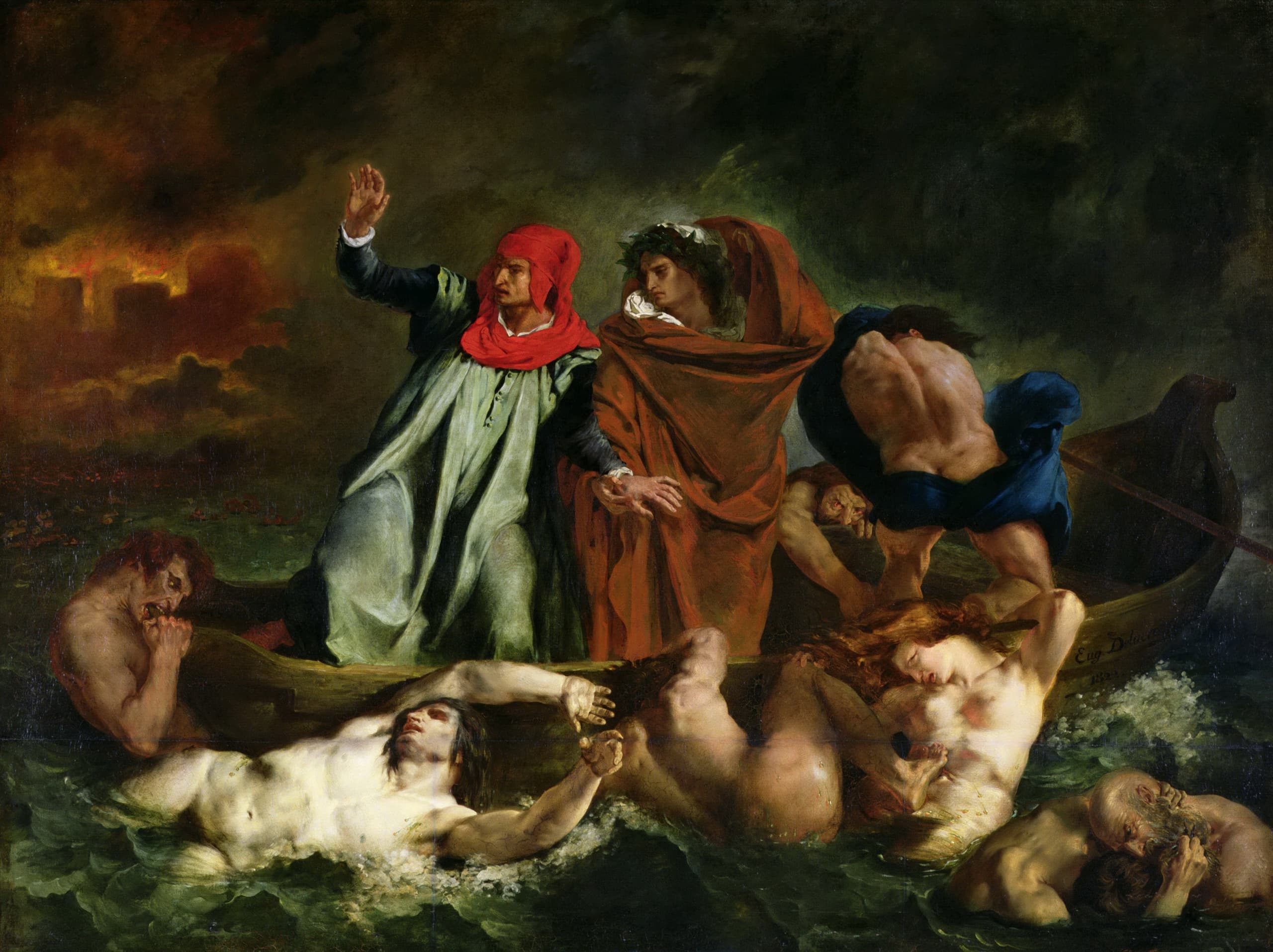
Dante and Virgil occupy the centre of the boat as a stable vertical group. Virgil steadies the younger poet; Dante’s fear is readable in posture rather than in any single gesture. Their uprightness is the painting’s classical anchor: two figures held in a clear, almost statuesque relation while everything around them heaves.
Planes and order
Subsidiary figures are set in studied poses along horizontal bands, so the eye still reads the picture in measured layers — boat, waterline, far shore. That rational stacking is a Neo-Classical habit. Delacroix keeps it even as the subject matter pulls toward disorder, which is why the canvas can feel both controlled and unsettled at once.
The water’s burden
The River Styx is not empty space under the hull. It is packed with tormented souls who clutch, twist and press against the boat. The lower half of the painting does the Romantic work: bodies in distress, smoke, a leaden mist, and the blazing City of Dis beyond. The drama is less in the poets’ faces than in the water they must cross.
The story
The Barque of Dante is an oil painting on canvas by Eugène Delacroix, completed in 1822. It measures 189 centimetres (6 ft 2 in) in height and 241.5 centimetres (7 ft 11 in) in width. The work belongs to the Department of Paintings of the Louvre, is inventoried as INV 3820, and hangs in Room 700. It is classed with Romanticism, and it is also known as Dante and Virgil in Hell.
The subject is taken, loosely, from canto eight of Dante’s Inferno. The poet Dante crosses the River Styx in a barque, steadied by Virgil, the classical guide of the poem. Around them the water heaves with the damned. Behind them a leaden, smoky mist and the blazing City of Dis close the view. The narrative is simple to name and hard to look past: a short crossing that must be endured among the lost.
What makes the picture instructive is how it is built. A group of central, upright figures holds the middle; subsidiary figures fall into studied poses arranged in horizontal planes. That architecture still answers to the cool, reflective Neo-Classicism that had dominated French narrative painting for nearly four decades. The boat is a stage of sorts, and the two poets are presented with a clarity that academic eyes would have recognised.
Beneath and beyond that order, the painting behaves differently. The damned crowd the water; the mist and fire refuse a clean, lucid distance. The canvas was finished for the opening of the Salon of 1822, and it has long been treated as Delacroix’s first major statement — a work that keeps the scaffolding of the older manner while letting Romantic turbulence into the lower half of the field. The shift is not a manifesto written across the surface. It is a tension you can still walk up to: balance in the figures, disorder in the river, both present at once.
Nothing in the secure record requires us to overstate the break. The composition complies with older tenets even as the subject and the handling of the damned pull away from them. The painting’s force lies in that double allegiance. It is large enough, and clear enough in its cast of figures, to be read as a public statement at the Salon; it is unsettled enough, in the water and the far fire, to feel like the start of another kind of narrative picture.
Why it mattered then
In 1822 the French Salon remained the arena where a narrative painting had to prove itself in public. Neo-Classicism had set the terms for nearly forty years: upright central groups, subsidiary figures in considered poses, a readable order of planes. Delacroix’s canvas does not discard those terms. It uses them. Dante and Virgil stand as a stable pair; the lesser bodies are organised rather than scattered at random. At the same time the subject — a crossing of the Styx among the damned, under smoke and the fire of the City of Dis — admits fear, thrashing flesh and a leaden atmosphere that academic calm could not fully absorb. Completed for that year’s Salon opening, the picture arrived as a first major work by its painter and as a visible hinge in the character of narrative painting, from the reflective manner toward Romanticism. Contemporaries did not need a theory to feel the pressure. The boat holds; the water does not.
Why it matters now
The painting still matters because it makes a historical change legible without reducing it to a slogan. Stand before it and the argument is spatial: classical composure in the poets, Romantic disturbance in the river and the far shore. That is a useful way to think about style shifts in general — not as clean replacements, but as tensions held inside a single surface. The canvas also keeps faith with its literary source without illustrating every line. A loose debt to canto eight is enough; the rest is pictorial. For anyone learning to look, the work rewards slow attention to plane, pose and the difference between a figure that steadies and a body that sinks. It hangs in the Louvre still, large enough at nearly two metres by two and a half that those distinctions remain physical, not merely historical.
The surprising detail
The painting’s academic manners and its Romantic violence are not successive layers added by later critics; they are built into the same composition. The upright poets and the horizontal ordering of the secondary figures obey Neo-Classical habit, while the crowded Styx and the blazing City of Dis do another kind of work. The canvas does not resolve the contradiction. That unresolved double structure is the point of looking, and it is why a Salon picture of 1822 still reads as a hinge rather than a simple illustration of Dante.
What is disputed
How far the picture was consciously planned as a break with Neo-Classicism is a matter of later reading rather than a single documented intention. The compositional debt to older tenets and the Romantic charge of the lower half are both visible; the exact weight each carried for Delacroix in 1822 should not be overstated.
Remember this
The Barque of Dante keeps Neo-Classical order in its upright poets while the river beneath them already belongs to Romanticism.
Test yourself
If the two poets were removed and only the water, the damned, the mist and the distant fire remained, what would the painting lose that is essential to how it worked in 1822?
It would lose the classical scaffolding that made the Romantic disorder legible as a challenge rather than as mere chaos. The upright pair and the studied, horizontal arrangement of secondary figures still answered Neo-Classical expectations at the Salon. Without that stable centre, the thrashing souls and smoky far shore would not press against an older order; they would simply be a scene of torment. The painting’s force in its moment depended on holding both systems in one frame.
Go deeper
Image: Eugène Delacroix, Public domain. Licence: Public domain. Source.