I · THE OBJECT · BRITISH MUSEUM
Heart of the Andes
▶ Listen · narrated
This is not a view from one hillside. It is a composed continent on canvas, shown under special light to paying crowds, and it made its painter the name to beat in American landscape.
At a glance
- Date
- 1859
- Artist
- Frederic Edwin Church
- Material
- Oil paint on canvas
- Dimensions
- 168 × 302.9 cm (9 ft 11 in)
- Collection
- Metropolitan Museum of Art
- Genre
- Landscape painting
Look closer
A canvas almost three metres across
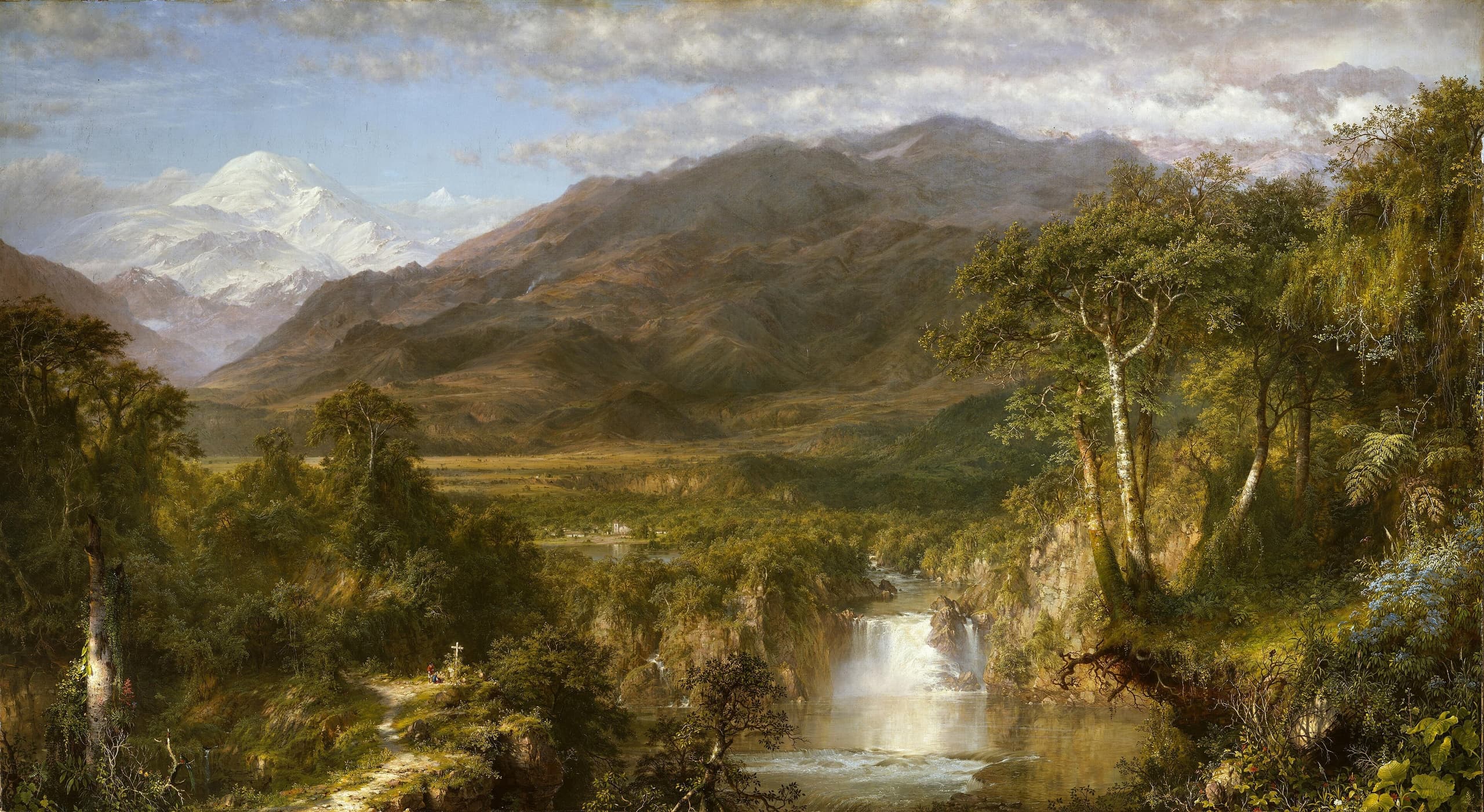
At 168 centimetres (5 ft 6 in) high and 302.9 centimetres (9 ft 11 in) wide, the painting is built for the body as much as for the eye. Stand at a normal viewing distance and the frame still fills the peripheral field. That physical claim on space was part of how the 1859 displays worked: the picture was not a window glanced through, but a surface approached and scanned.
The cross at lower left
In the left foreground, small figures visit a cross. The gesture is easy to miss at first because the surrounding path and foliage claim more paint, yet it sets the human scale. Animals and other signs of settlement appear elsewhere in the detail. Church’s Andes are not empty wilderness; they hold paths, devotion, and habitation inside the larger weather of mountain and forest.
Several altitudes at once
The composition moves from high snow — Mount Chimborazo among the sources — down through plain to jungle. These zones do not meet from one real standpoint as the canvas presents them. Church had travelled in South America on two occasions and joined the parts in the studio. What looks continuous is a deliberate assembly of climates and elevations.
The story
Heart of the Andes is an oil painting on canvas by the American artist Frederic Edwin Church, completed in 1859. It measures 168 centimetres (5 ft 6 in) high by 302.9 centimetres (9 ft 11 in) wide. The work is a landscape painting, made in the United States, and it has been in the collection of the Metropolitan Museum of Art since 1909, under the inventory number 09.95.
The scene is an idealised view of the South American Andes rather than a single surveyed prospect. Church had travelled in the region on two occasions. In the studio he brought together several Andean topographies in one composition: the snow of Mount Chimborazo, open plain, and jungle. Close looking turns up animals and marks of human settlement. At the left foreground, people approach a cross.
When the painting was first shown in New York City in 1859, it was staged less like a routine gallery picture than like a destination in its own right. The exhibition room used special lighting and decorative elements meant to recall the landscape on the canvas. The work was supported by a floor-standing frame. Visitors paid a twenty-five-cent entrance fee and were often willing to wait in line. The same canvas was later exhibited by itself in other cities in the eastern United States.
Much of the public fascination turned on the quantity of detail Church had locked into the surface. At a distance the picture read as atmosphere and recession; nearer to, it resolved into separate leaves, rocks, water, and figures. A landscape this large and this finished could hold a crowd in the way a panorama or a natural-history display might. The first private sale went to William Tilden Blodgett and broke a price record for a living American artist. From that market moment the painting’s fame was already secure; its later arrival at the Metropolitan Museum of Art confirmed a reputation formed half a century earlier under ticketed light.
Why it mattered then
In its own moment the painting mattered because a single canvas, shown alone under controlled light, could command an entrance fee and still draw queues. That reception helped establish Church as the foremost landscape painter in the United States in the eyes of the public and buyers who met the work on those terms. The success counted in a country still pressing the claims of its own artists against European models. The Andean subject also answered a wider appetite for far geography rendered with a precision that felt almost scientific, even though the view itself was a synthesis rather than a surveyor’s record. Scale, finish, and spectacle worked together: the painting was both an object of study and an event.
Why it matters now
The painting still rewards slow looking because its size and density were designed for exactly that kind of attention. It also records a particular nineteenth-century bargain between art and spectacle — the canvas as destination, the frame as stage, the ticket as part of the experience. For the Metropolitan Museum of Art it anchors a chapter of American landscape painting in which ambition was measured in metres as much as in subject. And it remains a clear case of how “faithful” landscape can be composite: assembled from travel, memory, and studio decision, yet still able to persuade as a place.
The surprising detail
Visitors paid twenty-five cents to see one painting, and the rooms were arranged with special lighting and decorations that echoed the Andean scene. The first sale, to William Tilden Blodgett, broke the price record for a living American artist. For a work finished in 1859 and already famous before it found a permanent museum wall, that early market shock belongs to the object’s history, not to a footnote beside it.
What is disputed
The painting is an idealised and composite view, not a record of one location. Church synthesised features from different Andean topographies, so the precise link between any single passage and a real site is a matter of interpretation rather than simple identification.
How it got here
The painting has been in the collection of the Metropolitan Museum of Art since 1909 (inventory number 09.95). Its first sale was to William Tilden Blodgett and broke a price record for a living American artist.
Remember this
A composite Andes on a canvas nearly three metres wide, shown as a paying spectacle in 1859, and still in the Metropolitan Museum of Art.
Test yourself
Church combined Mount Chimborazo, plain, and jungle in a single view rather than painting one real standpoint. What does that choice ask the viewer to accept?
That a landscape can be true to a region’s character without being true to a single optical moment. The painting offers the Andes as a totality — high snow, open ground, and dense growth held in one frame — and asks to be read as gathered knowledge and feeling rather than as a topographical survey from one hillside. The same logic that dressed the exhibition room with light and décor packed the canvas with places that do not sit side by side in nature.
Go deeper
Image: Frederic Edwin Church, Public domain. Licence: Public domain. Source.