III · THE WORK · ART HISTORY
Venus and Mars
▶ Listen · narrated
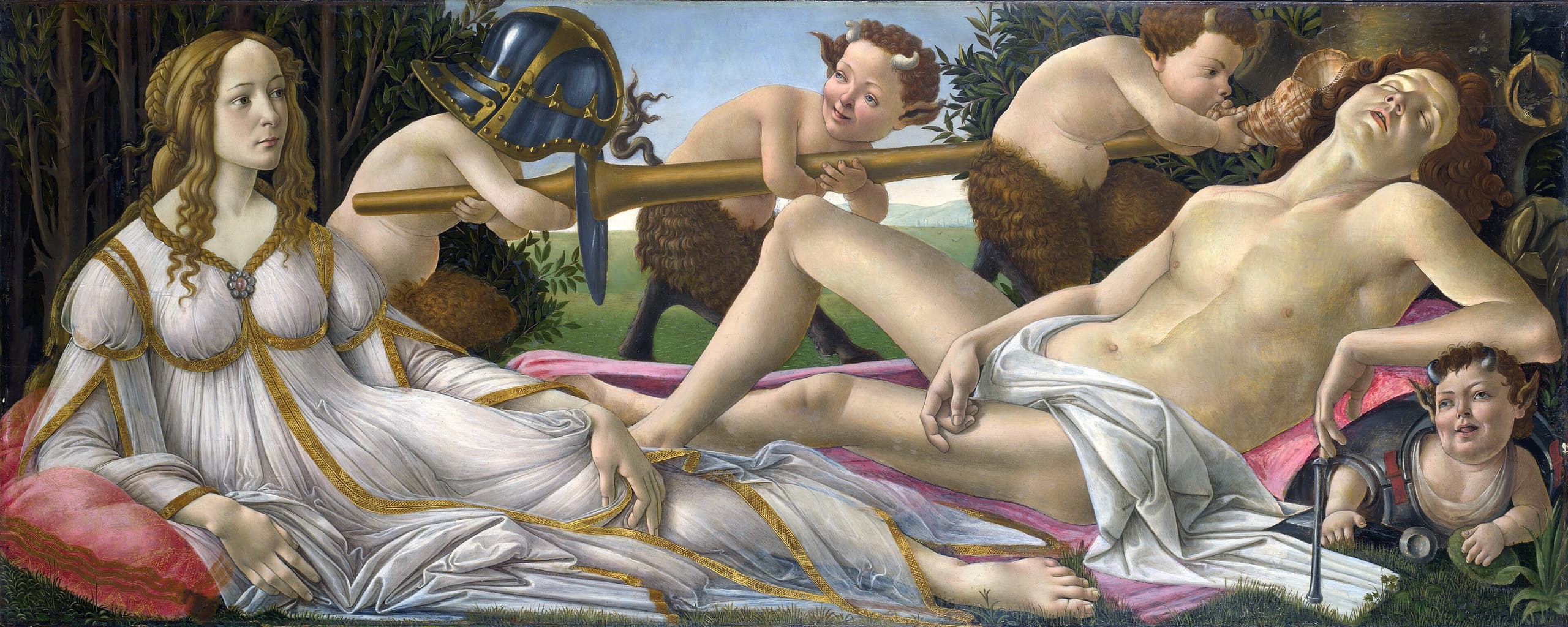
Botticelli laid the goddess of love opposite the god of war on a low, stretched panel. One figure stays alert; the other has let every weapon fall.
At a glance
- Artist
- Sandro Botticelli
- Date
- c. 1485
- Medium
- Tempera and oil on poplar panel
- Size
- About 69 × 174 cm (5 ft 9 in)
- Collection
- National Gallery, London (NG915)
- Genre
- Mythological painting
Look closer
The long horizontal field
The panel is more than twice as wide as it is high. Venus and Mars fill almost the full length, reclining toward one another across a shallow forest floor. There is little deep space behind them and almost no empty margin at either end. The proportions suit a painting meant to be read at close range, set into panelling or furniture rather than hung high on a wall as a public altarpiece would be.
Who is awake
Venus remains upright and clothed, her gaze turned toward Mars. He lies back, bare, eyes closed, body slack. Between them the contrast does the work of the allegory: love is alert; war has been disarmed into sleep. The composition does not show a battle or a triumph. It shows the aftermath, arranged as a quiet pairing of two bodies in different states of attention.
The satyrs and the armour
Small baby satyrs crowd around the sleeping god, handling pieces of his discarded armour and a lance. Their play is not incidental decoration. It makes visible what the reclining pair only implies: martial gear has become a toy. The weapons stay in the picture, but they no longer belong to a warrior on guard.
The story
Sandro Botticelli painted Venus and Mars in Florence in the mid-1480s, working in tempera and oil on a poplar panel. The picture belongs to the Early Renaissance taste for classical subjects treated with a clear, linear grace. It shows the Roman goddess of love and the Roman god of war reclining in a wooded setting, accompanied by playful baby satyrs who busy themselves with the armour Mars has set aside.
The format is decisive. At roughly sixty-nine centimetres high and one hundred and seventy-four wide, the panel is a long horizontal strip. Figures are brought close to the picture plane; the forest is a shallow stage rather than a deep landscape. That shape and that nearness are among the strongest clues to its first life. It was probably made to commemorate a wedding and set into panelling or a piece of furniture in a bedroom, perhaps as one of a group of related works. Nothing in the painting itself names a bride or groom, and no surviving contract pins it to a single household occasion, so the wedding purpose remains an informed inference from form and subject rather than a documented fact.
What the panel does state plainly is an allegory of beauty and valour arranged as sensuous ease. Venus is awake and composed. Mars is overcome by sleep. The satyrs turn his weapons into sport. Viewers in Botticelli’s circle would have recognised the classical pairing and the moral it carries: love softens strife; desire can quiet the god of battle. The idea is learned without being obscure, and it fits a private domestic setting better than a civic hall.
Scholars have long suspected that Botticelli shaped the programme with help from a humanist advisor, someone such as the Medici poet Poliziano, who could supply the classical allusions. That collaboration is plausible and often repeated, yet it is not proven by a signed programme or letter tied to this panel. What can be said more firmly is that the picture stands near Botticelli’s other mythologies of the 1480s. It seems to follow a few years after the Primavera and Pallas and the Centaur, and to sit around the time of The Birth of Venus. Of that group it is the only one not in the Uffizi. It has been in the National Gallery in London since 1874, inventoried as NG915, and is shown among the Florentine rooms devoted to painting between 1400 and 1500.
The making is as much about surface as about story. Tempera and oil on poplar, with plaster among the materials recorded for the work, point to a carefully prepared panel built for permanence inside a room rather than for procession or altar. The close cropping of the two gods, the scatter of armour, and the child-satyrs give the eye a sequence of stops along the length of the board: face, body, weapon, mischief, sleep. Nothing in the design asks for a distant spectator. It asks for someone standing near enough to read the joke in a satyr’s grip on a lance and the calm in Venus’s watch over her opposite.
Why it mattered then
In late fifteenth-century Florence, classical gods were not remote museum subjects. They were a shared language among patrons, poets and painters for talking about virtue, desire and the household. A panel that sets Venus against a sleeping Mars could honour a marriage by casting love as the power that stills conflict, an ideal suited to the bedroom for which the wide format seems designed. Myth offered cover for sensuality: bodies could be shown with a frankness that domestic portraiture would not allow, while the allegory kept the image respectable and witty. Whether or not a specific wedding commissioned this work, its genre and shape place it inside that culture of learned private painting, where a piece of furniture might carry as much intellectual freight as a chapel fresco.
Why it matters now
The painting still rewards slow looking because its argument is almost entirely visual. No inscription explains the scene; the meaning sits in who sleeps, who watches, and what the small satyrs have stolen from the armoury. Modern viewers meet it stripped of its original room, yet the panel’s unusual length continues to dictate how it is read—from side to side, at close range. It also anchors a larger question about Botticelli’s mythologies: how a Florentine workshop turned humanist themes into images for daily domestic space. Among those celebrated pictures, this is the one that left Florence and entered a London collection in the nineteenth century, so it remains many visitors’ most direct encounter with that side of his work.
The surprising detail
For a painting so often grouped with Botticelli’s famous mythologies, Venus and Mars is the outsider of the set. The Primavera, Pallas and the Centaur and The Birth of Venus remain in Florence; this panel alone has hung in the National Gallery since 1874. In 2024, for the Gallery’s bicentenary, it did leave London briefly—shown at the Fitzwilliam Museum in Cambridge between May and September—before returning. Even that short journey stands out, because the picture’s whole design assumes a fixed place in a room, not a life of travel.
What is disputed
The date is stylistic, not documentary. The National Gallery has used c. 1485; other scholars have preferred around 1483 or the later 1480s. The wedding destination, the idea of a furniture or panelling setting, and the possible role of an advisor such as Poliziano are widely held inferences from format, subject and context. They are not secured by a surviving commission tied to this panel and should be stated as probable rather than certain.
Remember this
The panel’s meaning lies in a simple contrast made long and low: Venus awake, Mars asleep, his armour given over to play.
Test yourself
Why does the panel’s unusual width matter to arguments about what Venus and Mars was for?
Because the extreme horizontal format, combined with the close view of the figures, matches paintings made to sit inside panelling or furniture in a private room rather than to hang as a free public picture. That physical clue is a main reason scholars treat a wedding or bedroom setting as likely, even though no contract names the occasion. The shape is not only a compositional choice; it is evidence about use.
Go deeper
Image: Sandro Botticelli, Public domain. Licence: Public domain. Source.