II · THE DISCOVERY · HISTORY OF SCIENCE
Silver
No name attached to its discovery, no year, not even a century. Silver's origin as a worked metal lies in the fifth millennium BC, before anyone was writing anything down.
At a glance
- Chemical symbol
- Ag, from Latin argentum meaning silver
- Atomic number
- 47
- Known since
- Roughly the 5th millennium BC
- Named after
- White, its colour
- Found in
- Galena, cerussite, acanthite, argentite
Look closer
The precision is a millennium, not a year
The date recorded is the fifth millennium BC — a span of a thousand years, not a year or a day. That imprecision reflects what the archaeological record actually supports: evidence that people were working silver by then, but no tighter dating and no record of who did it. When a discovery is this old, honesty means a wide bracket rather than a false precision.
Named after its colour
Silver takes its name from white, the colour of the metal. The chemical symbol Ag comes from the Latin argentum, which also meant silver. The two naming systems — the English common name and the Latin scholarly abbreviation — reflect different linguistic traditions, but both describe the same visual property: a soft, white, lustrous metal that reflects light better than any other.
A byproduct more often than the target
Most silver today is not mined for itself. It is recovered as a byproduct when refining lead–zinc, copper or gold. That means the economics of silver production are tied to the demand for other metals: a mine might be viable for its copper and yield silver as well, rather than the other way around. The metal occurs in minerals such as acanthite and argentite, but also in galena and cerussite, which are primarily lead ores.
The story
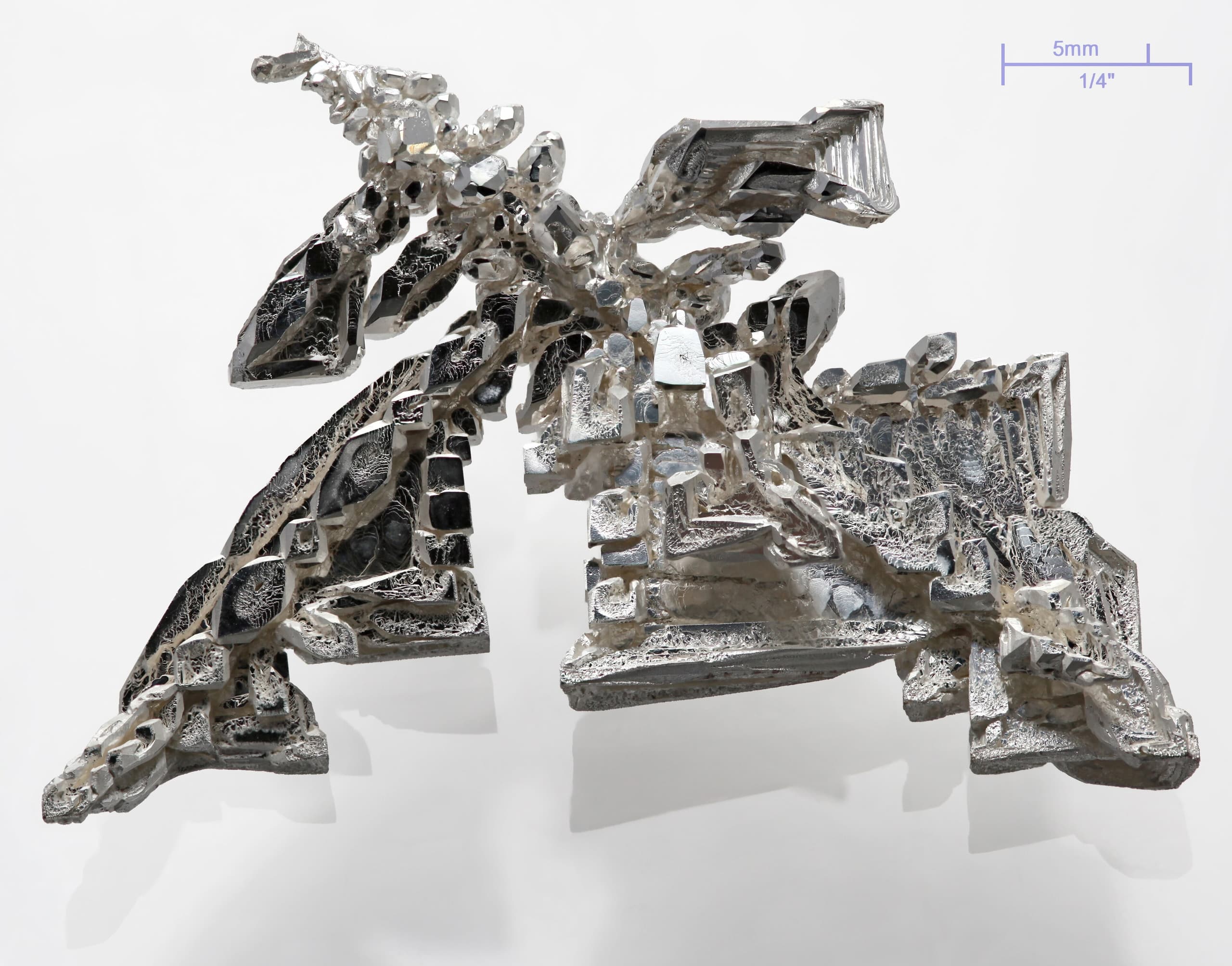
Silver is a chemical element with the symbol Ag and atomic number 47. It is a soft, white, lustrous transition metal — transition meaning it sits in the central block of the periodic table where elements tend to form coloured compounds and act as catalysts. Of all metals, silver exhibits the highest electrical conductivity, the highest thermal conductivity, and the highest reflectivity. Those properties make it useful in ways beyond ornament or currency, though those were its earliest uses and remain significant ones.
The metal has been known since roughly the fifth millennium BC. That date precision — a millennium rather than a year — reflects the archaeological evidence: objects and residues that show people were working silver by then, but no written record of who first extracted it or where. Silver is one of the seven metals of antiquity, meaning it was known and worked before the historical record begins in any detail. It occurs in the Earth's crust in several forms: as native silver, meaning the pure metal itself; as an alloy with gold and other metals; and in minerals such as acanthite, argentite and chlorargyrite.
Because pure silver is relatively soft, it is often alloyed with copper or other metals when used in jewellery, coinage or household objects. The purity of silver is measured on a per-mille basis: an alloy that is 94% pure silver is described as 0.940 fine. That measurement system reflects the metal's long role in currency, where the actual silver content of a coin determined its value, and where adulteration — adding cheaper metals to stretch the supply — was both common and regulated.
Today, silver has industrial uses that rest on those same physical properties that made it valued in antiquity. It is used in photovoltaics — solar panels — where its conductivity matters. It is used in electrical contacts and conductors, in printed electronics, and in brazing alloys, which are metals melted to join other metals together. It is used in specialised mirrors and window coatings, where its reflectivity is the highest available. It is used in antimicrobial materials, because silver ions disrupt bacterial cell function. Silver halides — compounds of silver and elements like chlorine or bromine — were central to photographic film and photographic paper, though demand for photographic silver has declined with the spread of digital imaging.
Why it mattered then
Silver's early history is tied to currency and ornament, but the discovery that matters is the extraction itself: learning to separate silver from the ores that contain it, which requires heating the ore to high temperatures in a process called smelting. That knowledge, which dates to roughly the fifth millennium BC, made it possible to produce the metal in quantity rather than relying on the rare native silver that occurs in pure form. Once people could extract silver, it became a standard for value. Its rarity, its resistance to corrosion, and its divisibility — you can cut it, melt it, and reform it — made it suited to coinage. Silver coins appear in multiple ancient cultures, and the metal's role in monetary systems persisted for millennia. The Latin word argentum, which gives silver its chemical symbol, also gave rise to words for money in several languages. Beyond currency, silver was worked into jewellery, tableware and decorative arts. Its lustre and its workability made it a prestige material, and the purity standards that developed around it — the per-mille measurement system still in use — reflect a long history of trade and regulation. The ability to alloy silver with copper allowed metalworkers to adjust its hardness and colour, producing objects that were both functional and durable.
Why it matters now
Silver remains a monetary metal: it is held as bullion and minted into coins for investment, though its role in everyday currency has largely ended. The industrial uses now outweigh the ornamental ones in economic terms, and those uses rest on properties that were not exploited until much later than the metal's discovery. Electrical conductivity makes silver essential in high-performance contacts and connectors, where resistance must be minimised. Thermal conductivity makes it useful in brazing alloys and heat sinks. Reflectivity makes it the material of choice for specialised mirrors, including those in telescopes and solar concentrators, and for window coatings that reflect infrared radiation to keep buildings cool. The antimicrobial properties of silver have found new applications in wound dressings, water purification systems and surface treatments, though the mechanisms are still being studied in detail. Silver halides, which were the basis of photographic film, are less central now that digital imaging has replaced most film use, but they remain important in some photochromic glass — glass that darkens in sunlight — and in certain high-resolution imaging applications. The fact that most silver is recovered as a byproduct of other mining means its supply is not directly responsive to silver demand alone. That economic structure affects its price and availability, and it means decisions about copper or lead–zinc mines have downstream consequences for industries that depend on silver.
The surprising detail
Silver's name comes from its colour — white — but the Latin argentum, which gives the element its chemical symbol Ag, also meant silver and gave rise to the name Argentina, a country named for the silver its colonisers hoped to find. The metal's linguistic traces run through currency and value: the French argent means both silver and money, and the English word Argentine can mean either relating to silver or relating to the country. That overlap reflects silver's long entanglement with systems of value, where the metal and the concept of money were difficult to separate.
What is disputed
The date precision is explicitly a millennium, meaning the discovery is known to have occurred sometime in the fifth millennium BC but cannot be dated more closely. The archaeological evidence supports working of silver by that period, but does not identify a specific year, place or person. The naming etymology — silver from white, and Ag from Latin argentum — is recorded in the verified facts, but the chain of linguistic derivation beyond that is not detailed in the material supplied.
Remember this
Silver has been worked since roughly the fifth millennium BC, and no name is attached to its discovery. What remains is the metal and its properties.
Test yourself
Why is the discovery date given as a millennium rather than a year, and what does that imprecision actually mean?
The fifth millennium BC is a span of a thousand years, and that is the honest precision the archaeological evidence supports. It means we have objects and residues showing people were working silver by then, but no tighter dating and no written record of who first extracted it or where. When a discovery is this old, the evidence does not support a sharper claim, and a millennium is what we can say with confidence. Narrowing it to a year or a century would be inventing precision the facts do not give us.
Go deeper
Image: Alchemist-hp ( talk ) ( www.pse-mendelejew.de ), CC BY-SA 3.0 de. Licence: CC BY-SA 3.0 de. Source.