I · THE OBJECT · BRITISH MUSEUM
The Fortune Teller
▶ Listen · narrated
A French painter’s name runs along the top right in careful script. The picture itself only reappeared around 1960, and not everyone has agreed it is his.
At a glance
- Date
- 1630
- Artist
- Georges de La Tour
- Material
- Oil paint on canvas
- Dimensions
- 101.9 × 123.5 cm (4 ft 1 in)
- Genre
- Genre art
- Inventory
- 60.30
Look closer
A signature that places the work
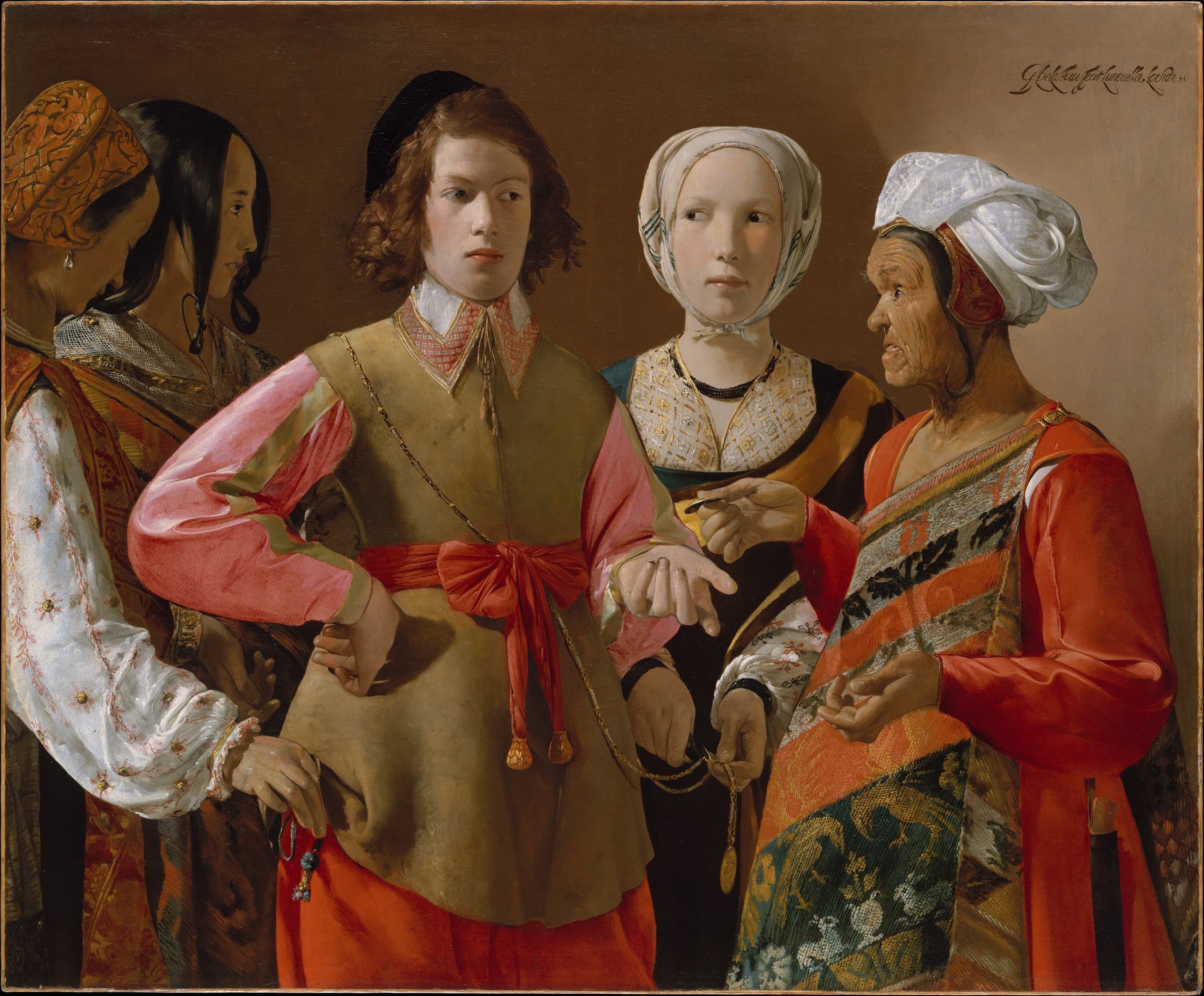
At the top right a calligraphic line reads “G. de La Tour Fecit Luneuilla Lothar” — “G[eorges] de La Tour made this, Lunéville, Lorraine.” The wording does two jobs at once. It claims the painting for a named hand, and it pins that hand to a town in eastern France rather than to Paris or a royal court. For a genre subject, that double claim is unusually explicit: authorship and place are written into the paint.
Oil, canvas, and a wide format
The support is canvas; the medium is oil paint. The panel measures 101.9 centimetres (3 ft 4 in) high by 123.5 centimetres (4 ft 1 in) wide, so the composition sits in a horizontal field rather than a tall upright one. That breadth suits a multi-figure exchange of the kind genre painting often stages, giving the eye room to move from one participant to another across a single continuous surface.
Genre, not history or devotion
The work is classed as genre art: its subject is drawn from ordinary human dealings rather than from scripture, classical myth, or state ceremony. In early modern Europe that category let painters observe social behaviour — bargaining, deception, display — without the formal apparatus of altarpiece or official portrait. The title names the transaction at the centre; the signature insists the observation is still a finished work by a known maker.
The story
The Fortune Teller is an oil painting on canvas by the French artist Georges de La Tour, dated 1630. It stands 101.9 centimetres (3 ft 4 in) high and 123.5 centimetres (4 ft 1 in) wide. It belongs to the Metropolitan Museum of Art in New York and is recorded there under the inventory number 60.30.
The painting is a work of genre art. That term, spare as it sounds, marks a real choice of subject. Instead of sacred narrative or court portraiture, the picture takes ordinary social dealing as its material. What secures the attribution in the most direct way is not a later catalogue entry but a line of paint: a calligraphic signature at the top right that reads “G. de La Tour Fecit Luneuilla Lothar.” Expanded, the Latin and place-name say that Georges de La Tour made the work at Lunéville, in Lorraine. The signature therefore does more than autograph the surface. It locates the maker in a specific town in eastern France and presents the canvas as a completed claim to authorship.
For a long stretch the painting was unknown to modern scholarship. It was uncovered in about 1960 and purchased that same year by the Metropolitan Museum of Art. François Georges Pariset described it in the museum’s bulletin and attributed it to La Tour — a natural reading given the signature. The path from rediscovery to acquisition was short. Within roughly a year of its reappearance the canvas had entered a major public collection, where it could be studied, published, and argued over in the open.
Argument followed. In the years after the purchase, the English art historian Christopher Wright questioned whether the painting is genuinely by La Tour. The challenge did not erase the signature or the museum’s attribution, but it did make plain that acceptance is not the same as unanimity. The Fortune Teller is generally accepted as La Tour’s work; the dissent remains part of its modern record.
What the object therefore offers is a tight knot of facts: a dated genre painting, a named artist, a place written into the signature, a late rediscovery, a rapid museum purchase, and a scholarly dispute that has never quite gone away. None of those facts is ornamental. Together they show how an early modern canvas becomes legible again — and how much of that legibility still rests on a few centimetres of carefully formed lettering at the upper right.
Why it mattered then
In 1630 a signed genre painting from Lunéville sat inside a culture that already sorted pictures by the dignity of their subjects. Sacred and classical themes carried one kind of prestige; scenes of common life carried another. By putting both his name and his town on the canvas, La Tour framed the work as a finished authorial statement rather than an anonymous workshop product. Genre art gave painters a way to stage social observation — the glance, the bargain, the small deceit — without the apparatus of altarpiece or state portrait. The signature insists that such observation still belonged to a known hand working in a named place in Lorraine.
Why it matters now
The painting still matters because its modern life is almost as revealing as its seventeenth-century one. Uncovered around 1960 and bought at once by the Metropolitan Museum of Art, it shows how quickly a rediscovered Old Master can move from obscurity into a public collection. The generally accepted attribution to Georges de La Tour rests in part on the painted signature; the challenge from Christopher Wright keeps that acceptance honest. Viewers inherit both the picture and the argument. In an age when museums are asked to explain not only what they hold but how they know what they hold, a canvas whose authorship has been affirmed, questioned, and still widely upheld is a useful object. It makes the machinery of connoisseurship visible without requiring the viewer to pretend the machinery never slips.
The surprising detail
The painting’s entire modern career is compressed into a single year. It was uncovered in about 1960 and purchased by the Metropolitan Museum of Art in that same year — then almost immediately drawn into print through François Georges Pariset’s account in the museum’s bulletin. Few major museum pictures have so short a gap between rediscovery and institutional ownership. The afterlife has been less tidy: Christopher Wright’s doubts about the attribution mean that a work bought with confidence has lived for decades under a light but persistent question mark, even while remaining generally accepted as La Tour’s.
What is disputed
The attribution to Georges de La Tour is generally accepted, supported in part by the calligraphic signature at the top right. It has nonetheless been questioned, notably by the English art historian Christopher Wright. The dispute has not displaced the standard attribution, but it remains part of the painting’s scholarly record and should be stated as such.
How it got here
The painting was uncovered in about 1960 and purchased that year by the Metropolitan Museum of Art, New York, where it is held under inventory number 60.30. François Georges Pariset published a description in the museum’s bulletin and attributed the work to La Tour. No contested-ownership or repatriation claim is recorded in the sources used here.
Remember this
A 1630 genre painting signed by Georges de La Tour at Lunéville, found around 1960, bought at once by the Met, and still generally accepted despite challenge.
Test yourself
The signature names both the painter and Lunéville in Lorraine. Why is that double claim useful when the painting’s authorship has later been disputed?
Because it gives the attribution an internal anchor rather than a purely external one. Scholars are not only matching style to other works; they are reading a painted statement of who made the picture and where. That does not settle every doubt — signatures can be added or doubted too — but it changes the shape of the argument. Dissenters must explain the lettering as well as the figures, and defenders can point to place and name as part of the original surface. The lesson is general: when authorship is contested, evidence written into the object itself becomes the hinge on which acceptance or rejection turns.
Go deeper
Image: Georges de La Tour, Public domain. Licence: Public domain. Source.