I · THE OBJECT · BRITISH MUSEUM
Oedipus and the Sphinx
▶ Listen · narrated
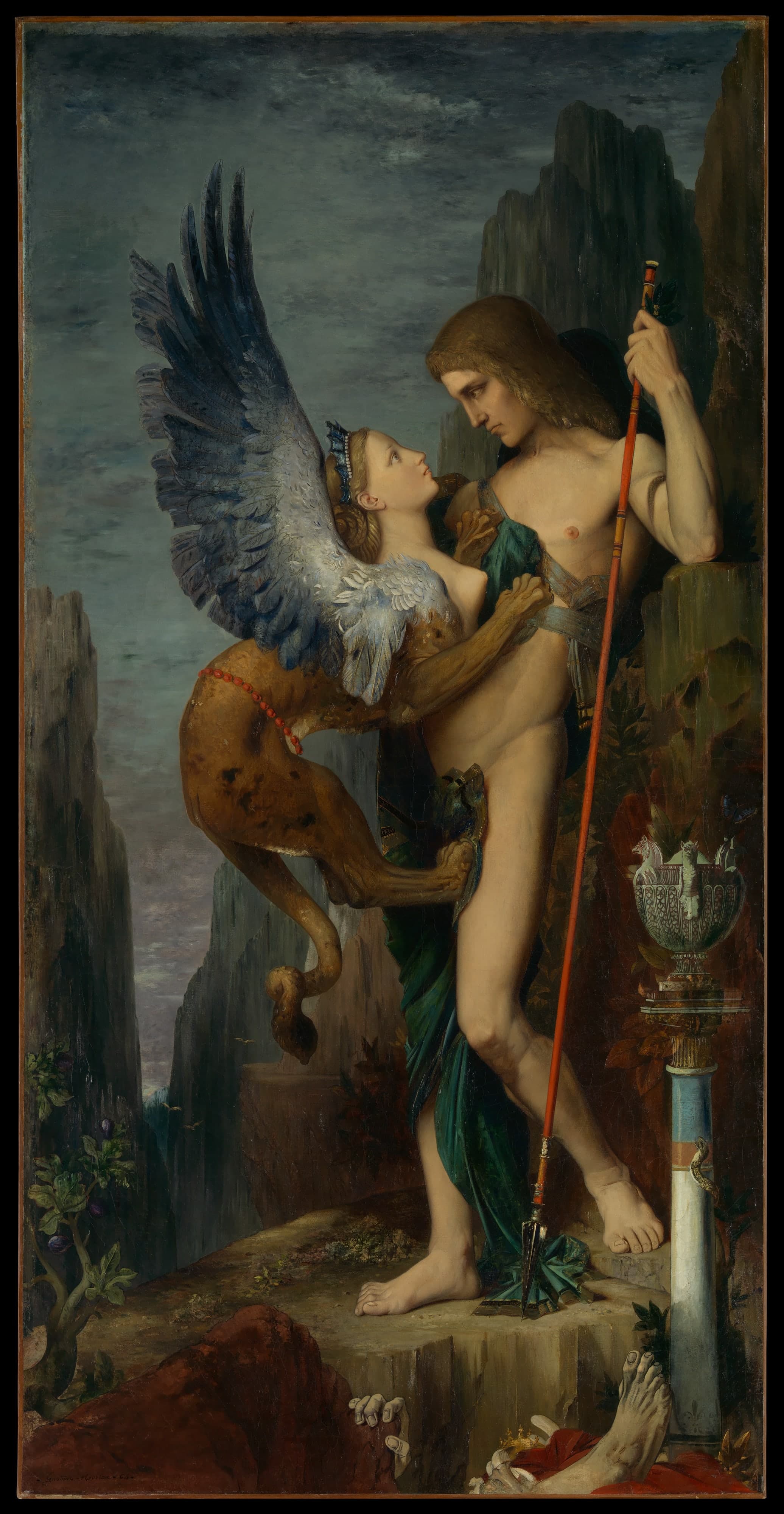
Oedipus meets the Sphinx on the road outside Thebes. Gustave Moreau painted that encounter in 1864, and the French Salon made it a success.
At a glance
- Date
- 1864
- Artist
- Gustave Moreau
- Material
- Oil paint on canvas
- Dimensions
- 206 × 105 cm (3 ft 5 in)
- Genre
- Mythological painting
- Movement
- Academic art
Look closer
A tall, narrow canvas
The painting stands 206 centimetres (6 ft 9 in) high and only 105 centimetres (3 ft 5 in) wide. That vertical proportion is not accidental. It stacks the encounter rather than spreading it, so the meeting of the two figures has to be read up and down the surface. In a Salon room crowded with horizontal histories and landscapes, a format this tall behaved like a standing figure: it held a strip of wall and asked to be faced at close range.
One subject, long already known
The scene is the meeting of Oedipus and the Sphinx on the road outside Thebes, the episode familiar from Sophocles’s Oedipus Rex. Moreau did not invent the story; he chose a subject already fixed in the classical repertoire. What the canvas offered in 1864 was a fresh treatment of that established moment, not a new myth. The work is catalogued as a mythological painting for that reason: its drama is borrowed from Greek tragedy and restaged in oil.
Academic art, publicly tested
The painting is linked to academic art—the training, finish, and classical subject matter expected of painters who showed at the official Salon. First exhibition was not a private viewing but the French Salon of 1864. Success there was immediate. For a work in this tradition, that public verdict mattered as much as the paint: the Salon was where academic ambition was measured against rivals and against the jury’s taste.
The story
Gustave Moreau’s Oedipus and the Sphinx is an oil painting on canvas, begun and completed in 1864. It measures 206 centimetres (6 ft 9 in) in height and 105 centimetres (3 ft 5 in) in width, a tall, relatively narrow field that suits a confrontation between two figures rather than a broad landscape or a crowded history scene. The work belongs to the Metropolitan Museum of Art, where it is held under the inventory number 21.134.1.
The subject is mythological and specific. Oedipus meets the Sphinx on the road outside Thebes, the encounter described in Sophocles’s play Oedipus Rex. Viewers in 1864 did not need the story explained; the pair was already part of the shared classical store. Moreau’s task was not invention of plot but treatment: how to stage a known meeting so that it looked newly considered without abandoning the gravity academic painting demanded of Greek myth.
The painting is associated with academic art. That label points less to a single style than to a system—studio training, elevated subject matter, and the expectation of careful finish—whose chief public arena in France was the Salon. Moreau showed the canvas at the French Salon of 1864. Contemporary response was immediate success. For a mythological picture of this ambition, Salon reception was not a side note; it was the moment when the work entered critical and professional conversation.
Oil on canvas was the standard vehicle for such a statement. The medium allowed dense modelling and a surface meant to be read under gallery light, at a height that brings the figures close to human scale without making them life-size portraits. The narrow width keeps the eye from wandering into secondary episodes. Whatever else Moreau may have packed into the composition, the format itself insists on the encounter as the sole centre of attention.
The painting remains in the Metropolitan Museum of Art. Museum records place it among nineteenth-century French works and describe it in the language of genre and movement: mythological painting, academic art. Those categories still do useful work. They remind a modern viewer that the canvas was made inside a professional culture that valued classical narrative and public exhibition, and that its first audience judged it in a room full of competing claims on the same tradition.
How the picture moved from the Salon wall to New York is not detailed in the facts supplied here. What is certain is its present home, its dimensions, its materials, its date, and the simple chain of subject and maker: Moreau, 1864, Oedipus and the Sphinx, oil on canvas, Metropolitan Museum of Art.
Why it mattered then
In 1864 the French Salon was still the decisive public stage for a painter working inside the academic system. A mythological canvas had to prove that classical subject matter could hold attention against modern themes and against other treatments of the same stories. Moreau’s picture did that at once. Immediate success at the Salon meant the work was not filed away as a private experiment; it was recognised as a serious contribution to the living repertoire of academic painting. The choice of Oedipus and the Sphinx mattered too. The episode from Sophocles was familiar enough to need no lengthy caption, yet open enough for a fresh arrangement of the two figures. For contemporaries, the painting demonstrated that academic art could renew a standard theme without leaving the Salon’s terms of finish, scale, and elevated narrative.
Why it matters now
The painting still matters because it sits at a clear junction: a classical story, an academic method, and a documented public debut whose success is part of the object’s history. In a museum collection it offers a concrete example of how nineteenth-century French painters used oil on canvas to restage Greek myth for a modern crowd. Its tall proportions and single concentrated encounter remain easy to grasp even for viewers who no longer arrive with Sophocles in mind. Catalogued as mythological painting and academic art, it also helps map a tradition that later movements defined themselves against. Looking at it now is a way to see what that tradition actually produced at full ambition, rather than only what its critics later rejected.
The surprising detail
The work’s first life was not quiet. Shown at the French Salon of 1864, it was an immediate success—an outcome that can sound routine until one remembers how many Salon canvases vanished into polite indifference. A tall mythological picture, in a system that rewarded both novelty and correctness, managed to satisfy both demands at once. That early verdict is why the painting entered history as a career-making statement rather than as a private study.
How it got here
The painting is in the Metropolitan Museum of Art under inventory number 21.134.1. The facts supplied here do not detail the chain of ownership between the 1864 Salon and the museum, so the route of acquisition is left unstated.
Remember this
A tall 1864 Salon canvas: Moreau, oil on canvas, Oedipus meeting the Sphinx—academic myth tested in public, and accepted at once.
Test yourself
Why did showing Oedipus and the Sphinx at the French Salon of 1864 matter as much as the choice of subject itself?
Because academic art was judged in public. The Salon was the arena where finish, scale, and classical narrative were measured against rivals and against official taste. Moreau took a known episode from Sophocles and gave it a fresh treatment, but the immediate success of the 1864 exhibition is what turned that treatment into a professional fact. Without that reception, the canvas would have remained a private handling of a standard myth; with it, the painting became evidence that academic painting could still command attention on its own terms.