II · THE DISCOVERY · HISTORY OF SCIENCE
Neptune
Most planets were seen first, then explained. Neptune was calculated first — predicted from the wobble it caused in another planet's orbit — then observed where the mathematics said it would be.
At a glance
- Discovered
- 23 September 1846
- Credited to
- Urbain Le Verrier, John Couch Adams, Johann Gottfried Galle, Heinrich Louis d'Arrest (contested)
- Classification
- Ice giant, outer planet
- Diameter
- 49,528 kilometres
- Named after
- Neptune, Roman god of the sea
Look closer
The credit is contested
Four names are recorded as discoverers, and the facts note that the credit is contested. Urbain Le Verrier and John Couch Adams both calculated where the planet should be, working independently. Johann Gottfried Galle and Heinrich Louis d'Arrest made the telescopic observation on the night of 23 September 1846. Who deserves the credit — the mathematicians who predicted it, or the observers who saw it, or all four — remains a matter of interpretation.
It is called an ice giant, not a gas giant
Neptune is classified as an ice giant rather than a gas giant, a distinction that reflects its composition. The interior is primarily ices and rock, not the hydrogen and helium that dominate Jupiter and Saturn. The ices here mean water, ammonia and methane in various states under pressure, not necessarily frozen solid. Uranus shares this structure, so the two outer planets are grouped separately from the two inner giants.
The diameter is known, but the surface is not
The diameter is recorded as 49,528 kilometres, a precise figure. Yet Neptune has no well-defined solid surface — being composed primarily of gases and liquids, there is no boundary you could stand on. The diameter refers to a conventional level in the atmosphere, not a physical edge. This is true of all the giant planets, but it makes the precision of the measurement slightly misleading: it measures a defined pressure level, not a shore.
The story
Neptune is the eighth planet from the Sun, and the farthest known planet orbiting it. It sits in the outer Solar System, far enough out that it is not visible to the unaided eye. It was discovered on 23 September 1846, but not by someone sweeping the sky with a telescope hoping to find something new. It was discovered because two mathematicians, working independently, calculated where an unseen planet ought to be, and an astronomer pointed a telescope at that spot and found it.
The reasoning behind the prediction was indirect. Uranus, the seventh planet, had an orbit that did not quite match what Newton's laws said it should have. The discrepancies were small but real, and the hypothesis was that another planet, farther out, was tugging on Uranus gravitationally and perturbing its path. If you assumed such a planet existed, you could work backwards from the perturbations to estimate where the unseen body would have to be, how massive it would need to be, and where in the sky an observer should look for it.
Urbain Le Verrier in France and John Couch Adams in England both performed this calculation, independently. Le Verrier sent his prediction to Johann Gottfried Galle, who observed the predicted region on the night of 23 September 1846 with the assistance of Heinrich Louis d'Arrest. They found Neptune within a degree of the position Le Verrier had given. The match between prediction and observation was close enough to be convincing.
The credit for the discovery is contested. The facts name four people: the two who calculated, and the two who observed. Whether the discovery belongs to the mathematicians who predicted it, the astronomers who saw it, or all four, depends on what you count as discovery. The mathematics came first, but the observation confirmed it. The record lists all four names and notes the contest without resolving it.
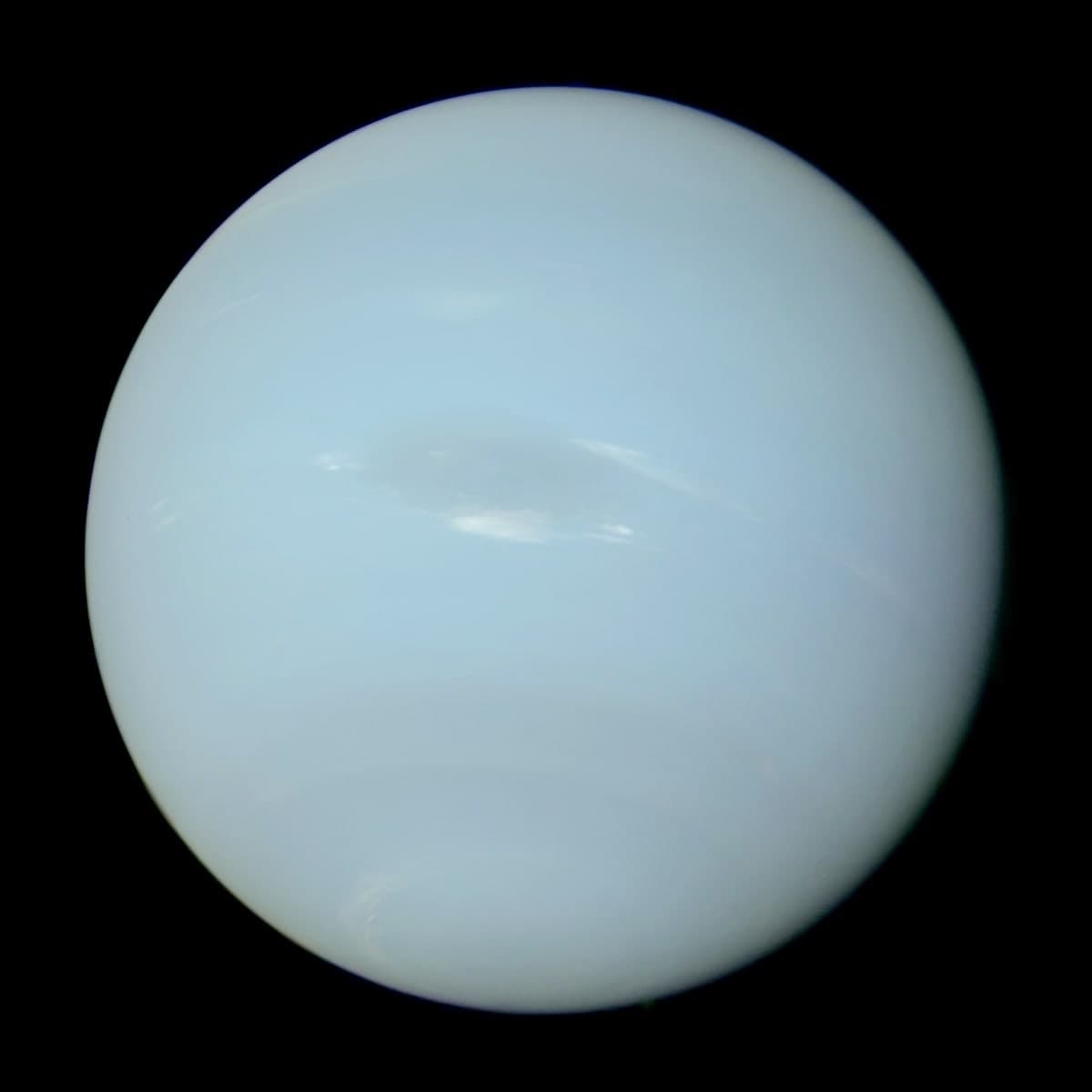
Neptune is classified as an ice giant, a term that distinguishes it from the gas giants Jupiter and Saturn. Its interior is primarily composed of ices — water, ammonia and methane under pressure — and rock, rather than the hydrogen and helium that dominate the inner two giants. Uranus shares this structure, so the two outer planets are grouped together. The atmosphere is composed primarily of hydrogen and helium, with traces of hydrocarbons and possibly nitrogen, but contains a higher proportion of ices such as water, ammonia and methane. Traces of methane in the outer atmosphere, along with Rayleigh scattering, give Neptune a faint blue appearance.
The planet has a diameter of 49,528 kilometres, making it the fourth-largest planet in the Solar System by that measure. It is the third-most-massive planet, and the densest of the giants. It has no well-defined solid surface, being composed primarily of gases and liquids, so the diameter refers to a conventional level in the atmosphere rather than a physical boundary.
Neptune orbits the Sun once every 164.8 years, at an orbital distance of 30.1 astronomical units. Its distance from the Sun makes it dim, and its distance from Earth gives it a small apparent size, so it has been challenging to study in detail. Voyager 2 flew by Neptune on 25 August 1989.
Why it mattered then
Before Neptune was found, Uranus had an orbit that did not fit. The discrepancies were not large, but they were persistent, and they suggested either that Newton's law of gravitation was wrong at great distances, or that something unseen was pulling on Uranus. The successful prediction and discovery of Neptune was evidence that the law held, and that the unseen could be found by calculation. Neptune was discovered by mathematical prediction rather than by direct observation, and it demonstrated that gravitational theory could be used as a tool for discovery, not just for explaining what had already been seen. The match between Le Verrier's prediction and Galle's observation was close enough to be convincing within a single night of searching.
Why it matters now
Neptune remains the farthest known planet orbiting the Sun. It marks the outer edge of the planetary system as we define it now, though there are smaller bodies farther out. Its discovery established a method: using the gravitational influence of an unseen object to infer its existence and location. That method has been used since to search for other bodies, including the hypothetical planets that were proposed to explain features of the outer Solar System before better explanations were found. Neptune itself is still studied, and its atmosphere, weather and ring system remain subjects of observation from Earth-based telescopes.
The surprising detail
Neptune was found on the first night of searching, within a degree of where Le Verrier predicted it would be. That is a remarkable match, and it made the discovery convincing immediately. But the mathematics that produced the prediction were not as precise as the result made them seem. Le Verrier's calculation assumed a certain distance and mass for the unseen planet, and those assumptions were not quite right — Neptune's actual orbit and mass differ from what he predicted. The position happened to be close enough, at that moment in time, for Galle to find it. Had the search been made a few years earlier or later, the error in the predicted orbit would have been larger, and the planet might not have been in the expected place. The discovery succeeded in part because the timing was fortunate.
What is disputed
The credit for discovering Neptune is contested. The facts name four people: Urbain Le Verrier and John Couch Adams, who independently calculated where the planet should be, and Johann Gottfried Galle and Heinrich Louis d'Arrest, who observed it on 23 September 1846. The record does not resolve who should be credited, and the lesson follows that: it names all four and notes the contest without choosing between them.
Remember this
Neptune was predicted by mathematics before it was seen through a telescope.
Test yourself
The facts record four people as discoverers of Neptune, and note that the credit is contested. What is actually being contested — who saw it first, or what counts as discovery?
What counts as discovery. Urbain Le Verrier and John Couch Adams both calculated where the planet should be, working independently from the perturbations in Uranus's orbit. Johann Gottfried Galle and Heinrich Louis d'Arrest made the telescopic observation on 23 September 1846, finding Neptune close to where Le Verrier had predicted. The contest is not over priority in time — the observation came after the calculations — but over whether discovery belongs to the people who predicted where to look, or the people who looked and saw it, or all four. The facts list all four names and leave the question open.
Go deeper
Image: NASA / Voyager 2 / PDS / OPUS / Ardenau4, CC0. Licence: CC0. Source.