III · THE WORK · ART HISTORY
The Turkish Bath
▶ Listen · narrated
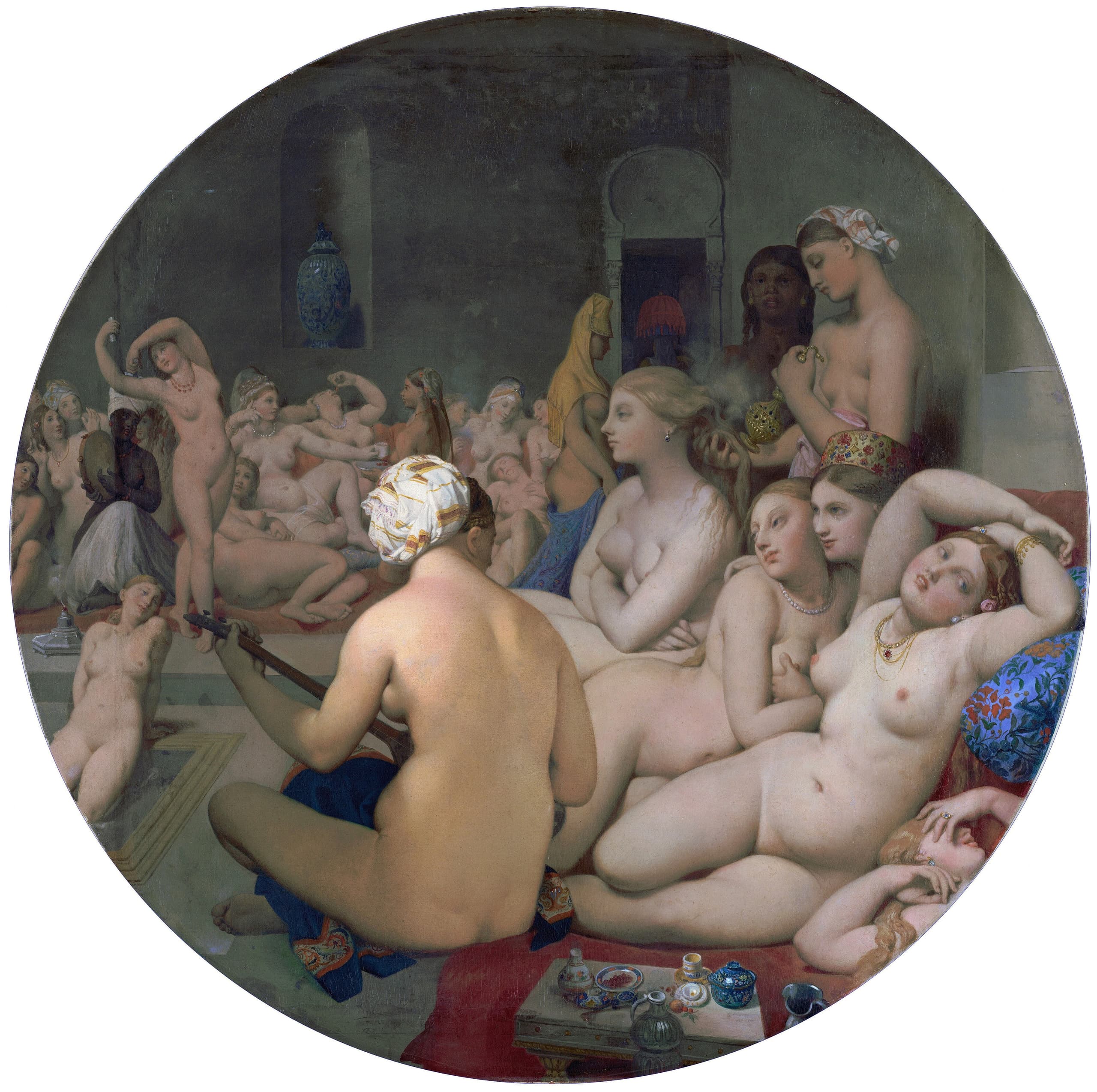
At about eighty-two, Ingres signed a tondo of women at a pool. The circle closes what had been a rectangle; the subject closes a career-long return to the nude.
At a glance
- Artist
- Jean-Auguste-Dominique Ingres
- Date
- 1862
- Medium
- Oil on canvas; panel
- Form
- Tondo, diameter 110 cm (3 ft 7 in)
- Collection
- Department of Paintings of the Louvre
- Inventory
- R.F. 1934
Look closer
The circle that came late
The painting is a tondo: a circular format roughly 110 centimetres (3 ft 7 in) across. It did not begin that way. Ingres first worked the subject as a rectangle, then cut and reframed it as a circle in 1862, the year he signed and dated the finished work. A photograph by Charles Marville records the earlier rectangular state. The change is not a frame-maker’s afterthought; it is a compositional decision that forces every figure into a closed, centripetal field, with no corners in which to rest the eye.
Bodies borrowed from himself
The group of nude women at a pool expands motifs Ingres had already painted decades earlier, above all the back-turned bather of 1808 known as the Valpinçon Bather and the reclining figure of La Grande odalisque of 1814. What looks like a crowded harem scene is, in part, a private inventory: poses and contours reworked, multiplied and set beside one another inside a single round field. The erotic charge of the picture is inseparable from that long self-quotation.
A harem without a place
The setting is offered as a Turkish bath, a pool inside a harem, and the work is routinely classed under Orientalism as well as Romanticism and Neoclassicism. Nothing in the picture, however, documents a specific building or city. The Near East functions as a licence for the nude rather than as a report. Genre and nude meet here as categories on the label; the room itself remains a studio invention, circular, sealed, and lit for flesh rather than for ethnography.
The story
Jean-Auguste-Dominique Ingres signed and dated The Turkish Bath in 1862, when he was around eighty-two. The Louvre holds it today in the Department of Paintings, inventory R.F. 1934, as an oil painting on canvas and panel, a tondo about 110 centimetres (3 ft 7 in) in diameter. Those plain facts already describe a late work that had been long in preparation. The subject was first brought to a finished rectangular state between the early 1850s and 1859; only in 1862 did Ingres alter the format, cutting the composition into a circle and fixing the date we now read on the surface. Charles Marville’s photograph of the rectangular version survives, so the change is not a rumour but a documented act of revision.
What the circle contains is a group of nude women gathered at a pool, presented as a scene inside a harem. The mood is erotic, and the painting draws at once on Western conventions of the mythological nude and on the nineteenth-century European taste for Near Eastern fantasy. It is listed among works of Orientalism, Romanticism and Neoclassicism — three labels that sit together less comfortably than catalogues sometimes imply. The line is classical in its attention to contour; the subject is romantic in its heat and its distance from observed life; the setting is orientalising without being topographical.
The densest art-historical fact about the picture is how much of it Ingres took from himself. Motifs from The Valpinçon Bather of 1808 and La Grande odalisque of 1814 reappear inside the round field, not as citations for the viewer’s cleverness but as a working method. A back, a reclining stretch of torso, the slow turn of a neck: these were problems he had already solved in earlier oils and was prepared to solve again, side by side, until the bath felt full. The Turkish Bath is therefore less a single invention than a late synthesis — a career’s worth of bathers and odalisques pressed into one continuous skin of paint.
Because the final shape is a tondo, the composition has no natural margin. Figures crowd toward the rim and toward one another; the pool anchors the lower part of the circle; the upper register packs heads, arms and instruments into the remaining arc. The eye cannot exit through a corner. That pressure is the point of the 1862 revision. By discarding the rectangle, Ingres discarded the ordinary breathing space of a salon picture and replaced it with a closed world whose only logic is the arrangement of bodies.
The work remains a painting of genre and of the nude at once. It offers a social fiction — women at leisure in a bath — and withholds almost everything that would make that fiction historically precise. No named sitter, no identified building, no claim to reportage. What it does claim, quietly and repeatedly, is mastery of the female contour as Ingres had practised it since the first years of the century, now gathered, multiplied and sealed inside a circle he cut for the purpose.
Why it mattered then
In 1862 the picture arrived as the late statement of a painter already identified with the disciplined nude and with a classical line that had outlasted many shifts in French taste. To rework bathers and odalisques from 1808 and 1814 into a single harem scene was to treat a lifetime’s studio vocabulary as still current. The turn from rectangle to tondo mattered in its moment as a formal wager: a circular field was less common for a multi-figure oil of this ambition, and it announced that composition, not anecdote, would carry the subject. At the same time the orientalising bath answered a mid-century appetite for Near Eastern settings that licensed erotic display under the cover of genre. Romanticism, Neoclassicism and Orientalism were not tidy boxes for Ingres’s audience so much as overlapping permissions — for ideal contour, for sensual subject matter, and for a place that need not be verified. Signed by a man of about eighty-two, the painting also read as a demonstration that the old authority on the nude had not exhausted his claim.
Why it matters now
The Turkish Bath still matters because it makes visible how a European nude can be assembled from earlier European nudes and then dressed in the fiction of elsewhere. Close looking does not require us to accept the harem as information; it asks us to watch poses migrate from the Valpinçon Bather and La Grande odalisque into a crowded roundel and to notice what that migration does. The Marville photograph keeps the making honest: we know the circle was chosen, not given, and that knowledge sharpens every judgment about compression and edge. In a museum culture alert to Orientalism, the painting is useful precisely because its fantasy is so openly studio-bound. It hangs in the Louvre as oil, canvas, panel and inventory number, but it also hangs as an argument about quotation, desire and the frames — literal and cultural — that hold them.
The surprising detail
The painting’s most decisive feature was added at the end. Ingres completed a rectangular version first, then in 1862 cut and reformed it as a tondo about 110 centimetres (3 ft 7 in) across, signing it at around the age of eighty-two. The discarded rectangle is not lost to description alone: Charles Marville photographed that earlier state, so the revision can still be compared with the circle now in the Louvre. Few major nudes of the period carry such plain evidence of a late change of shape.
What is disputed
Wikidata records the inception as 1862, the year of the signature and of the change to a tondo; the longer campaign from the early 1850s to 1859 describes the rectangular stage before that revision. The labels Orientalism, Romanticism and Neoclassicism all attach to the work, but they name overlapping tendencies rather than a single agreed classification. The harem setting is a pictorial fiction, not a documented place.
Remember this
The Turkish Bath is a late circular revision of a rectangular harem nude, built from motifs Ingres had been painting for decades.
Test yourself
Ingres changed The Turkish Bath from a rectangle to a tondo in 1862. Leaving aside taste, what does that change force upon the group of figures, and why does the survival of Marville’s photograph matter to how we read it?
A tondo removes corners and straight margins, so the nudes must be organised inside a closed curve; crowding and centripetal arrangement become structural necessities rather than optional effects. Marville’s photograph preserves the rectangular state, which means the circle is not an original given but a documented decision. We can treat the format itself as part of the invention of 1862, not as a neutral container for a scene already fixed.
Go deeper
Image: Jean-Auguste-Dominique Ingres, Public domain. Licence: Public domain. Source.