III · THE WORK · ART HISTORY
Danaë
▶ Listen · narrated
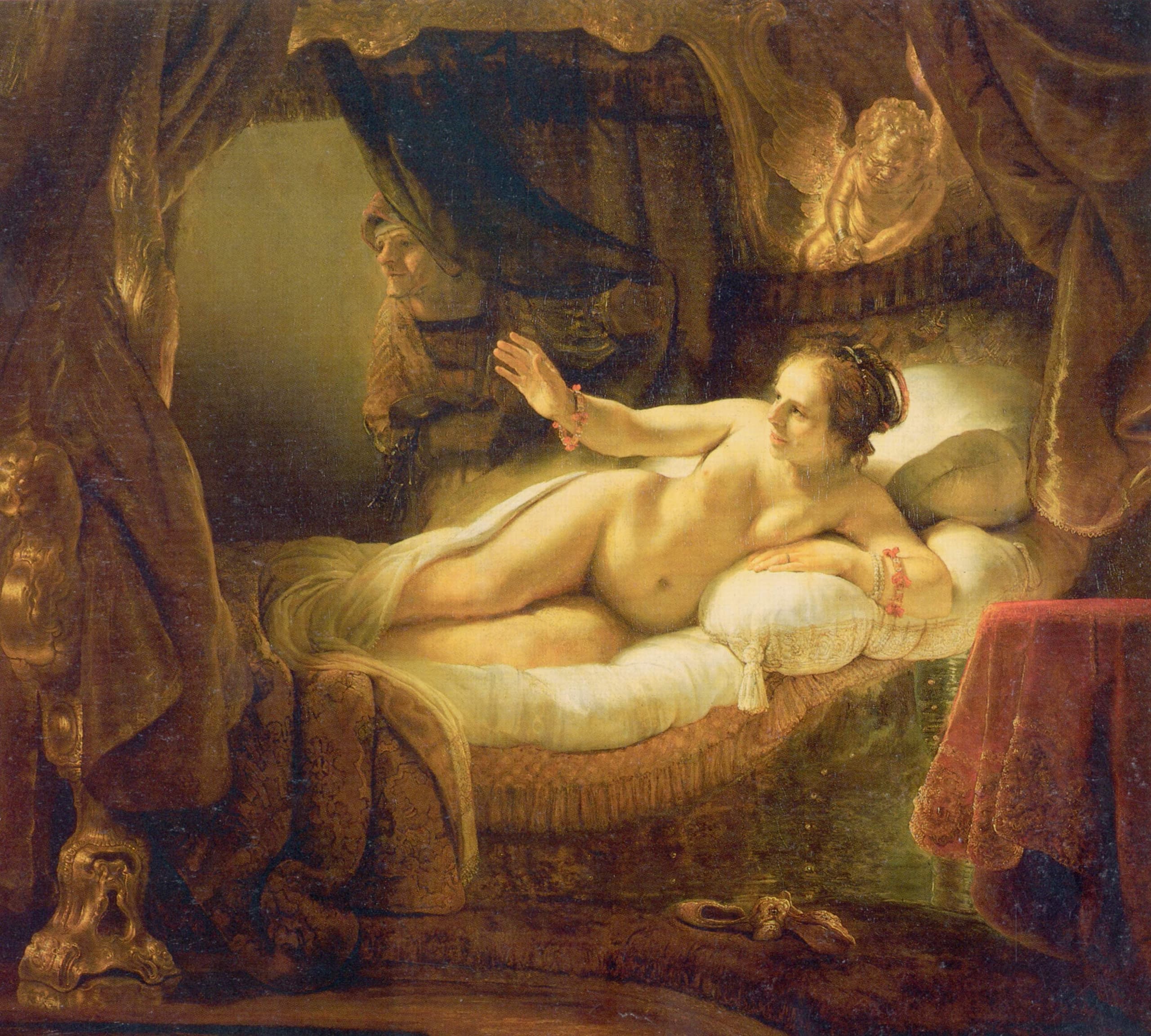
A reclining woman greets a visitor who arrives only as light. Rembrandt painted her in 1636, then returned to the figure and changed her face, arm and legs.
At a glance
- Artist
- Rembrandt
- Date
- 1636
- Medium
- Oil on canvas
- Dimensions
- 185 × 202.5 cm (6 ft 8 in)
- Collection
- Hermitage Museum
- Inventory
- ГЭ-723
Look closer
The body that was moved
Danaë is life-sized, a nude reclining across a wide canvas. Rembrandt did not leave the pose alone. In a later campaign of work he shifted the head, the outstretched arm and the legs. What we see is therefore not a single sitting fixed in 1636 but a figure whose gesture was reconsidered years afterwards, with the earlier arrangement buried under the paint we now read as final.
A face substituted
The original model for Danaë was Rembrandt’s wife Saskia. At a later stage he changed the face to that of his mistress Geertje Dircx. The substitution is not a minor retouch: it alters who the mythological body is made to resemble, and it ties the painting’s history to the painter’s household as well as to the classical story it illustrates.
Light as the visitor
In the myth Zeus reaches Danaë as a shower of gold. On this canvas the divine presence is not a solid figure but an arrival of light toward which she turns. The composition asks the viewer to treat illumination itself as the narrative agent — the thing she is welcoming — rather than a separate character standing in the room.
The story
Danaë is an oil painting on canvas by Rembrandt, first completed in 1636. It measures 185 centimetres (6 ft 1 in) in height and 202.5 centimetres (6 ft 8 in) in width and belongs to the Hermitage Museum, where its inventory number is ГЭ-723. The genre is both nude and mythological painting; the movement is Dutch Golden Age painting. The subject is Danaë, the mother of Perseus in Greek myth: imprisoned by her father, she is visited by Zeus in the form of a shower of gold and becomes pregnant. Rembrandt shows her at life size, reclining, apparently welcoming that approach.
The work did not remain as he first finished it. By 1643 at the latest he had reworked it significantly. Among the changes were new positions for Danaë’s head, her outstretched arm and her legs. The face, for which his wife Saskia had originally been the model, was later altered to that of his mistress Geertje Dircx. The canvas has also been considerably cut down, so the proportions and margins we see today are not those of the painting as it left the studio in its first state. A hard-to-read signature includes a date ending in 6; that inscription may not be genuine.
Before it entered the Hermitage in the eighteenth century, the picture belonged to the collection of Pierre Crozat. In 1985 it was seriously vandalised. It has since been restored and remains on view in St Petersburg.
What the painting offers, then, is not a single decisive image frozen in one year but a surface that carries revision. The myth supplies the story; the successive sittings and scrapings supply another — of a large studio canvas kept, altered, and only gradually released into the world of collectors. Its scale may have made it difficult to place; its survival in a major collection has made the revisions permanent public fact.
Why it mattered then
In the Dutch Golden Age a life-sized mythological nude was an ambitious studio undertaking. Rembrandt’s choice of Danaë allowed him to treat a classical subject through the body rather than through crowded narrative incident: the drama is concentrated in one figure and in the light that stands in for Zeus. Completing the canvas in 1636 and then returning to it within a few years suggests that the painting mattered enough in the studio to justify further labour — whether from attachment, dissatisfaction, or the hope of a better sale. Large dimensions could hinder a buyer; keeping and revising the work was one way of living with that problem. The later substitution of Geertje Dircx’s features for Saskia’s also shows how a mythological commission or speculative piece could absorb the painter’s private life without abandoning the classical frame. Once the picture entered Pierre Crozat’s collection and, in the eighteenth century, the Hermitage, it moved from the unstable economy of the studio into the permanence of princely and then public display.
Why it matters now
Danaë still matters because it makes the history of making visible in the finished object. Viewers who know that the head, arm and legs were repositioned, and that the face was changed, cannot treat the pose as inevitable; they see a sequence of decisions. The painting also remains a test case for how museums hold damaged and restored works: the 1985 vandalism and the subsequent restoration are part of what any honest account must include. As a Hermitage picture that once belonged to Crozat, it links Dutch seventeenth-century painting to the later European taste that absorbed it. And as a nude whose divine visitor is only light, it continues to ask a simple compositional question — how little solid form a myth needs in order to be legible — that later painters and viewers still recognise.
The surprising detail
The face on the body is not the face Rembrandt first painted. Saskia modelled Danaë; later he replaced her features with those of Geertje Dircx. Combined with the shifted arm, head and legs, the change means the figure we meet is a composite of two women and at least two campaigns of work, not a single likeness fixed in 1636.
What is disputed
The signature’s date ending in 6 may not be genuine and should not be treated as secure documentation. The reworking is securely placed by 1643 at the latest, but the precise motives for each change — and how far the cut-down edges once extended — are not settled by the facts given here.
Remember this
Danaë is a 1636 Rembrandt nude whose pose and face were revised years later; the canvas was cut down, damaged in 1985, and restored in the Hermitage.
Test yourself
Rembrandt reworked Danaë’s head, outstretched arm and legs after the first completion. Setting aside exactly why he did so, what does that sequence of changes do to the way we should read the finished pose?
It means the pose is not a single unbroken invention from 1636 but a second thought laid over a first. The reclining figure and the welcoming gesture look inevitable only because the earlier arrangement is hidden. Knowing the revisions forces us to treat the composition as provisional — a solution Rembrandt reached by moving the body, not the only solution he tried — and to see the painting as a record of studio time rather than a moment captured once.
Go deeper
Image: Rembrandt, Public domain. Licence: Public domain. Source.