IV · THE GAME · MAJOR LEAGUE BASEBALL
Hank Aaron
A record built out of ordinary seasons is harder to picture than one enormous year. Aaron's highest total was forty-seven. The rest of the answer is arithmetic and time.
At a glance
- Career
- 3,298 games · 3,771 hits · 755 home runs · 2,297 runs batted in · .305 average
- Debut
- 13 April 1954, aged 20, at Crosley Field, Cincinnati
- Last game
- 3 October 1976, for the Milwaukee Brewers
- Best year
- 1959 — 223 hits and a .355 average; his most home runs came in 1971, at 47
- Patience
- 1,403 walks against 1,383 strikeouts in 13,941 plate appearances
- Batted
- Right-handed; threw right-handed; wore number 44
Look closer
The debut was a loss, and a close one
On 13 April 1954 the Milwaukee Braves and the Cincinnati Redlegs each made thirteen hits. Milwaukee led 5–3 after three innings, gave up three runs in the fourth and three more in the sixth, and lost 9–8. Cincinnati never had to bat in the ninth, which is why that half-inning is a dash rather than a nought. The whole thing took three hours and four minutes in front of 33,185 people.
The season line that nobody expects
Aaron's highest home-run total in any single year was 47, in 1971, when he was 37. He cleared 30 home runs in fifteen different seasons and 40 in eight of them, and hit at least 20 in twenty seasons out of twenty-three. The career figure is what that looks like when it is added up rather than a peak anybody watched happen.
He walked more often than he struck out
Over 13,941 plate appearances Aaron drew 1,403 walks and struck out 1,383 times. For a hitter with 755 home runs that ratio is unusual: power normally costs strikeouts. His career slugging percentage was .555 and his on-base percentage .374, which is the same fact from two directions — he got on base often and did a great deal of damage when he swung.
The story
Hank Aaron's first major-league game was in somebody else's ballpark, on a Tuesday afternoon in Ohio, and his team lost it. On 13 April 1954 the Milwaukee Braves visited the Cincinnati Redlegs at Crosley Field. Milwaukee scored twice in the first, twice in the second and once in the third; Cincinnati answered with one in the second, two in the third and three in the fourth, and by the end of the sixth they were ahead 9–6. The Braves got a run back in the seventh and another in the eighth and finished a run short. Both clubs made thirteen hits. Milwaukee made three errors and Cincinnati two, and one run is exactly the width of that difference. The attendance was 33,185 and the game took three hours and four minutes.
Aaron was twenty. He played 122 games that first season, made 131 hits, hit 13 home runs and finished at .280 — a good first year and not obviously the start of anything.
What followed is better read as a table than as a narrative, because the table is where the shape is. From 1955 to 1974 he hit at least twenty home runs every year. He passed thirty in fifteen seasons and forty in eight. His best average was .355, in 1959, the year he also made 223 hits. His most home runs in a year came much later, in 1971, when he was thirty-seven and hit 47 with an OPS of 1.079 — the highest of his career, in his eighteenth season.
The clubs changed around him more than he did. He signed with the Milwaukee Braves and stayed when the franchise moved to Atlanta for the 1966 season. In 1975, at forty-one, he went back to Milwaukee to play for the Brewers, and it was for them that he played his last game, on 3 October 1976. Those final two seasons read differently from the rest: 12 home runs and a .234 average in 1975, 10 and .229 in 1976, in 85 games.
The totals at the end of it: 3,298 games, 12,364 at-bats, 3,771 hits, 624 doubles, 98 triples, 755 home runs, 2,174 runs, 2,297 runs batted in, 6,856 total bases. A .305 average across twenty-three seasons.
Why it mattered then
A career total accumulates in public, one season at a time, and for most of Aaron's twenty-three years there was nothing dramatic to report — a good season, then another good season. The numbers that make a player famous in one summer are not the numbers that make a career record, and his season lines are the clearest available demonstration of the difference. The clubs moved; the league expanded; he kept producing roughly the same year, twenty times over.
Why it matters now
Baseball keeps a more complete record of itself than almost any other human activity, and that is why this lesson can show you the box score of a game played in 1954 rather than a recollection of it. The inning-by-inning runs, the hits, the errors, the elapsed time and the crowd were all written down at the time and are still readable today. Nothing on this page is anybody's memory of what happened.
The surprising detail
The two totals that sit oddest together are 755 home runs and 47 — the most he ever hit in one season. Nothing about the career total was concentrated. It was earned at something close to a steady rate for twenty years, which is the least cinematic way a record can possibly be set.
What is disputed
Every figure here comes from the MLB Stats API. Statistical categories were not all recorded consistently across the twenty-three seasons covered, and records for the 1950s were compiled retrospectively from contemporary scoring; the totals are the ones the league publishes today rather than anything independently recomputed here.
Remember this
755 home runs, and never more than 47 in a season: the record is a length of time as much as it is a talent.
Test yourself
Milwaukee and Cincinnati each made thirteen hits in Aaron's debut game, and Cincinnati won by a single run. Using only the linescore, what explains the result?
Errors and timing. Milwaukee made three errors to Cincinnati's two, and a one-run margin is exactly the size of that gap. The runs also arrived in different shapes: Milwaukee scored in five separate innings, one or two at a time, while Cincinnati put three on the board in the fourth and three more in the sixth. Equal hits do not mean equal innings — clustered hits score, scattered ones strand runners. Note too that Cincinnati never batted in the ninth, which is why that half-inning shows a dash: the home side does not bat when it is already ahead.
Go deeper
- Hank Aaron — MLB Stats API player record · MLB Advanced Media
- Hank Aaron — career hitting totals (MLB Stats API) · MLB Advanced Media
- Debut game linescore — MLB Stats API game 135212 · MLB Advanced Media
- Hank Aaron — Wikidata · Wikidata
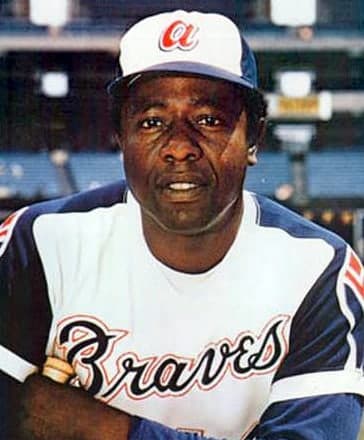
Image: Unknown author, Public domain. Licence: Public domain. Source.