I · THE OBJECT · BRITISH MUSEUM
Mérode Altarpiece
▶ Listen · narrated
Its panels make private devotion visible through rooms, tools and thresholds, while its unsettled attribution asks how securely a name can attach to a work.
At a glance
- Form
- Triptych, reredos and altarpiece
- Medium
- Oil paint on oak panel
- Creator
- Robert Campin; Master of Flémalle
- Collection
- Metropolitan Museum of Art
- Size
- 64.5 × 64.50 centimetres (2 ft 1 in)
- Number
- 56.70a–c
Look closer
A threshold and its visitors
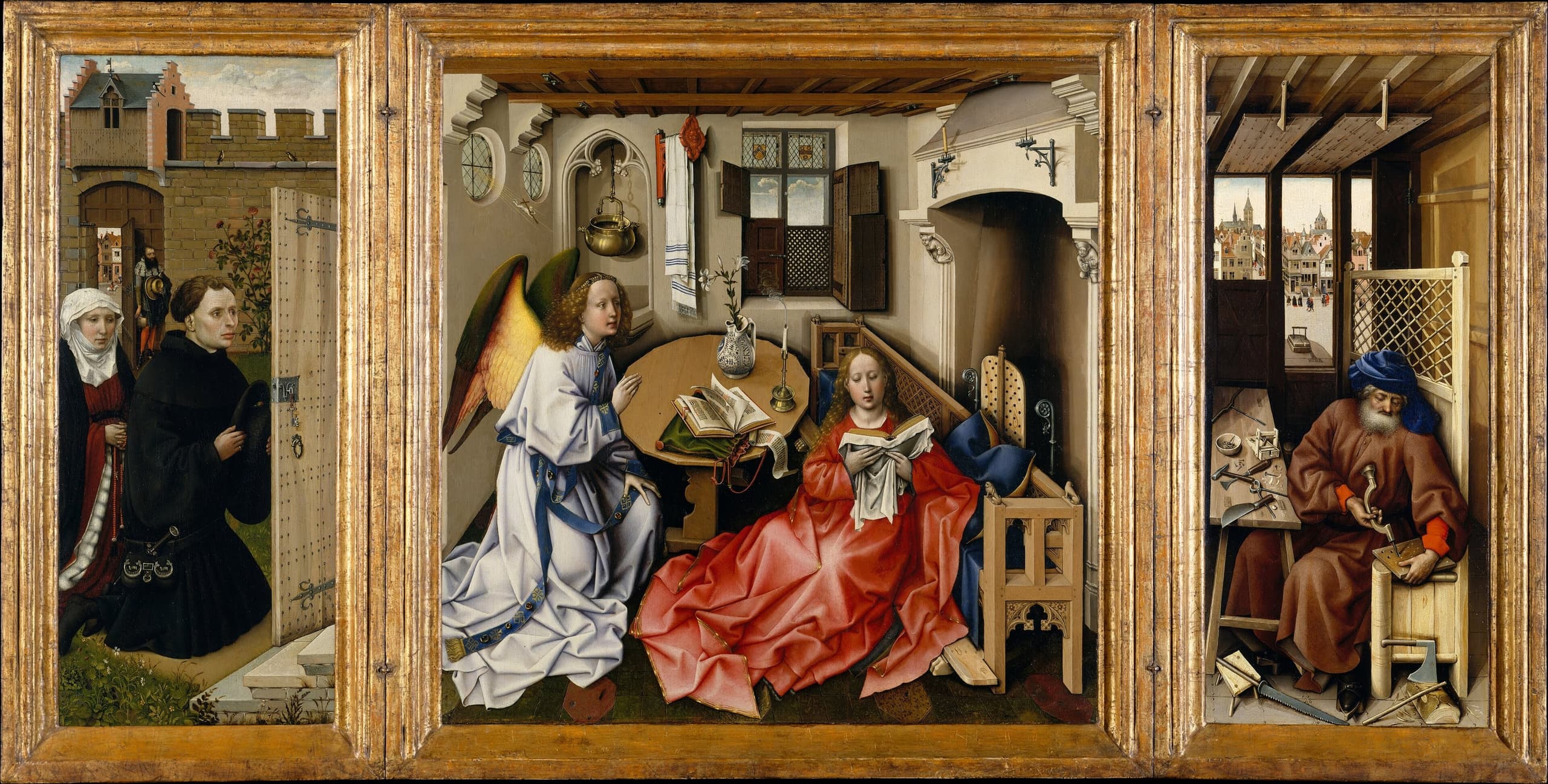
The left wing places the donors at a garden entrance rather than within the central room. They kneel in prayer at the threshold, with the open doorway making their relation to the sacred event deliberately awkward: they are near it, but not simply absorbed into it. The device turns the hinge between panels into part of the scene.
An Annunciation indoors
The central panel sets the Annunciation in a domestic interior. Mary’s setting is not an empty gold field or a distant architectural stage, but a room furnished for ordinary use. A lily and fountain are included among the religious signs described for the scene, while rays enter through the left-hand window to indicate the Holy Spirit.
Joseph at work
The right wing gives Saint Joseph a separate room and a recognisable occupation. He is shown as a carpenter, surrounded by the tools of his trade. This is not merely an identifying attribute held for display: the workshop makes labour, timber and domestic space part of the work’s religious world.
The story
The Mérode Altarpiece is an oil painting on oak panel, made as a triptych and also classified as a reredos and altarpiece. It belongs to the Metropolitan Museum of Art and is located at The Cloisters. Its three parts are recorded under the single inventory number 56.70a–c.
The work’s religious subject is distributed across three connected spaces. At left, donors kneel in a garden. The centre shows the Annunciation to Mary in a contemporary domestic setting. At right, Saint Joseph works as a carpenter. The arrangement makes a compact sequence of doors, rooms and thresholds: devotion approaches from one side, an angelic encounter occupies the middle, and manual work continues beside it.
The creator field names both Robert Campin and the Master of Flémalle. The reference account further describes the work as unsigned and undated, and associates parts of it with a workshop. That matters because the altarpiece is often approached not as the unambiguous statement of one hand, but as an object whose attribution has to remain open to examination.
Its visual language is equally attentive to ordinary things. The central scene is not detached from household life, and Joseph’s tools are given a place of their own. Such details do not make the religious subject less serious. They make its setting more particular. The triptych asks viewers to look across the panels, connecting a praying couple, Mary’s room and a carpenter’s workshop.
The supplied record gives no account of where the altarpiece was discovered, who owned it before the museum, or how it entered the collection. That absence is worth keeping in view. A museum location tells us where an object is now; it does not, by itself, supply the history of its earlier movement.
Why it mattered then
The work’s classification brings form and purpose together. As religious art, an altarpiece and a reredos, it was made for sustained attention to a sacred subject rather than for a single passing glance. Its triptych structure separates the donors, the Annunciation and Joseph while holding them in one object. The reference description’s domestic setting gives that structure particular force. A garden entrance, a room and a workshop make religious experience legible through familiar spaces. The donors’ position at the edge of the central event is especially telling: prayer is represented not as ownership of the sacred scene, but as an approach towards it.
Why it matters now
The Mérode Altarpiece still rewards slow looking because it makes interpretation depend on small, visible relations. A door changes the donors’ status in the scene. Household furnishings alter the setting of the Annunciation. Joseph’s tools insist that work belongs in the picture’s devotional field. It also offers a useful corrective to easy certainty about authorship. The collection data names Robert Campin and the Master of Flémalle, while the supplied background describes workshop participation. The painting remains available for close study even where the account of who made each part is not final.
The surprising detail
The supplied record identifies the work as a sixteenth-century object, yet also classifies it as Early Netherlandish painting. Its maker is entered under both Robert Campin and the Master of Flémalle, so even the catalogue’s basic labels invite careful reading.
What is disputed
The supplied materials do not fully align on dating: the database records an inception in the 16th century, while the background account proposes a more specific earlier chronology. Attribution is also not wholly settled; the background account describes an unsigned work and possible workshop participation.
How it got here
The supplied facts identify the Metropolitan Museum of Art as the collection and The Cloisters as the location, but provide no acquisition history, earlier ownership record, find circumstance or ownership claim.
Remember this
A triptych can make devotion visible through the most ordinary of things: a doorway, a room and a carpenter’s tools.
Test yourself
Why does placing the donors at the garden threshold, rather than inside Mary’s room, change the meaning of their presence?
The threshold makes their prayer an act of approach. They are connected to the Annunciation but remain outside its central space, so the picture preserves a distinction between those who witness the sacred event and those who seek proximity to it. The division of the triptych is therefore part of the religious idea, not just a way of organising the composition.
Go deeper
Image: Workshop of Robert Campin, Public domain. Licence: Public domain. Source.