III · THE WORK · ART HISTORY
Assumption of the Virgin
▶ Listen · narrated
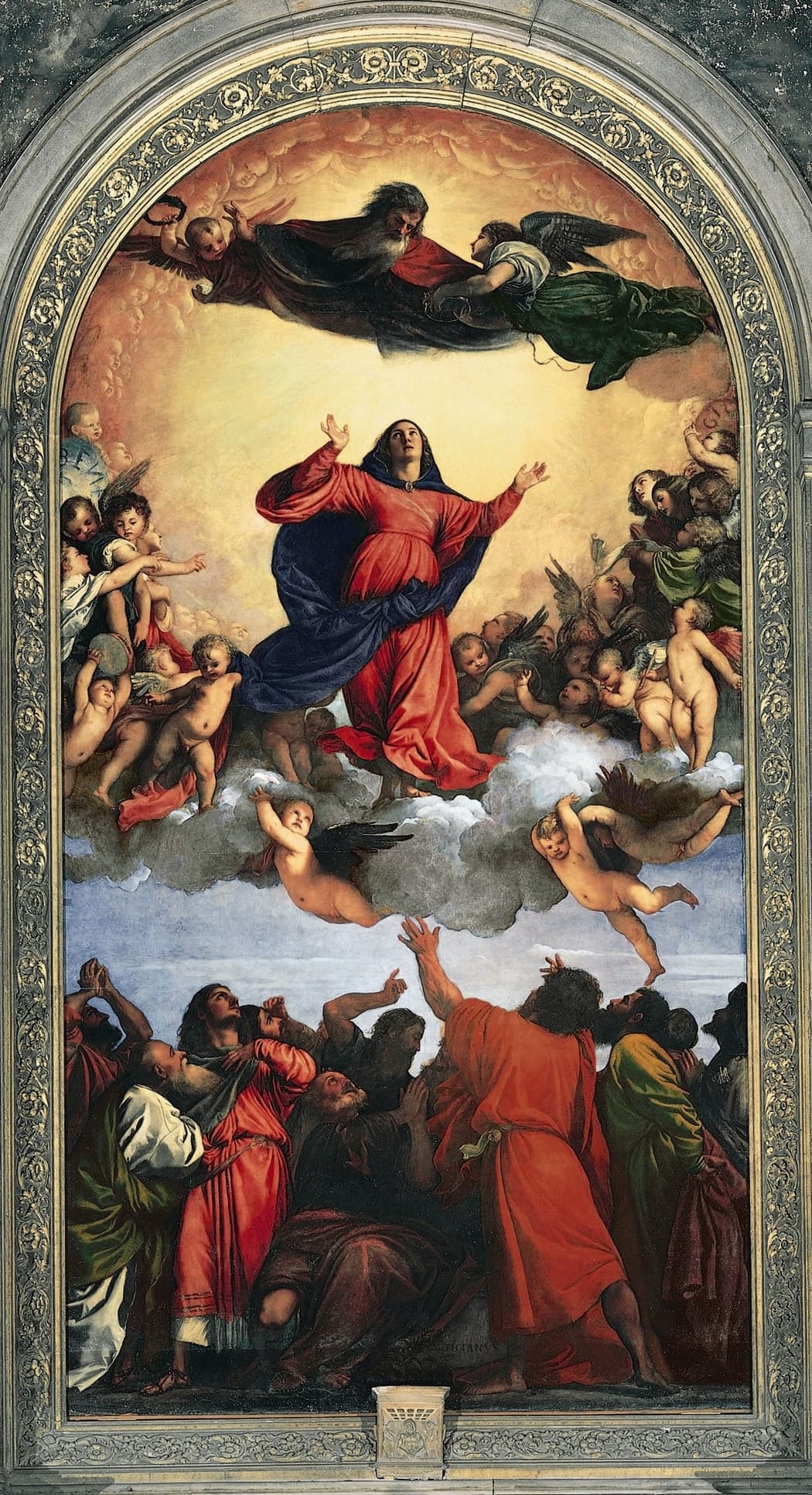
Titian’s 1517 reredos remains where it was made to hang. The Apostles do not meditate; they strain upward, and the whole surface is organised as a single vertical pull.
At a glance
- Artist
- Titian
- Date
- 1517
- Medium
- Oil paint on panel
- Size
- 668 × 344 cm (11 ft 3 in)
- Location
- Santa Maria Gloriosa dei Frari, Venice
- Type
- Reredos; religious art
Look closer
Three registers, one ascent
The panel divides into stacked zones that the eye climbs rather than scans sideways. At the base the Apostles crowd and twist; above them the Virgin rises on cloud; higher still a divine figure waits in a disk of light. The joins between zones are not quiet borders. Arms, gazes and drapery carry the motion upward so that the whole surface reads as a single path rather than three separate pictures stacked for convenience.
Scale against the nave
At 668 centimetres (21 ft 11 in) high and 344 wide, the figures are well over life-size. That is not display for its own sake. The panel was made for the high altar of a large Franciscan church, with a long gap between altar and congregation. From the nave the over-sizing corrects for distance: what would look inflated in a close gallery becomes legible mass once the viewer is forced to stand far back.
Apostles who will not keep still
In the lower zone the holy figures do not arrange themselves in the calm, frontal stillness long associated with Venetian altarpieces. Bodies turn, hands open, heads tip back. The empty space they ring is as important as the figures themselves: it is the vacated ground from which the Virgin has already lifted, and their agitation is the human register of that departure.
The story
The Assumption of the Virgin is a large oil-on-panel reredos painted by Titian in 1517 for the high altar of Santa Maria Gloriosa dei Frari in Venice. It is still there. That simple fact shapes almost everything else about the work. This is not a picture that has been relocated into museum light and a neutral wall; it remains a liturgical object at the far end of a nave, meant to be approached on foot and read across a considerable stretch of church air.
The panel is 668 centimetres (21 ft 11 in) high and 344 centimetres (11 ft 3 in) wide. Those numbers matter because they were answers to a practical problem. From the body of the church the altar is distant. Life-size figures would shrink into decoration. Titian’s figures are oversized so that, at range, they hold their weight. The composition exploits the same distance. Instead of a single crowded plane, the surface is stacked in ascending registers: Apostles below, the Virgin in mid-air, and above her a divine presence in light. The viewer in the nave is already looking up; the painting simply continues that direction of travel.
The lower zone is restless. The Apostles gather around an emptied centre, bodies twisted, arms raised, faces tilted. Venetian religious painting of the preceding generation had often favoured a meditative stillness in its saints. Here the holy company is caught in the moment of loss and recognition, not arranged for quiet contemplation. That agitation is not only emotional colouring. It supplies the first impulse of the vertical movement that the rest of the panel will complete.
Above them the Virgin rises on cloud, her drapery and pose carrying the eye higher still, toward the upper register where light gathers around a waiting figure. Red, the colour most able to travel across dim church space, is used with force in the central ascent. Nothing in the design asks to be inspected inch by inch from a few feet away. The whole is built for a congregation that will never get that close during ordinary use.
In material terms the work is straightforward to name and harder to take lightly: oil paint on panel, a reredos, religious art of the Venetian school in the High Renaissance. It belongs to the Republic of Venice in origin and to the Frari in location. Wikidata also lists the Gallerie dell’Accademia among its collections, but the painting’s working home — the place it was scaled and staged for — remains the high altar for which it was made.
What the panel does, then, is fuse subject and setting. The Assumption is a doctrine about a body leaving the earth. Titian’s design makes the church fabric itself participate: the long approach, the upward gaze, the over-life-size flesh that only resolves at distance. The painting does not merely illustrate a belief. It organises the viewer’s body into the same upward path the Virgin takes.
Why it mattered then
In 1517 Venice already had a strong tradition of altarpiece painting, often associated with calm, lucid arrangements and a meditative tone. Titian’s Frari panel marked a clear turn. The agitated Apostles broke with that stillness. The stacked, dynamic ascent and the sheer physical scale announced an artist alert to High Renaissance ambitions further south, in Florence and Rome, while still working inside a Venetian church and a Venetian commission. The panel was, by some accounts, startling to its first public — not because the subject was new, but because the treatment refused the expected quiet. Recognition followed. The work helped confirm Titian as the leading painter in Venice and as a figure who could stand comparison with the major artists of central Italy. It was not a private experiment later promoted by critics; it was a public high-altar image whose success was measured in the most exposed setting the city offered. As a reredos it also did institutional work. It fixed the Assumption at the visual climax of a major Franciscan basilica and did so at a size no later visitor could treat as incidental. In a city of competing churches and competing patrons, that permanence and that scale were arguments in paint.
Why it matters now
The painting still occupies the site it was built for. That continuity is rarer than it sounds. Many Renaissance altarpieces survive as museum pictures, cut off from the distances, sightlines and liturgical approaches that once justified their proportions. Here the original problem — how to make a sacred ascent legible from far down a nave — remains the condition under which the work is seen. That makes the panel a useful check on how we look at large religious art indoors. In a gallery, over-life-size figures can feel theatrical. In the Frari they feel calibrated. The composition’s vertical pull only fully makes sense when the viewer is already standing where Titian expected: not at arm’s length, but in the body of the church, looking up. It also remains a precise document of a stylistic shift inside Venetian painting — from contemplative stillness toward a more physically urgent High Renaissance language — without needing later biography to carry the point. The evidence is on the surface: the twisting Apostles, the forced ascent, the colour that carries, the refusal to let the lower register settle into quiet rows.
The surprising detail
The panel is routinely described as the largest altarpiece in Venice, and its figures are well over life-size for a reason that is easy to forget in reproduction: the gap between high altar and congregation in the Frari is long enough that ordinary human scale would simply fail. Titian did not enlarge the holy figures as a flourish. He enlarged them so they would still read as bodies once air and architecture had done their work. The painting’s drama is partly an engineering solution to a nave.
What is disputed
Wikidata gives the inception date as 1517; broader accounts often spread the work across a short span of years around that point. Claims that the first Venetian audience found the panel shocking are reported with hedging in the secondary literature and should not be treated as a documented event. The dual collection listing that includes the Gallerie dell’Accademia is recorded, but the painting’s location remains the Frari high altar.
Remember this
This is an Assumption designed for a specific distance: oversized, stacked upward, and still on the Frari high altar it was scaled to command.
Test yourself
Why does the over-life-size scale of the figures matter more in the Frari than it would on a gallery wall?
Because the panel was made for a high altar set a considerable distance from the congregation. At that range, life-size figures would lose force and detail. The enlarged bodies compensate for distance, so that from the nave they still read as substantial human forms. In a close gallery hanging the same enlargement can look inflated; in the church it is a correction, not an excess. The composition’s vertical stacking works with the same condition: the viewer is already looking up the length of the building, and the painting continues that direction rather than fighting it.
Go deeper
Image: Titian, Public domain. Licence: Public domain. Source.