I · THE OBJECT · BRITISH MUSEUM
William the Hippopotamus
▶ Listen · narrated
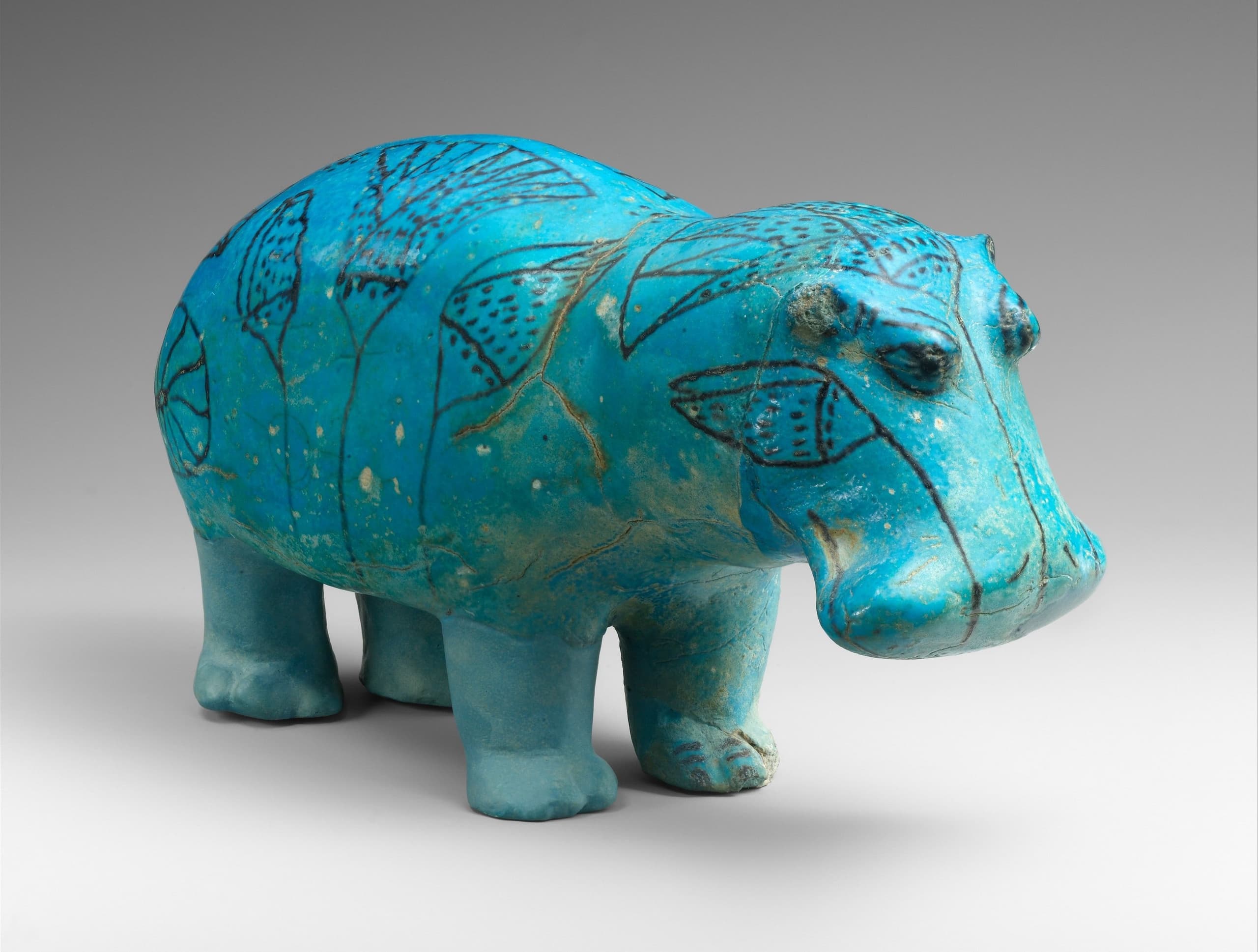
This twenty-centimetre figurine was buried among the funerary furnishings of a Middle Kingdom steward. Its material and form show how Egyptian craft served the tomb.
At a glance
- Date
- c. 1961–1878 BC
- Material
- Egyptian faience
- Size
- 20 cm (8 in)
- Findspot
- Meir, Upper Egypt
- Inventory
- 17.9.1
- Collection
- Metropolitan Museum of Art
Look closer
A clay-less body
Egyptian faience is not pottery. It is a glazed, quartz-based composition made without potters’ clay. The surface takes a bright glaze; the core is a crushed siliceous paste. This hippopotamus is a particularly clear demonstration of that technique at Middle Kingdom scale: a small, fully modelled animal whose material is as deliberate as its subject.
One of a funerary type
The figure belongs to a recognised class of Middle Kingdom tomb equipment. Animal forms of this kind were placed among funerary furnishings rather than made as household ornaments. William is one example among others recovered in connection with the same tomb, not a unique commission standing alone.
Twenty centimetres of modelling
At twenty centimetres the figurine is large enough for the volume of the animal to read clearly and small enough to have been set with other goods in a burial context. The scale is practical for the tomb and generous enough to show how carefully the craftsman handled faience as a sculptural medium.
The story
William is an Egyptian faience hippopotamus figurine made in Egypt in the twentieth century BC, during the Middle Kingdom. It measures twenty centimetres. The Metropolitan Museum of Art in New York acquired it in 1917; it remains in that collection and has become the museum’s informal mascot. Visitors can see it in Gallery 111.
The piece was found in a shaft associated with the Upper Egyptian tomb chapel of a man titled “The Steward, Senbi,” at the site now known as Meir. The date range usually attached to it, about 1961 to 1878 BC, falls within the reigns of Senusret I and Senusret II. William was not an isolated find. It was one of several objects linked to Senbi’s tomb that entered the museum in the same year.
Egyptian faience is a clay-less material: a glazed composition built on crushed quartz rather than on potters’ clay. In its Bulletin for 1917 the museum described this hippopotamus as a particularly fine example of a type found, in common with various other animal forms, among the funerary furnishings of Middle Kingdom tombs, and as an exemplary piece of Egyptian faience. The wording is careful. It places the object inside a known class of burial goods and treats the quality of the glaze and modelling as the point of interest, not a later legend about the animal.
Who shaped it is not recorded. No craftsman’s name travels with the figurine. What can be said is narrower and more useful: a workshop in Middle Kingdom Egypt produced a hippopotamus in faience for a funerary setting connected with a steward’s tomb chapel, and the result was good enough that a major museum still holds it up as a clear instance of the technique.
The object’s later life is simpler to trace. Once in New York it gathered a modern name and a public role the ancient makers never intended. The nickname “William” and the status of informal mascot are modern attachments. They do not change the archaeological facts, but they do explain why a twenty-centimetre tomb figure is now among the most readily recognised objects in the building.
Why it mattered then
In its own moment the figurine belonged to the equipment of the tomb, not to the furniture of daily life. Middle Kingdom burials could include animal forms in faience among other goods placed for the dead. A hippopotamus modelled in a bright glazed material fitted that practice: it was a familiar Nile animal rendered in a craft reserved for objects meant to last and to look finished under the glaze. The link to the steward Senbi matters because it anchors the piece in a specific social setting. Stewards were administrative figures; a tomb chapel with an associated shaft was a structured burial complex, not a casual grave. Funerary furnishings in such a context were chosen and deposited with purpose. William’s value then was local and functional within that assemblage, one well-made animal figure among the goods that accompanied Senbi’s burial arrangements.
Why it matters now
The figurine still matters for two overlapping reasons. First, it is a clear, portable demonstration of Egyptian faience at a high level of craft: clay-less body, glazed surface, fully modelled animal, Middle Kingdom date. Few objects of this size make the technique so easy to see. Second, it has acquired a modern public role the ancient context never required. As the Metropolitan Museum’s informal mascot it draws attention that a less approachable tomb object might not. That popularity is useful when it leads back to the real substance—the material, the funerary type, the Meir findspot, and the 1917 acquisition—rather than stopping at the nickname. The object remains a small masterclass in how craft, burial practice, and later museum life can sit inside a single figure.
The surprising detail
A funerary hippopotamus from a Middle Kingdom shaft at Meir is now the informal mascot of a major New York museum. The ancient makers prepared an animal figure for a steward’s burial; the modern institution gave it a personal name and a public identity. The gap between those two roles is the memorable part: nothing in the tomb assemblage predicted that this particular twenty-centimetre faience animal would become the face of the collection that holds it.
What is disputed
The find is described as coming from a shaft associated with the tomb chapel of the steward Senbi at Meir, not as an object excavated in a fully documented single deposit with a precise find-spot diary. The association with Senbi’s chapel is the published link; the exact circumstances of recovery are less tightly recorded than the museum acquisition that followed.
How it got here
The Metropolitan Museum of Art acquired the figurine in 1917 as one of several objects associated with the tomb of the steward Senbi at Meir. It has remained in the museum’s collection under inventory number 17.9.1 and is displayed in Gallery 111. No separate modern ownership dispute is recorded in the facts supplied here.
Remember this
A twenty-centimetre faience hippopotamus from Senbi’s tomb at Meir—clay-less glaze technique, Middle Kingdom funerary type, now the Met’s informal mascot.
Test yourself
The museum’s 1917 Bulletin praised William as a fine example of a type found among Middle Kingdom funerary furnishings. Why does calling it a “type” change how we should look at the object?
Because it shifts attention from uniqueness to practice. If the hippopotamus belongs to a recognised class of animal figures placed in tombs, then its interest lies in how well it represents a shared craft and burial habit, not in being a one-off curiosity. The faience body, the animal subject, and the tomb context become evidence of what workshops routinely made for the dead, and William becomes a strong instance of that system rather than an exception to it.