III · THE WORK · ART HISTORY
The Sleeping Gypsy
▶ Listen · narrated
Henri Rousseau set a lion and a sleeper in the same stretch of desert and declined to say what happens next. The painting still withholds that answer.
At a glance
- Artist
- Henri Rousseau
- Date
- 1897
- Medium
- Oil on canvas
- Dimensions
- 129.5 × 200.7 cm (6 ft 7 in)
- Movement
- Naïve art
- Collection
- Museum of Modern Art
Look closer
The sleeper’s stillness
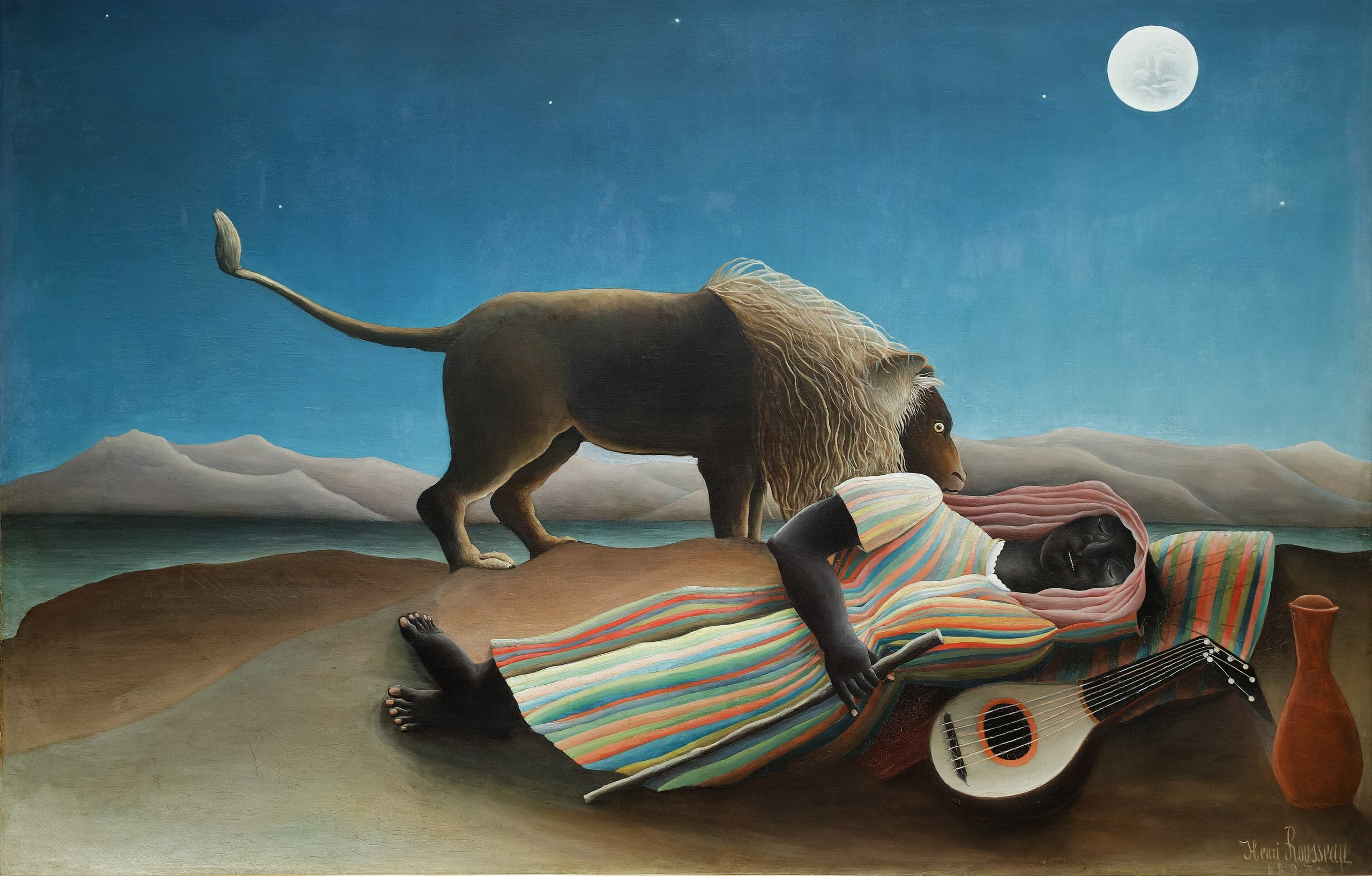
The woman lies full-length across the lower half of the canvas, head resting on one arm, body turned slightly toward us. Her pose is deep and unbroken; nothing in the limbs suggests she has stirred. Rousseau gives her the largest share of the foreground and then refuses the usual cues of dreaming or waking. She is simply asleep, and the whole drama of the picture depends on that unbroken quiet.
The lion that does not spring
The lion stands over her, close enough that its muzzle almost meets her shoulder. Its body fills the middle ground in profile, mane dark against the pale ground, tail curving back into the night. What the painting withholds is intent. The animal is neither mid-pounce nor clearly at rest; it seems only to attend. That pause is the picture’s real subject: proximity without a decided outcome.
Moon and empty distance
Above the two figures the land falls away in long, spare bands toward a low horizon. A full moon hangs in a deep sky, lighting the scene without softening it. There is almost no clutter between sleeper, lion and distance — no thicket, no crowd, no shelter. The emptiness is deliberate. It leaves the pair exposed and makes the moonlight feel less like atmosphere than like a hard, even witness.
The story
The Sleeping Gypsy is an oil painting on canvas, completed in 1897 by Henri Rousseau. It measures 129.5 centimetres (4 ft 3 in) high by 200.7 centimetres (6 ft 7 in) wide — a wide, horizontal field that suits the stretch of open ground it describes. The picture belongs to the Museum of Modern Art in New York; it has also been associated with the John Quinn Art Collection. In the museum’s records it carries the inventory number 646.1939.
What we see is simple enough to state and harder to settle. A woman sleeps on bare earth. Beside her stands a lion. Night holds the scene, with a full moon high in the sky and a long, almost empty landscape running back to the horizon. The genres assigned to the work — genre art and landscape painting — both fit and neither quite contains it. It is a figure scene and a place scene at once, and the tension between those two claims is part of how the painting works.
Rousseau is grouped with naïve art: painting made outside the academic training that shaped most professional artists of his century. That label is useful as a historical placement and less useful as a verdict on the picture. The composition is not casual. The sleeper occupies the foreground in a long horizontal, the lion a second horizontal just above her, the horizon a third. The moon pins the upper register. Colour is laid in clear zones rather than dissolved into atmosphere. Edges stay legible. Nothing is half-stated by accident.
The drama, such as it is, is almost entirely a matter of interval. The lion is near enough to the sleeper that a single step would close the gap; it does not take that step. She does not wake. The land offers no refuge and no audience. Rousseau has removed the usual narrative machinery — pursuit, rescue, allegory spelled out in attributes — and left a single charged pause. Viewers supply the before and after; the canvas itself stays with the present tense of the encounter.
Because the painting refuses to resolve into attack, tenderness or pure fantasy, looking becomes a kind of waiting. One notices how little the ground is particularised, how evenly the moonlight falls, how the two bodies share the same shallow stage without quite belonging to the same order of being. The woman is painted with the care of a portrait subject who happens to be unconscious. The lion is painted with the clarity of a sign that has wandered into a desert. Their meeting feels both inevitable and unexplained.
That balance — between the ordinary fact of sleep and the extraordinary fact of the animal — is what the picture holds open. It does not ask us to decide whether the scene is dream, omen or plain night in a bare place. It asks us to stay with the arrangement as painted: two figures, a moon, and a width of empty ground wide enough that the silence has room to stand.
Why it mattered then
In 1897 Rousseau was working as a painter whose training and social position set him apart from the academic mainstream of French art. The Sleeping Gypsy belongs to that moment: a large, deliberate canvas that treats a fantastical night scene with the flat clarity and steady drawing associated with naïve art. To place a lion and a sleeping woman in an open landscape, without the usual mythological scaffolding or exotic stage-set, was to test how far a plain, frontal style could carry a subject that might otherwise have been framed as allegory or anecdote. The work sits at the meeting point of genre and landscape, and that double classification still records how awkwardly it fitted the categories ready to hand at the end of the nineteenth century. What it offered its own time was less a manifesto than a fully finished image that declined to behave like salon narrative or impressionist atmosphere, and asked to be taken seriously on those terms.
Why it matters now
The painting still matters because it stages a problem that has not gone away: how close danger and calm can be made to sit without the picture telling us which one wins. Modern viewers, used to cinematic suspense and to dream imagery, recognise the setup at once and still cannot close it. The wide format, the spare ground and the unbroken sleep keep the encounter in the present tense. As a work now held at the Museum of Modern Art, it also marks a longer shift in what institutions came to value — painting once set aside as naïve later entered the modern canon not despite its clarity but because of it. Looking closely remains the point. The lion has not moved. Neither has she.
The surprising detail
The same painting is classed at once as genre art and as landscape painting. Those labels usually pull in different directions — one toward human incident, the other toward place. Rousseau’s canvas earns both: the sleeper and the lion supply the incident, while the long bare ground and moonlit sky claim equal weight. The double cataloguing is not a clerical accident so much as a quiet record of how hard the picture is to put in a single box. At 200.7 centimetres (6 ft 7 in) across, it also gives that undivided night more horizontal room than many narrative scenes of its date ever received.
What is disputed
What the lion intends, and whether the scene is best read as dream, fable or plain nocturnal encounter, is not settled by the painting and should not be presented as settled. The label naïve art describes Rousseau’s historical position outside academic training; it is not a measure of the work’s simplicity of meaning.
Remember this
Rousseau holds a lion and a sleeper in the same moonlit ground and leaves the next moment unpainted.
Test yourself
The painting is catalogued as both genre art and landscape. What in the composition makes each label feel earned, and why does the overlap matter to how we read the scene?
Genre fits because the primary incident is human and animal encounter: a woman asleep, a lion standing over her. Landscape fits because the bare ground, low horizon and moonlit sky are not backdrop alone; they occupy as much of the canvas and as much of the mood as the figures. The overlap matters because it stops us from treating the desert as scenery or the figures as a story dropped onto neutral earth. Place and incident are locked together, which is why the pause feels so complete — there is nowhere else for the eye, or the danger, to go.
Go deeper
Image: Henri Rousseau, Public domain. Licence: Public domain. Source.