I · THE OBJECT · BRITISH MUSEUM
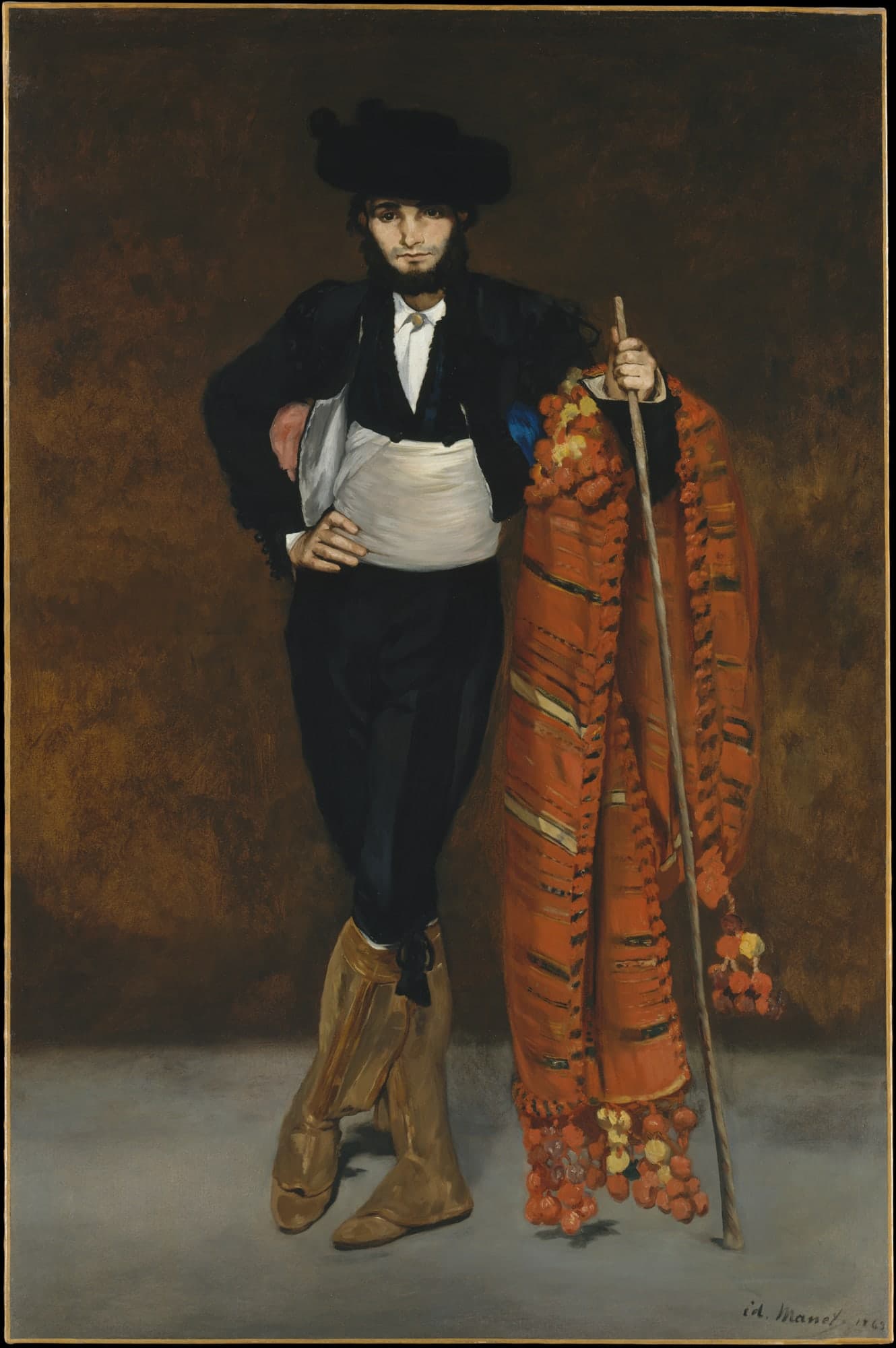
Young man in Mayo costume
▶ Listen · narrated
A costume from Spain, a brother from Paris, and a painter testing how much borrowed swagger the official Salon would refuse. The picture remains both portrait and performance.
At a glance
- Date
- 1863
- Artist
- Édouard Manet
- Material
- Oil paint on canvas
- Dimensions
- 188 × 124.8 cm (4 ft 1 in)
- Inventory
- 29.100.54
- Collection
- Metropolitan Museum of Art
Look closer
A full-length field
At 188 centimetres (6 ft 2 in) high and a little under 125 centimetres (4 ft 1 in) wide, the canvas is built for a standing figure rather than a bust or half-length. That height belongs to the world of formal portraiture and public display. Costume becomes architecture: the dress has to read from several paces away, and the stance has to carry the whole vertical span. The painting is not a quick fancy-dress note; it claims the scale of a serious exhibition picture.
Brother under the hat
The model was Gustave Manet, the painter’s youngest brother, shown in the outfit associated with the majos — young Spaniards whose dress had become a known type in French eyes. The work is therefore doing two jobs at once. It offers a genre subject, a recognisable Spanish character, while keeping the face inside the family. Portrait and costume study occupy the same surface without a clean border between them.
Genre, at portrait scale
The picture is classed as genre art: a scene of type and dress rather than scripture, myth, or state history. That label is precise and limiting. A life-size majo asked the 1863 viewer to treat borrowed Spanish clothes as a modern subject worthy of large oil, not as a minor theatrical aside. The academic system had clearer shelves for history painting; this canvas sat between portrait and fancy dress and did not apologise for the ambiguity.
The story
In 1863 Édouard Manet painted a young man in the costume of a majo, the colloquial name for a dashing type of young Spaniard whose dress had already entered French visual culture. The work is oil on canvas, 188 centimetres (6 ft 2 in) high and about 125 centimetres (4 ft 1 in) wide. It belongs to the Metropolitan Museum of Art, where it is held under the inventory number 29.100.54.
The sitter was Gustave Manet, the painter’s youngest brother. Dressing a family member as a majo folded portrait into genre. The face stayed personal; the clothes signalled Spain. At this date Manet was deep in a Spanish phase, looking hard at Diego Velázquez and other Spanish painters. The debt is stylistic as much as sartorial. Dark grounds, a direct stance, and the authority of a full-length figure gave him a way to test that precedent on a living Parisian body.
The same year, the canvas was shown at the Salon des Refusés, the exhibition arranged for works turned away by the official Salon jury. It appeared there beside Manet’s Déjeuner sur l’herbe and Miss V Dressed as a Bullfighter. Three Manets in the room of the refused made a concentrated claim: Spanish dress and modern bodies, large formats, and a refusal to sand the paint down for academic comfort. Young Man Dressed as a Majo is quieter than the Déjeuner, yet it belongs to the same season of argument.
What survives of the picture’s first public life is that context. It is a genre painting by the terms used for it. The same records also attach the movement label academic art — a tag that sits uneasily with the fact of its refusal and with Manet’s wider reputation. The tension is worth keeping. The canvas borrows the scale and finish expected of serious painting while choosing a subject the official system did not quite know how to file. A brother in majo dress, life-size, was neither pure portrait nor pure costume piece, and that in-between state is part of why the work still holds the wall.
Why it mattered then
In Paris in 1863 the Salon remained the chief gate through which a painter reached a wide public. Rejection was not private; it shaped reputations in full view. The Salon des Refusés gave the excluded a parallel room, and Manet used it. Showing a life-size majo beside the Déjeuner and a woman dressed as a bullfighter made the Spanish interest legible as a programme rather than a single fancy. Viewers who knew Velázquez from the Louvre or from prints could read the dark handling and the upright figure as deliberate homage under modern conditions. For the jury system, a genre figure at portrait scale, without moral narrative, was harder to reward. The picture mattered then as evidence of what Manet was prepared to put forward when the official route closed.
Why it matters now
The painting still matters because it holds several identities at once without resolving them: family likeness, costume piece, Spanish exercise, and Salon flashpoint. Museum categories often pull those roles apart; this canvas keeps them stacked. It also records a moment when French painting absorbed Spanish precedent not only as exotic décor but as a way of standing a figure in space and in oil. For anyone tracing how later art used older art, the majo is a concrete case — brother, canvas, 1863, refused, retained. At the Metropolitan the work remains public at full height, so the sheer size of the argument is still part of what a visitor meets.
The surprising detail
The canvas did not walk into controversy alone. In 1863 it hung at the Salon des Refusés with two other Manets: Déjeuner sur l’herbe and Miss V Dressed as a Bullfighter. One brother’s majo outfit and one woman’s bullfighter dress framed the more infamous picnic as a pair of Spanish disguises. Manet’s refusal that year was collective, not the isolation of a single odd picture.
What is disputed
Width is recorded as both 125 centimetres (4 ft 1 in) and 124.8 centimetres (4 ft 1 in); the gap is small and likely a matter of rounding or of measuring with or without later framing. The movement label academic art sits awkwardly beside the work’s exhibition among the refused and beside Manet’s wider reputation; genre art is the more stable classification in the same records. How the painting travelled from the 1863 exhibitions into the Metropolitan’s collection is not set out in the facts used here.
Remember this
A brother in majo dress, life-size on canvas, refused in 1863 — portrait and genre sharing one frame.
Test yourself
Why does treating this work only as a Spanish costume study miss a large part of what it is doing?
Because the model was Manet’s own youngest brother, Gustave. The majo dress supplies a genre type familiar to French viewers, but the sitter keeps the picture inside the family. Scale and directness pull it toward portraiture even as the clothes signal Spain. Reading only the costume flattens that double use; the painting is working as likeness and as type at the same time.
Go deeper
Image: Édouard Manet, Public domain. Licence: Public domain. Source.