III · THE WORK · ART HISTORY
The Magpie on the Gallows
▶ Listen · narrated
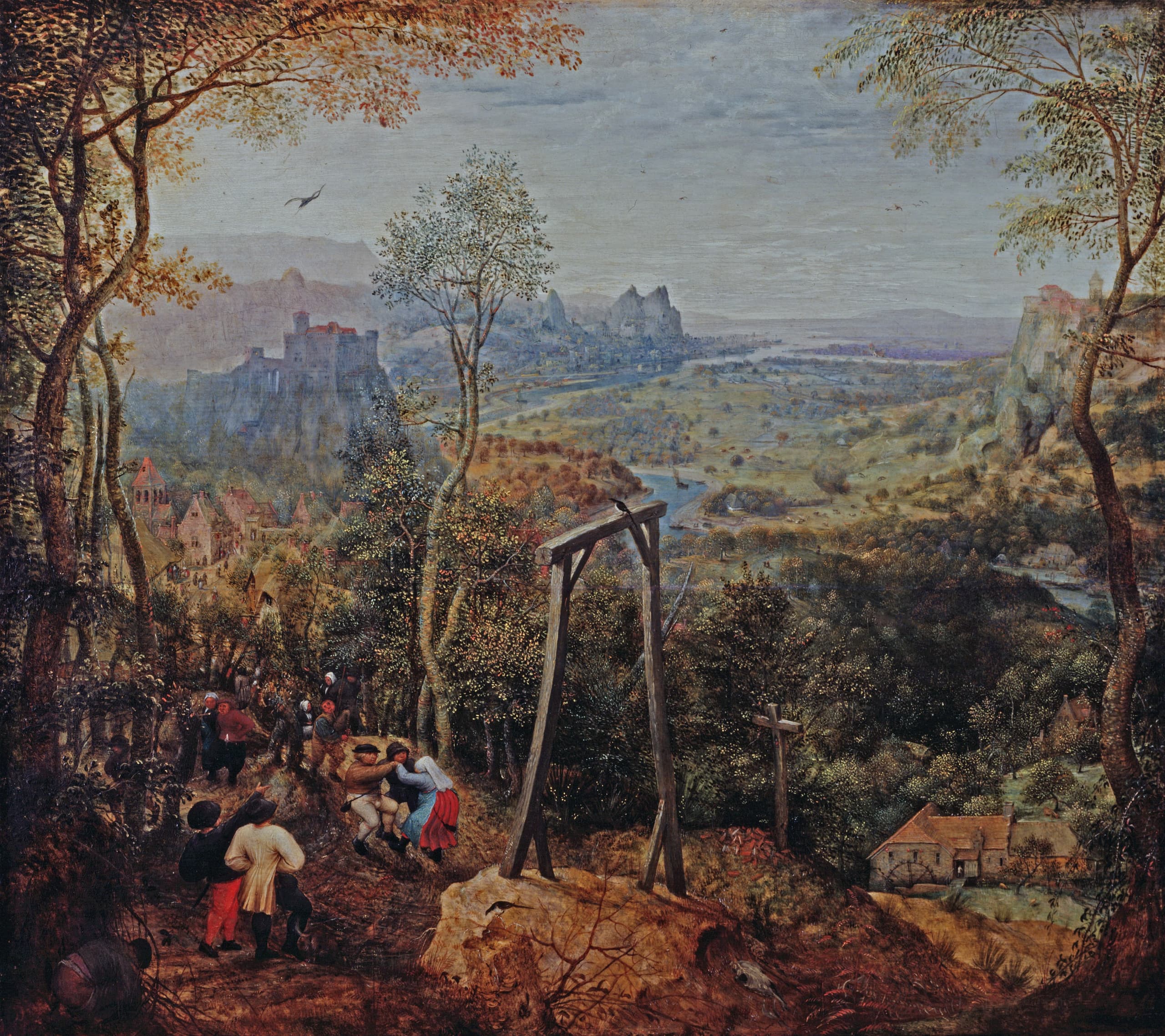
Bruegel’s gallows stand empty but occupied: a single bird rests on the crossbeam while the land below goes about its business as if nothing were wrong.
At a glance
- Artist
- Pieter Bruegel the Elder
- Date
- 1568
- Medium
- Oil paint on panel
- Dimensions
- About 46 × 51 cm (1 ft 8 in)
- Collection
- Hessian State Museum Darmstadt
- Inventory
- GK 165
Look closer
The gallows as architecture
The wooden gallows rise near the centre of the panel, built as a simple rectangular frame with a crossbeam. They are not pushed to the margin or half-hidden; they occupy the middle ground like a piece of rural carpentry, solid enough to cast a presence over the path and the dancers. A magpie sits on the beam. The structure is empty of a human body, yet it is not empty of meaning: it is the one object in the landscape that was made for a single purpose, and everyone in the picture has to live with it in view.
Two scales at once
The panel is small — roughly forty-six by fifty-one centimetres — yet it opens onto a deep valley of hills, water, trees and distant buildings. Near forms are painted with a denser touch; far ones thin into pale air. Bruegel keeps genre incident and landscape space on the same surface without letting either cancel the other. You can read the picture as a scene of peasants at leisure, or as a survey of country under a high sky, and both readings are held in the same glance.
Motion under a still beam
Below and beside the gallows, figures gather and move. Some dance; others stand or walk the path. Their activity is ordinary and slightly untidy, the sort of village ease Bruegel often set into open country. What matters is the contrast of tempo: human motion is restless and local, while the gallows and the bird on it stay fixed. The painting does not stage an execution. It stages the awkward fact of festivity continuing in the shadow of a machine built for punishment.
The story
The Magpie on the Gallows is a small oil painting on panel, dated 1568, by Pieter Bruegel the Elder. It belongs to the Hessian State Museum in Darmstadt, where it is held under the inventory number GK 165. In genre it sits between landscape and genre art: a broad stretch of country is the stage, and the people who use that country are the actors.
At first sight the eye takes in a rolling valley under an open sky. Trees climb the slopes; water and buildings settle into the distance; paths pull the viewer inward. Only after that first sweep does the gallows lock into place — a plain wooden frame set in the middle ground, high enough to command the path and the clearing beside it. On the crossbeam sits a magpie. There is no hanged figure. The instrument of death is present as furniture of the landscape, as settled in its place as a mill or a barn.
Around and below it, life goes on. Peasants dance and cluster; other figures stand talking or move along the track. Nothing in their posture suggests that the gallows have interrupted the day. That calm is the picture’s pressure. Bruegel does not illustrate a hanging. He paints the ordinary world continuing beside a structure whose only job is to end lives, and he gives the crossbeam to a bird rather than a body.
The panel’s modest size matters to how this works. At about forty-six centimetres high and fifty-one wide, it is a picture meant for close approach, not a hall. Distance and nearness are compressed into a surface you can take in almost at arm’s length. The far valley stays legible; the timber joints of the gallows stay legible too. Landscape breadth and human incident are not separated into different zones so much as folded together, so that the threat and the dance share one climate.
What the magpie and the gallows were meant to say is less settled than the composition itself. Later viewers have read the bird as a sign of idle talk, the gallows as a warning, the whole as a moral landscape in which pleasure and punishment share the same ground. Those readings have a long afterlife, but the painting does not label its symbols. What it does state, in paint, is a spatial fact: the gallows stand where people gather, the bird occupies the beam, and the country does not stop for either.
Bruegel’s late panels often hold more than one tone without resolving them into a single lesson. Here the tones are festivity, watchfulness and weather. The result is neither pure satire nor pure topography. It is a view of land in which a tool of justice — or of power — has become part of the scenery, and in which a magpie has claimed the highest horizontal line in the middle of the frame.
Why it mattered then
In 1568 a panel that joined landscape expanse to peasant incident belonged to a live Netherlandish practice: the countryside was no longer only a backdrop for sacred story, and ordinary figures could carry the weight of a picture. Bruegel worked that seam with unusual density. A gallows in open country would not have been an invented prop; such structures stood in real landscapes as public warnings. To paint one without a victim, and to set dancers beside it, was to make the viewer hold celebration and judicial terror in a single view. Whether the first audience took the magpie as proverb, omen or simply a bird on a beam, the painting’s force lay in that refusal to separate the cheerful from the punitive. It showed rural life as a place where both already coexisted.
Why it matters now
The panel still works because it will not tidy its own mood. Modern viewers recognise the pattern at once: public threat standing in plain sight while daily pleasure continues underneath it. The picture does not shout a programme; it arranges space so that you cannot look at the dance without also seeing the beam, or admire the valley without noticing what occupies its middle ground. That double vision remains useful. It is a way of thinking about how landscapes — literal and political — absorb instruments of power until they look almost natural. The smallness of the panel sharpens the effect. You lean in for genre detail and find yourself inside a moral weather that has not been explained away.
The surprising detail
For all the breadth of country it contains, the panel is strikingly small — only about forty-six by fifty-one centimetres. The whole valley, the gallows, the dancers and the distant slopes fit on a surface closer to a large book cover than to a mural. Bruegel’s ambition here is not scale of canvas but scale of attention: a pocket of wood asked to hold a world in which death’s furniture and village leisure share the same light.
What is disputed
The precise meaning of the magpie and the gallows is not fixed by the surviving evidence. Moral and proverbial readings have been proposed, but the painting itself offers no inscription or single key, and those interpretations should be treated as later attempts to name a tension the panel shows rather than explains.
Remember this
A magpie holds the gallows’ beam while peasants dance below — threat and pleasure left deliberately unresolved in one small landscape.
Test yourself
The gallows in this panel hold no human body. Why does that absence sharpen, rather than weaken, the painting’s unease?
Because an empty gallows is not a finished event but a standing possibility. If someone were hanging, the picture would narrate a single punishment already carried out. Empty, the frame becomes part of the landscape’s permanent equipment — something the dancers and walkers must inhabit rather than merely witness. The magpie on the beam underlines the point: life, even trivial life, has occupied the place of death without removing the structure’s purpose. The viewer is left with coexistence instead of climax, which is harder to dismiss.
Go deeper
Image: Pieter Brueghel the Elder, Public domain. Licence: Public domain. Source.