I · THE OBJECT · BRITISH MUSEUM
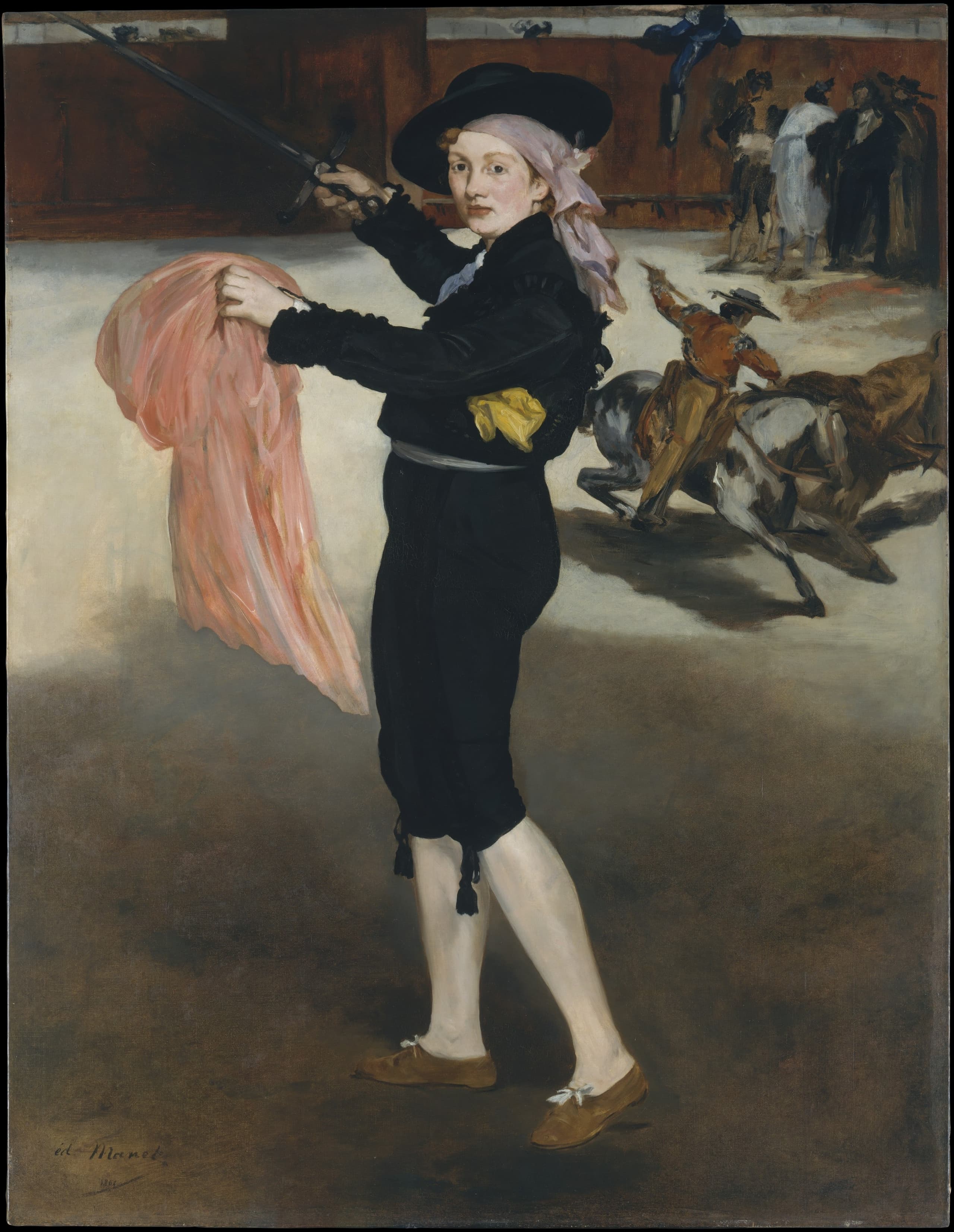
Mademoiselle V. . . in the Costume of an Espada
▶ Listen · narrated
Refused by the official Salon and shown instead among the rejects of 1863, this canvas still stands as a plain record of Manet turning toward Spanish costume and subject.
At a glance
- Date
- 1862
- Artist
- Édouard Manet
- Material
- Oil paint on canvas
- Dimensions
- 165.1 × 127.6 cm (4 ft 2 in)
- Collection
- Metropolitan Museum of Art
- Inventory
- 29.100.53
Look closer
A costume, not a ring
The title fixes the subject as a woman in the dress of an espada, the sword-bearing bullfighter, rather than as a scene of the corrida itself. What we are given is genre art built around costume and pose: the interest lies in the borrowed role, not in narrative action inside the arena. The painting’s scale — more than a metre and a half high — treats that dressed figure with the gravity usually reserved for formal portraiture.
Three refusals hung together
Manet showed the picture at the 1863 Salon des Refusés beside Jeune Homme en costume de majo and Le Déjeuner sur l’herbe. The grouping mattered. Two of the three works put bodies into Spanish dress; the third became the scandal of the exhibition. Seen as a set, they mark a single campaign of submission and rejection rather than three isolated experiments.
Spanish art as a cited influence
Writers often point to this canvas when tracing Spanish art’s hold on Manet in these years. The claim rests on costume, subject and the company the picture kept on the wall, not on a documented copy after a single Spanish master. The influence is repeatedly asserted; the precise pathway remains a matter of interpretation rather than a settled chain of evidence.
The story
Mademoiselle V. . . in the Costume of an Espada is an oil painting on canvas made by Édouard Manet in 1862. It measures 165.1 centimetres (5 ft 5 in) in height and 127.6 centimetres (4 ft 2 in) in width. The work belongs to the Metropolitan Museum of Art in New York, where it is held under the inventory number 29.100.53. In classification it is genre art: a scene of type and costume rather than a commissioned likeness or a history subject.
The title does most of the identifying work. It names a woman, left partly anonymous as Mademoiselle V. . ., and places her in the costume of an espada. An espada is the bullfighter who works with the sword. Manet’s interest, as far as the title and the genre label allow us to say, is the figure dressed for that role, not a report from the bullring.
In 1863 he sent the painting to the Salon des Refusés. That exhibition had been created to show works turned away from the official Salon. Manet’s canvas hung there with two others from his studio: Jeune Homme en costume de majo and Le Déjeuner sur l’herbe. The first of those companions also puts a figure into Spanish dress; the second became the most discussed picture of the show. The three works together give a clear sense of what Manet was prepared to put before the public that year, and of what the regular jury would not accept.
The painting is frequently cited as evidence that Spanish art shaped Manet’s practice around this date. The citation is common in the literature; it is not, on the facts available here, pinned to a single source picture or a recorded visit. Costume, subject and the pairing with the majo figure are the observable grounds for the claim. Beyond that, the degree and route of influence remain open to argument.
The museum acquired the work in 1929. It has remained in the Metropolitan’s collection since then. What survives for the visitor is a large oil of a woman in bullfighter’s dress, made in a year when Manet was testing Spanish costume in more than one canvas, and first shown in the company of pictures the official Salon had refused.
Why it mattered then
In 1863 the official Salon still set the terms of public reputation for a painter working in Paris. To be refused was ordinary; to be refused and then hung in a state-sanctioned exhibition of the refused was new. Manet used that second room. By placing Mademoiselle V. . . beside a second Spanish costume piece and beside Le Déjeuner sur l’herbe, he presented costume experiment and social provocation as parts of one submission. The picture mattered in its moment less as a finished manifesto than as evidence of what a serious painter would risk when the regular door was closed.
Why it matters now
The canvas still matters because it holds several threads in one object: Manet’s turn toward Spanish dress, the machinery of the Salon des Refusés, and the later museum life of a work first shown among rejects. It is large enough, and plain enough in its genre ambition, to show how costume alone could carry a modern subject. It also remains a useful check on easy stories about influence. Spanish art is often named in connection with it; the painting itself offers costume and context, not a signed debt. That gap between repeated claim and visible evidence is part of what keeps the work worth slow looking.
The surprising detail
The same year and the same rejected exhibition yoked this costume piece to Le Déjeuner sur l’herbe. One picture dresses a woman as a bullfighter; the other became the scandal of 1863. They were not stray submissions but companions on the wall, two parts of a single refused group that also included a young man in majo dress.
What is disputed
The painting is often cited as an example of Spanish art’s influence on Manet. That reading is widespread, but the facts supplied here do not name a specific Spanish source or document the path of influence; costume, subject and exhibition context are the secure grounds, and the rest remains interpretive.
How it got here
The Metropolitan Museum of Art acquired the painting in 1929. It remains in that collection under inventory number 29.100.53. No contested-ownership claim is recorded in the facts used for this lesson.
Remember this
A genre painting of a woman as an espada, refused by the Salon, shown in 1863 beside Manet’s majo and his Déjeuner, and now in the Metropolitan under 29.100.53.
Test yourself
Why does hanging this painting with Jeune Homme en costume de majo and Le Déjeuner sur l’herbe at the Salon des Refusés change how we read it?
Because the three works formed one refused submission, not three separate accidents. Two of them put figures into Spanish costume; the third was the exhibition’s great provocation. Seen together, Mademoiselle V. . . belongs to a deliberate cluster — costume experiment and public risk offered as a set — rather than standing as an isolated Spanish fancy.